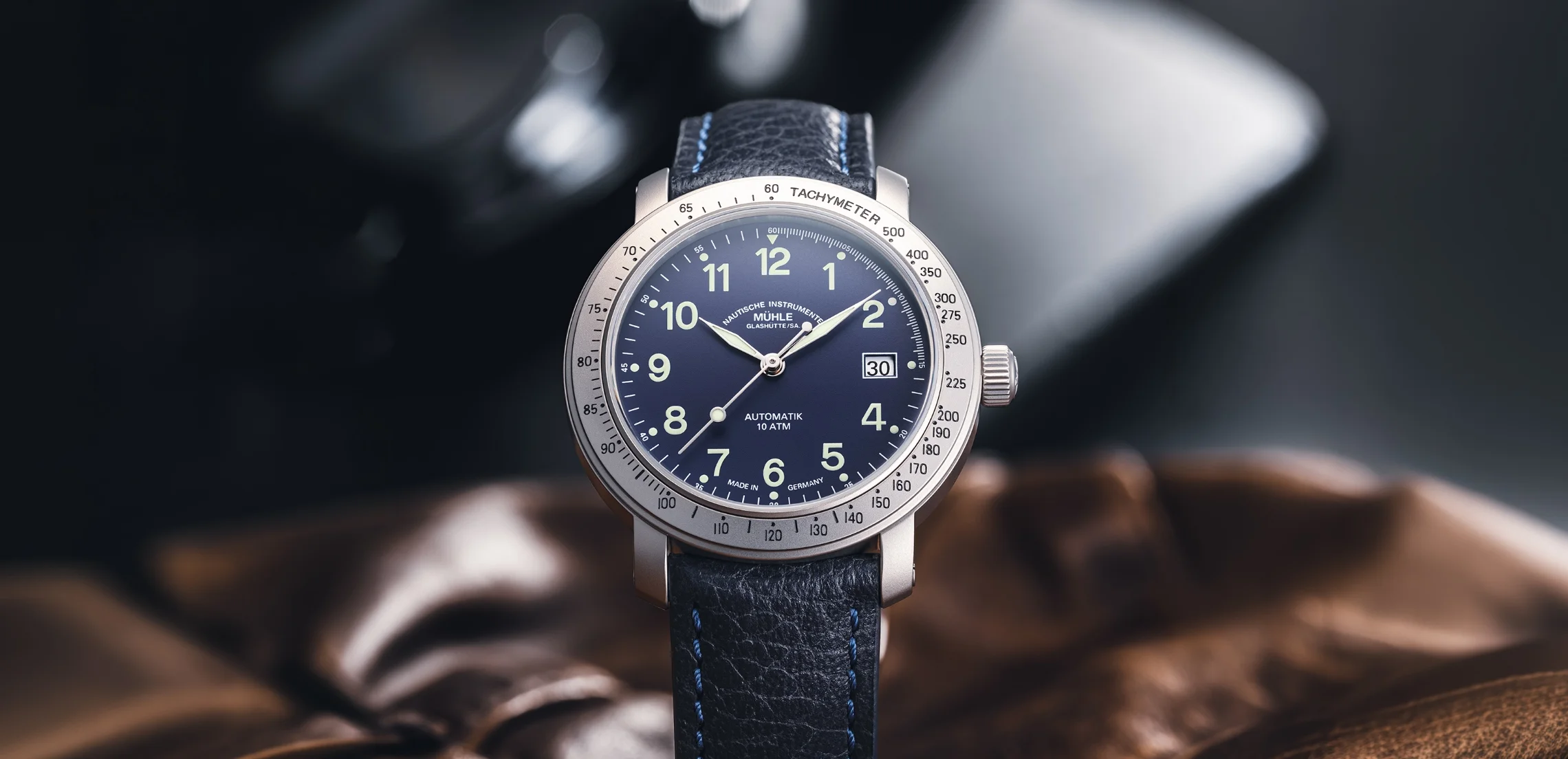

The Mühle-Glashütte Marinefliegeruhr-I Edition 2026—limited to 300 pieces—recreates a watch from the first wristwatch collection of the German firm, which was re-established in 1994 as a manufacturer of marine chronometers.
The Mühle family has worked in Glashütte since 1869, when Robert Mühle opened a precision-engineering workshop that made measuring instruments for the town's watchmakers. The family firm was expropriated twice, in 1945 and in 1972, and Hans-Jürgen Mühle founded it again on 1 April 1994, with two employees and a catalog of marine chronometers and ship's clocks. A year later, one of the shipyards that bought those instruments asked whether he could also make robust, water-resistant wristwatches to equip its ships. Hans-Jürgen Mühle took the order, and in 1996 the firm put its first collection on sale, made up of two sports diving watches and the Marinefliegeruhr-I, whose name means "naval aviator's watch."
Thirty years on, Mühle-Glashütte has reissued that model as the Marinefliegeruhr-I Edition 2026, a limited series it presented at the end of August.
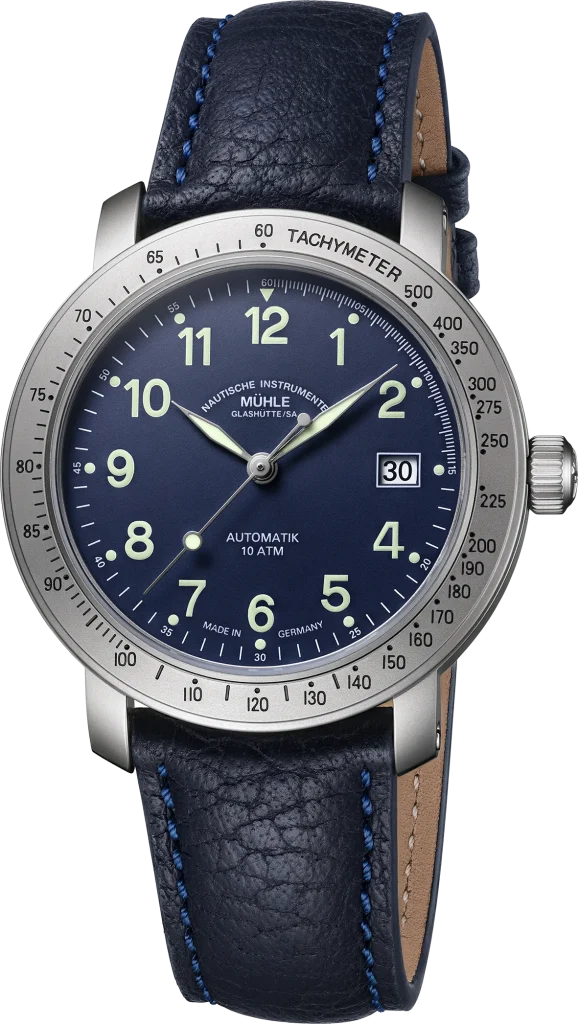
Technical Specs
| Reference | M1-30-01-1996-LB |
| Case | Stainless steel with a matte finish; 40 mm in diameter, 10 mm thick and 45.5 mm lug to lug; bezel with tachymeter scale; screw-down crown |
| Crystal and back | Anti-reflective sapphire crystal; sapphire crystal caseback |
| Water resistance | 10 bar (100 meters) |
| Dial | Dark blue, with Arabic numerals; hands and hour markers with Super-LumiNova; date at 3 o'clock |
| Caliber | Sellita SW200-1 in Mühle version, automatic, 28,800 vibrations per hour (4 Hz); woodpecker neck fine regulation and commemorative rotor; stop-seconds and quick date correction; power reserve of up to 41 hours |
| Strap | Dark blue leather with light blue stitching; stainless steel folding clasp; screwed strap bars |
| Edition | Limited to 300 pieces |
| Price | 1,996 euros in the official online shop, German taxes included; 2,799 dollars on the brand's United States site |
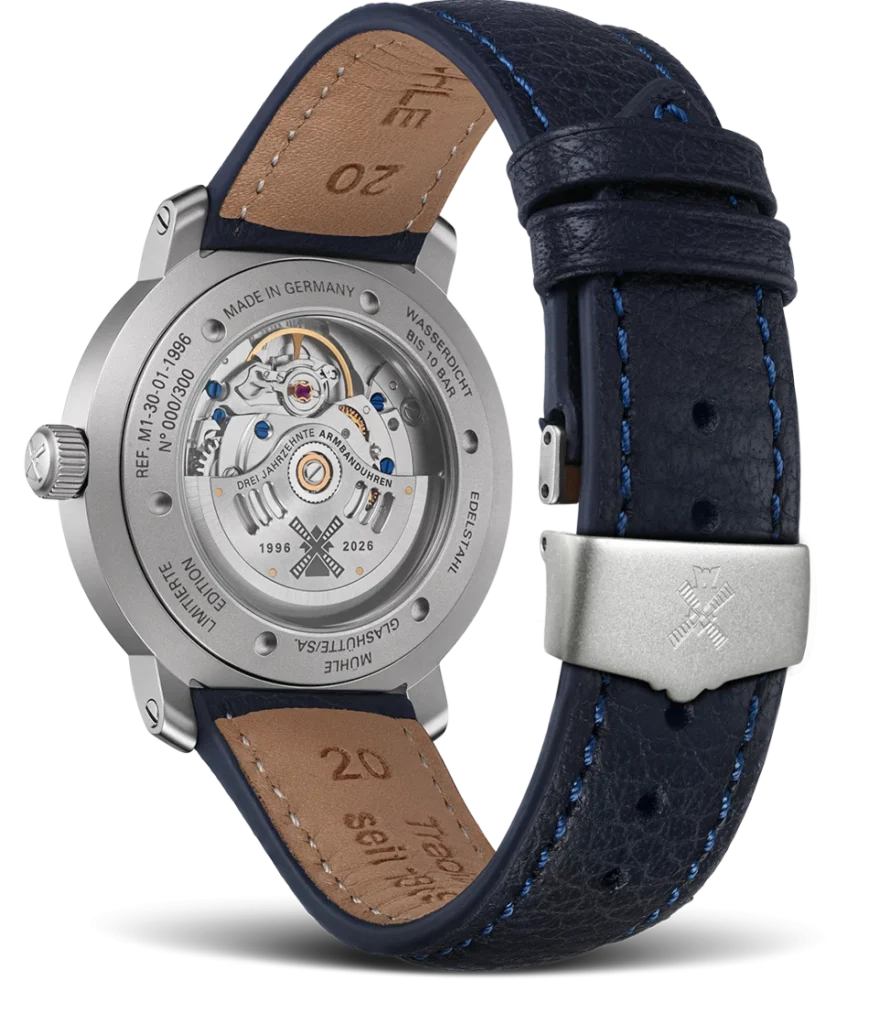
A design taken from the original
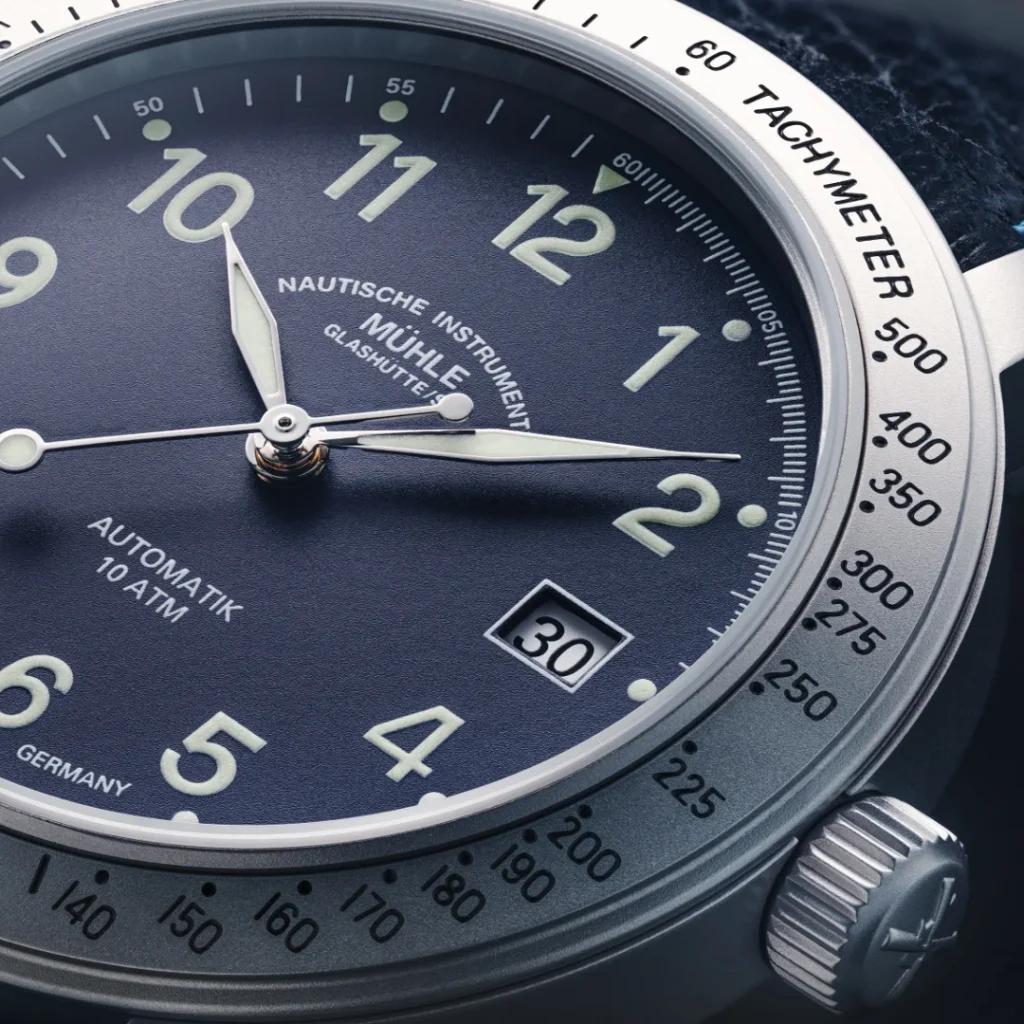
The steel case of the Edition 2026 has a matte finish and measures 40 mm across and 10 mm thick. The wide bezel has a tachymeter scale, used to work out an average speed from the time taken to cover a known distance. On a three-hand watch, that means starting the count as the seconds hand passes 12, so the scale is mostly a design trait carried over from the original.
The dial is dark blue and made to be read at a glance, with large luminous Arabic numerals, a fine minute track with small numerals for the seconds and, every five minutes, markers shaped like dots and triangles. The date is at 3 o'clock. The lancet-shaped hour and minute hands are filled with a greenish-yellow luminous material that, like the dark blue leather strap with light stitching and the folding clasp, reproduces the look of the first version.
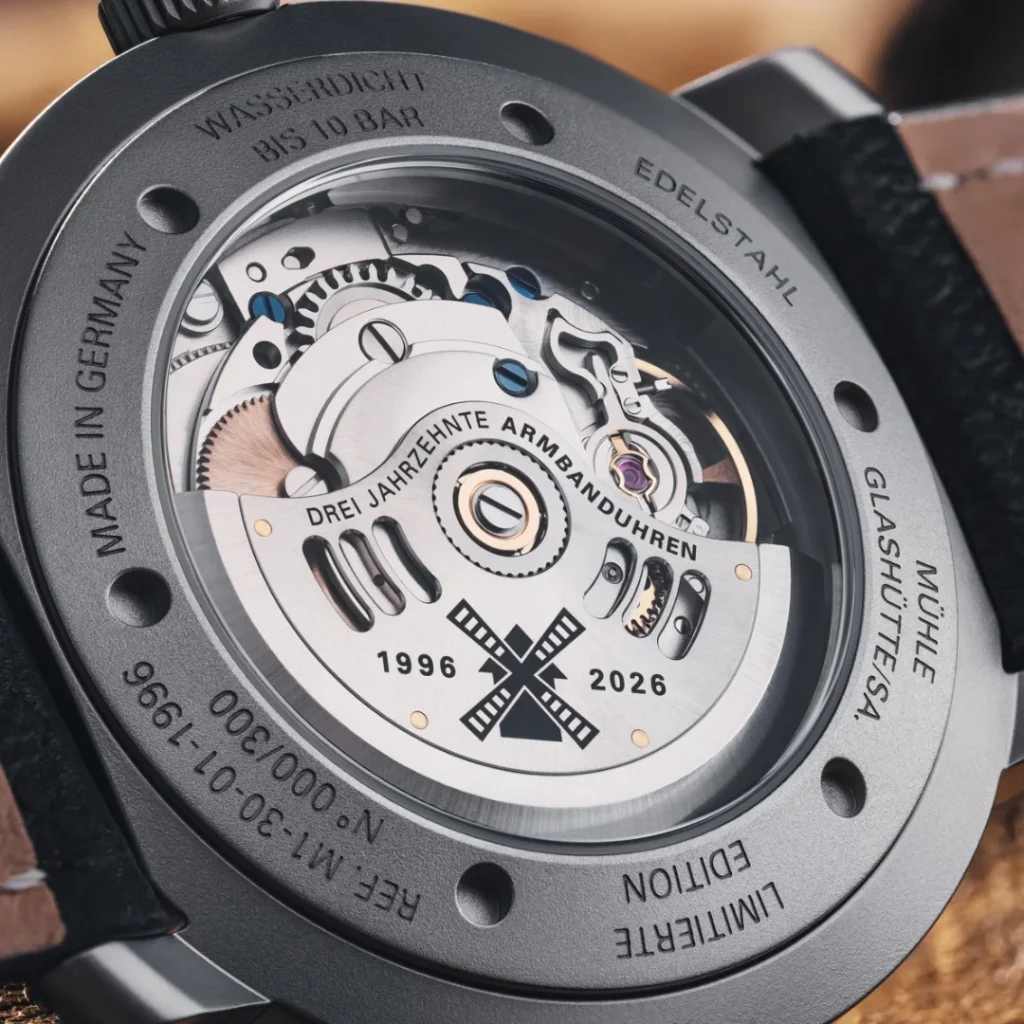
The sapphire crystal caseback, which shows the movement, is one of the changes from the 1996 watch, which had a closed back. The crown screws down and water resistance is 10 bar, a rating the brand itself considers suitable for swimming, although it recommends keeping leather straps dry.
The Sellita SW200-1, Mühle version
The movement is the SW200-1, a Swiss automatic caliber from Sellita that runs at 28,800 vibrations per hour (4 Hz) and, in this watch, has a power reserve of up to 41 hours, with stop-seconds and quick date correction. Mühle receives it from Switzerland and modifies it in its own workshop. The most distinctive part of that modification is the woodpecker neck fine regulation, which the firm developed in 2003 from Glashütte's traditional swan neck. A spring shaped like that bird's head and neck presses the regulator, the arm the watchmaker uses to adjust the rate, against its adjusting screw and against the balance cock, so that a hard knock does not shift it and the adjustment holds.
The rotor is also Mühle's own; the firm designs and machines its oscillating weights in Glashütte. The one in this edition is inscribed "Drei Jahrzehnte Armbanduhren," three decades of wristwatches, and is reserved for the pieces in the series. Each movement is regulated in six positions so that the watch runs between 0 and +8 seconds a day. The brand prefers its watches to run slightly fast, on the grounds that the owner will then never be late because of the watch.
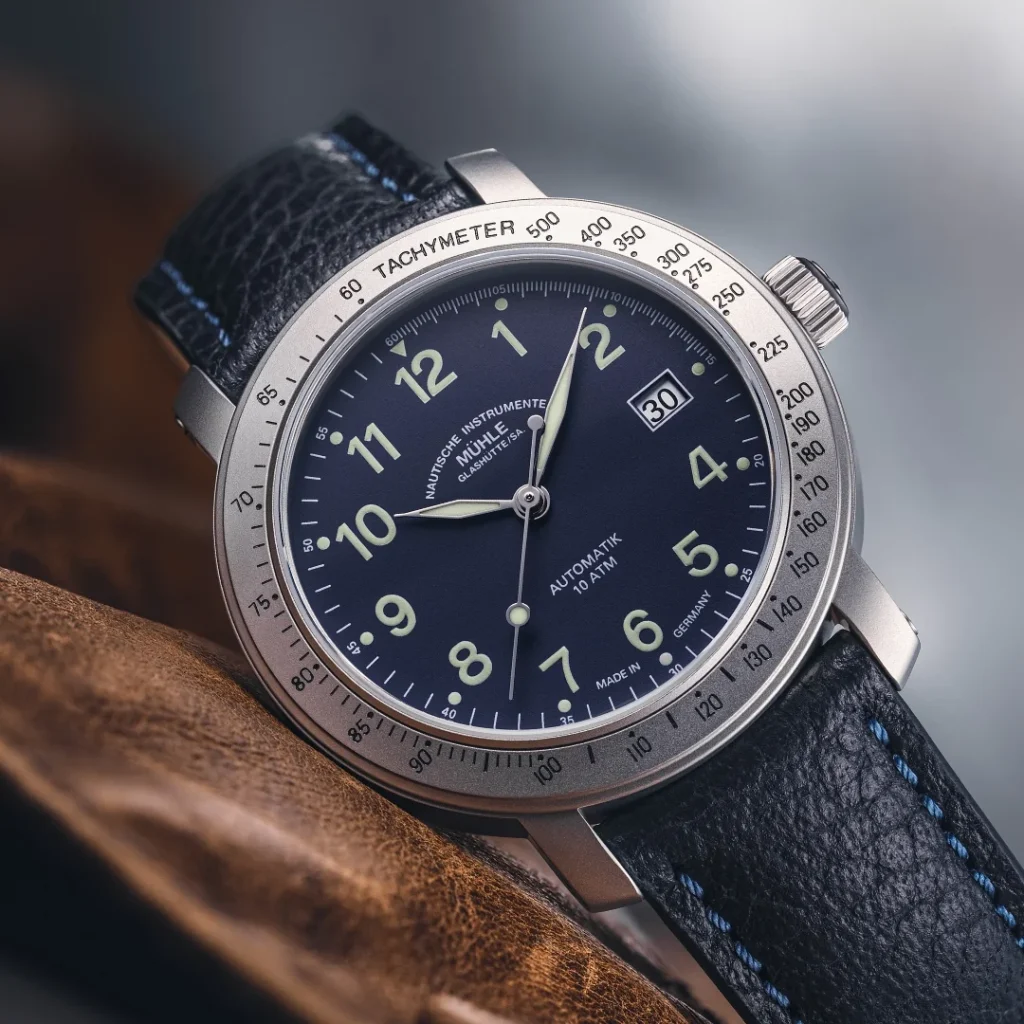
The Glashütte origin
The Glashütte name is a designation of origin protected by a German federal regulation of February 2022. For a watch to carry it, the assembly and starting of the movement, its regulation, the fitting of the dial and hands and the casing of the movement must be done entirely in the town, and more than half of the value added by the essential stages of manufacture has to be generated in the area of origin. In Mühle's watches, that local work includes the firm's own parts added to the caliber, the finishing, the assembly, the regulation and a final inspection that, according to the brand, lasts almost a week.
Price and where to buy
Mühle-Glashütte's online shop offers the Edition 2026 for 1,996 euros, German taxes included, a figure that matches the year of the original model; in early October it was taking orders with a delivery time of four to five weeks. The brand's site for the United States, run by its distributor there, lists it at 2,799 dollars, with availability from October. Mühle does not publish a price in Mexican pesos, and its list of retailers includes no shop in Mexico. In Spain the list names the watch retailer El Cronómetro, in Seville, which sells other models from the brand in its online shop, and in Latin America, the distributor ITG International Time Group, in Buenos Aires. For other countries, the brand says it answers each international inquiry with an individual offer or refers it to the wholesaler for the area, so anyone who wants to buy it from Mexico, Colombia or Chile can write to the firm directly.
A faithful, updated reissue
The Marinefliegeruhr-I Edition 2026 reproduces one of the watches with which a maker of nautical instruments began making wristwatches, and it keeps its 1996 design. The new parts are in the movement: the woodpecker neck regulation, which Mühle developed seven years after that first model, and a rotor found only in the watches of this edition, both visible through the sapphire caseback.
Mühle-Glashütte is still a family business, with around 65 employees and Thilo Mühle, Hans-Jürgen's son, in charge. The brand credits its watches with the qualities of the shipboard instruments it started over with in 1994, which it sums up as legibility, robustness and precision, and the Edition 2026 brings them together in one of its first wristwatch models, with a movement modified and regulated in Glashütte.