
Masami Watanabe spent more than thirty years bringing Western luxury watches to Japan. Then he asked why Japan had no answer of its own. Kiwame Tokyo is that answer — and the Kubo is its most sophisticated statement yet.
There is a 1933 essay called In’ei Raisan — "In Praise of Shadows" — in which Japanese writer Jun'ichirō Tanizaki argues that Japanese aesthetics do not live in light but in what light allows you to glimpse.
Masami Watanabe doesn't cite Tanizaki. But the Kubo inhabits that same philosophy.
Kiwame Tokyo is a Japanese microbrand founded in 2025 from Asakusa, Tokyo. The name — 極, kiwame— means to pursue something to its very limits, without compromise. After three decades in the watch industry introducing European brands to Japan, Watanabe asked: why does Japan, with its meticulous craft tradition, have so few genuine independent brands?
The Kubo — fourth collection, June 2026 — is the most articulate answer yet.
Asakusa: tradition as discipline
Kiwame Tokyo didn't choose Asakusa arbitrarily. The neighborhood has been Tokyo's artisan heart for centuries. The Kaminarimon — the Thunder Gate, with its 700-kilogram red lantern — has marked the entrance to Sensō-ji temple since the tenth century.
Every Kiwame Tokyo watch is assembled in their Asakusa workshop. "Honest watchmaking": no excess, no superficial luxury, designed to last, priced to reflect what they are.
Kubo: shadow in the dial
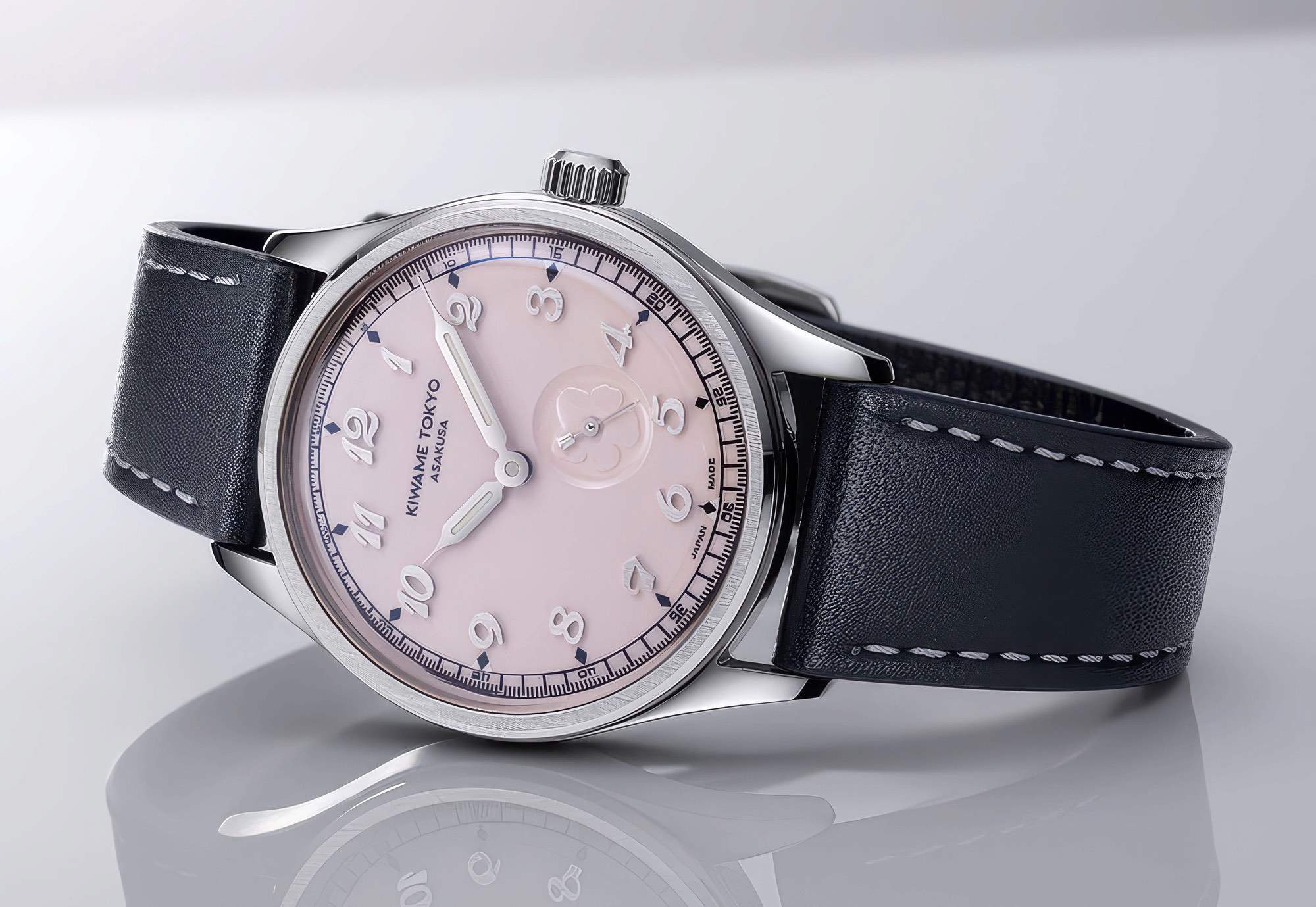
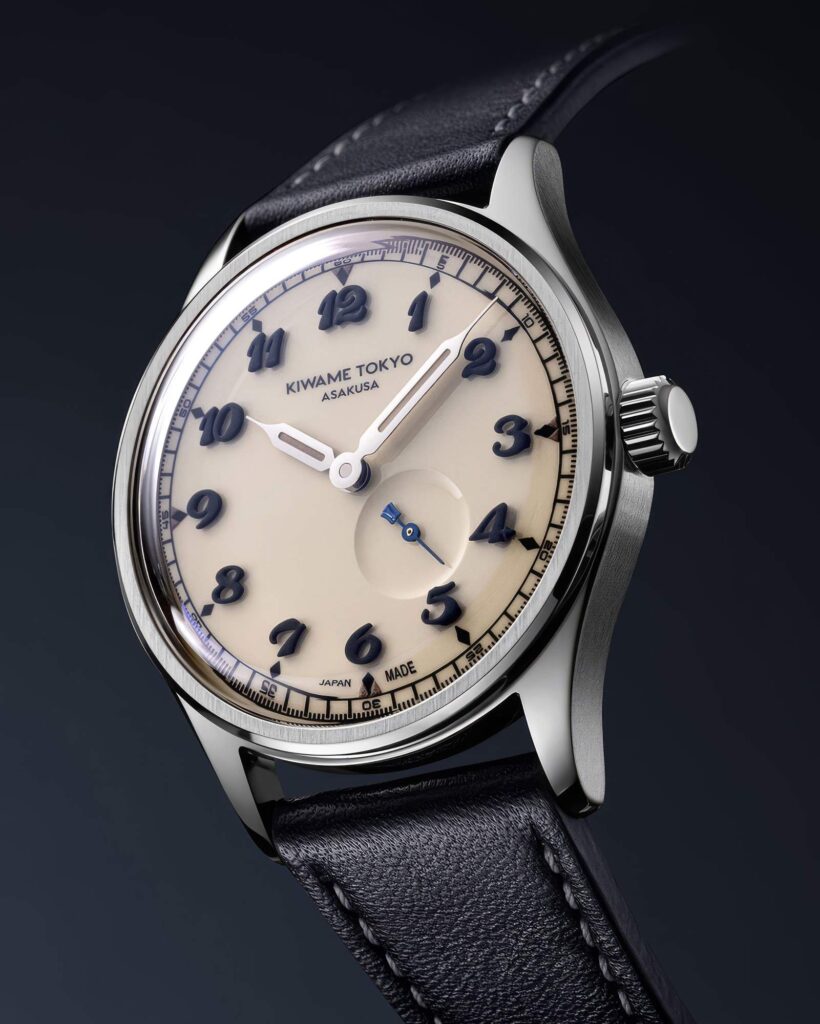
The name says it all. Kubo (窪) means hollow, sunken space. It was chosen to describe what happens when a flat surface incorporates a depression: the shadows created by this difference in level change with the light, the angle, and the time of day. The dial is not a surface but a conversation between layers.
The most visible element of this conversation is the small seconds subdial recessed at 4:30—an asymmetrical position, deliberately off-center. The seconds hand is unconventional: its counterweight is carved with the silhouette of the great roof of the Kaminarimon in Asakusa. It's not decoration: it's a signature. A reference to the place where the watch was born, engraved in the visible movement of each piece.
In the Sakura version—soft pink—the background of the seconds subdial features the outline of a cherry blossom. In the other two versions, the subdial is a clean space that exists to create depth, not information.
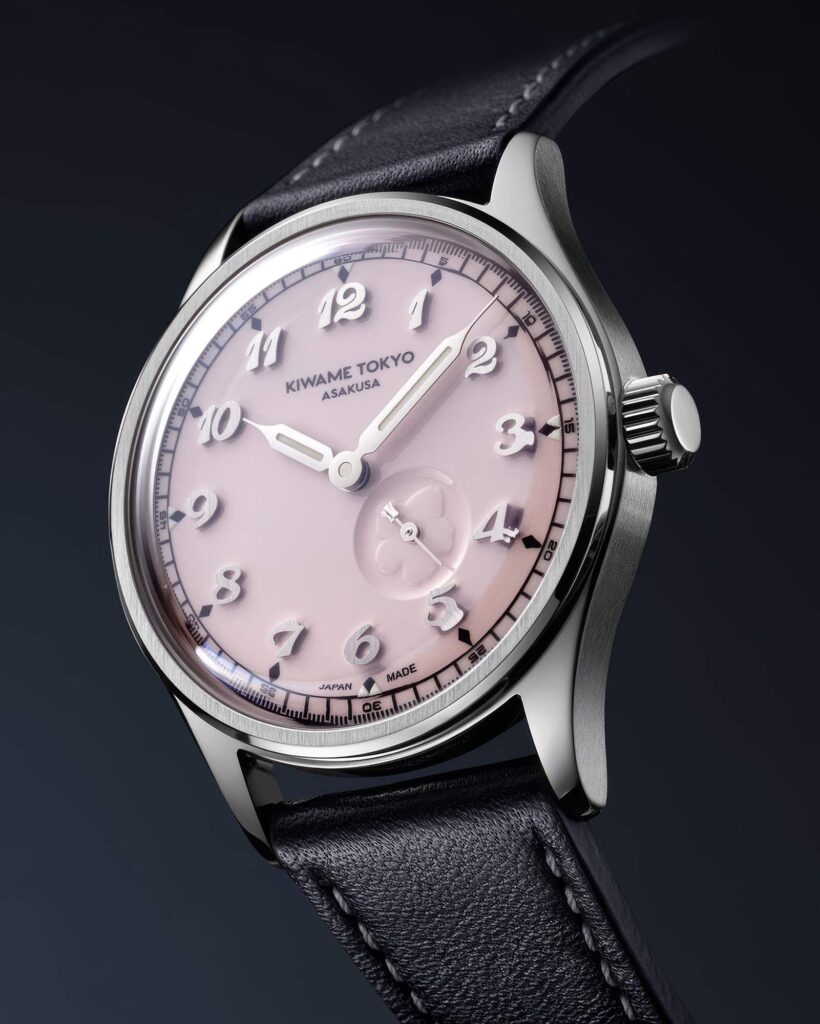
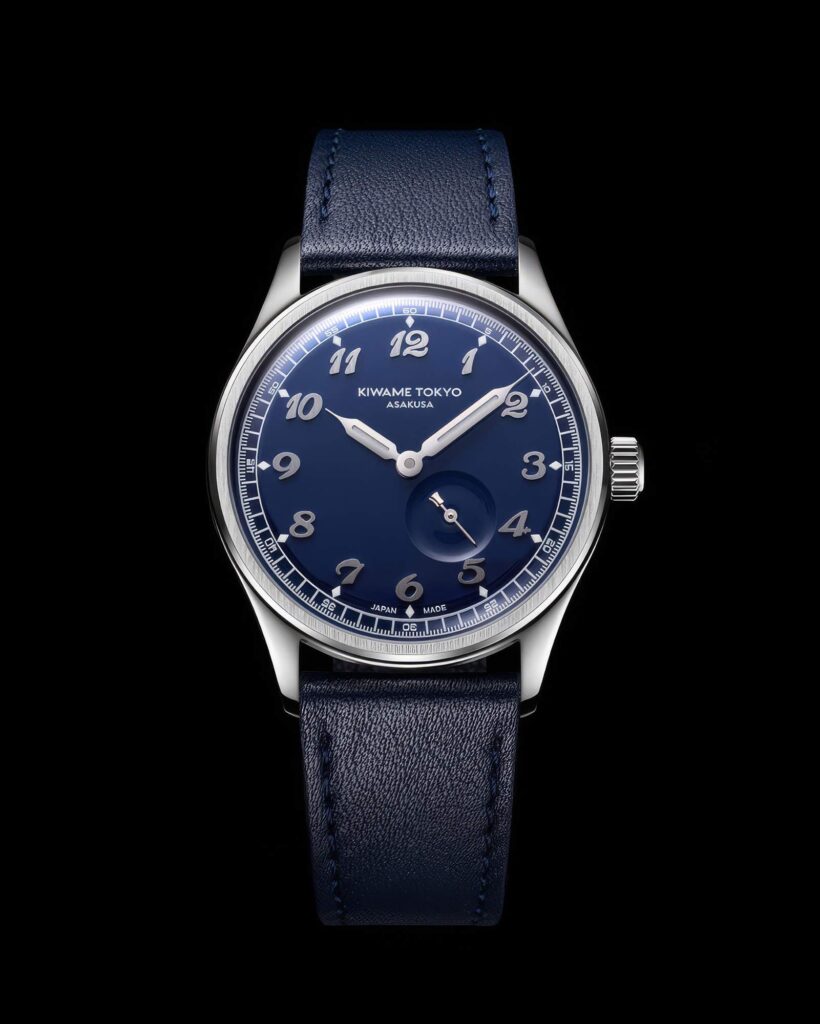
The rest of the dial is lacquered and glossy—available in three colors: Sakura (cherry blossom pink), Tetsukon (deep navy blue, inspired by the hue of iron), and Usuki (warm ivory, referencing traditional Japanese interiors). The colors are not arbitrary: each has centuries of use in Japanese visual culture. Tetsukon blue is the color iron takes on over time. Usuki is the white of rice paper, not the white of a hospital.
The hour markers are three-dimensional, applied Arabic numerals in the Breguet style, with diamond-shaped markers at the five-minute intervals. The hands—syringe-style—feature blue luminescent material. The minute track printed around the perimeter completes a dial that is both precise and visually calming.
The case, the movement, the trade-offs
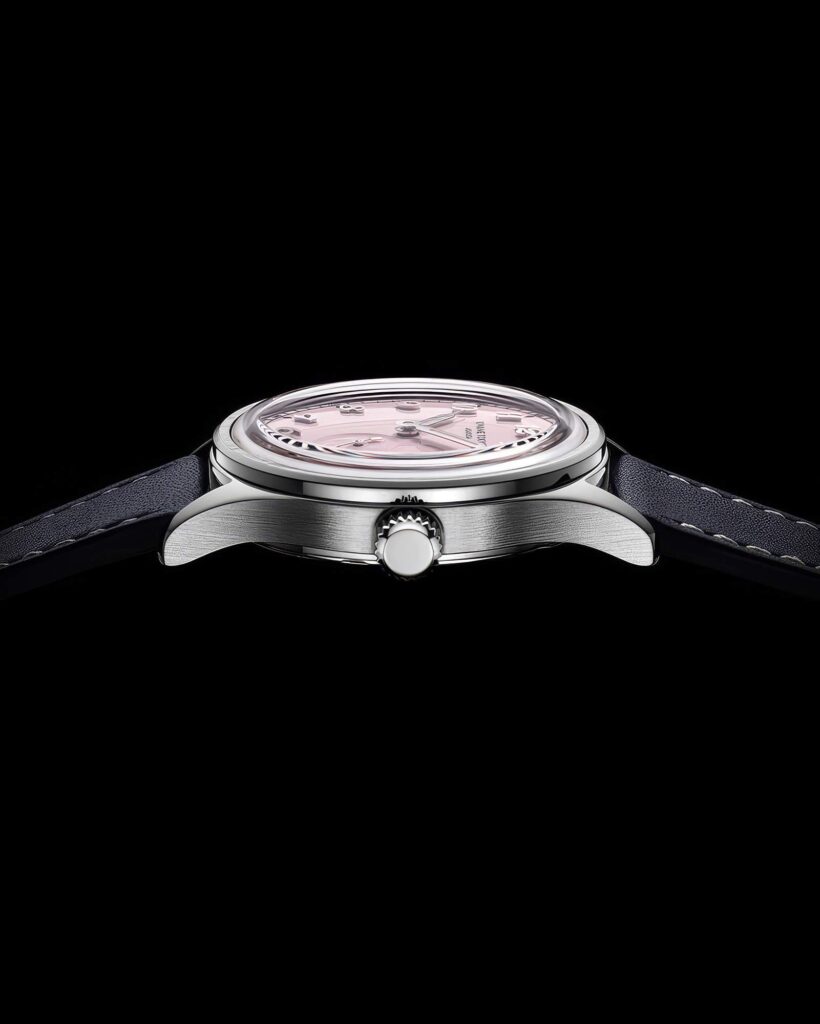
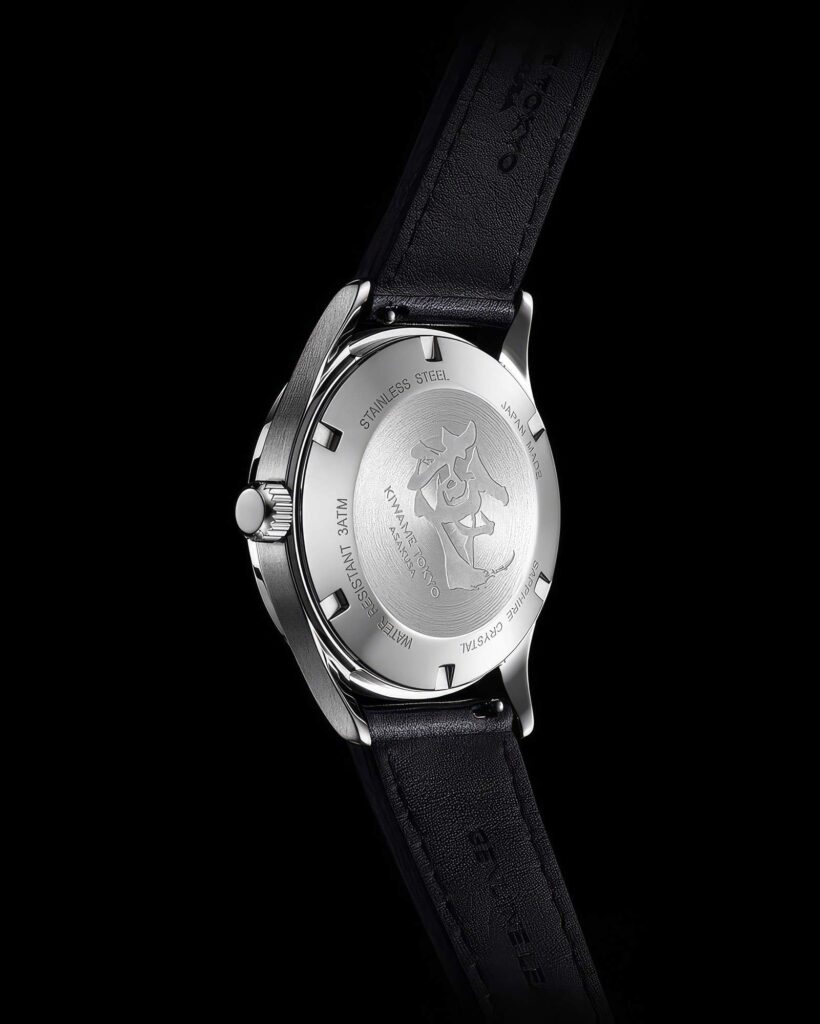
The case is made of 316L stainless steel and measures 37mm in diameter—the most compact in the Kiwame Tokyo catalog. It is 9.3mm thick without the crystal and 10.7mm thick with the domed sapphire crystal. Lug to lug: 45mm. The finish combines brushed surfaces on the sides and bezel with polished surfaces on the top of the case and the sides of the flat bezel—a decision that prioritizes everyday usability over the fragility of a fully polished finish.
It's water-resistant to 30 meters with a push-pull crown. It's not an adventure watch: it's a watch for everyday wear, dinners, and relaxed Sundays.
The movement is the automatic Miyota 82S5: 21,600 vph (3Hz), 42-hour power reserve, hours, minutes, and small seconds. It's a reliable and tried-and-tested movement, but it's worth mentioning honestly: it's a step below the Miyota 9039 that Kiwame Tokyo used in its previous collections. The 9039 runs at 4Hz and has a better reputation for accuracy. The 82S5 has the advantage of offering the small seconds function that the 9039 doesn't—a reasonable trade-off, but anyone familiar with the brand's previous catalog will notice. (Check kiwametokyo.com if you have specific questions.)
The strap is made of Italian calfskin leather, 20/16mm, with a quick-release buckle. It features a steel pin buckle closure.
Price: $630 USD before taxes (verify at kiwametokyo.com).
The context that matters
The Kubo does not compete with Seiko or Citizen. It competes with the other question: if you have $630 USD to spend on an in-house Japanese-designed automatic dress watch, what else is out there?
Kurono Tokyo—Hajime Asaoka's brand—offers watches at significantly higher prices. Grand Seiko starts in another range completely. In the $500–$800 USD space with authentic Japanese identity and in-house workshop craftsmanship, the Kubo has few direct competitors.
What it offers: design with concrete and verifiable cultural references, case finish above average in its range, three color options with their own history, and a design signature—the Kaminarimon counterweight—that does not exist in any other watch in the world.
What you need to accept: 30m of water resistance, 3Hz movement, and a brand with barely a year on the market. They are real commitments. They are not fatal defects.
Latin America Perspective
Kiwame Tokyo sells directly from kiwametokyo.com with international shipping. Base price: $630 USD excluding taxes. In Mexico: 16% VAT plus an estimated tariff of 15–20%—the actual cost upon receipt is around $750–$800 USD equivalent. (Approximate number—please verify with your customs agency or directly with the brand before ordering.) No distributors in LATAM; warranty and service directly with the Kiwame Tokyo team in Japan.
Tanizaki wrote that Japanese beauty is not imposed: it is discovered. That requires time, stillness and willingness to look more slowly. The Kubo works like this. It's not a watch that catches your eye from five meters away—it's a watch that gives you something new every time you look at it up close. The recessing of the subdial at 4:30. The shadow that changes with the angle. The Kaminarimon roof on the counterweight of the seconds hand.
At $630 USD, Kiwame Tokyo isn't selling a cheap watch with a good story. It's exporting a philosophy that Japan was too slow to embrace: that "honest" and "beautiful" are not contradictory terms.