
Since 2019, no Serica had carried a date window. The first one that does costs a hundred euros more than the watch that made the brand's name, and both remain in the catalogue.
There was never a press release saying so, nor a founder's line anyone could quote. For seven years, simply, no Serica carried a date window. Not the diver, not the field watch, not the dress watch. Buyers read it for what it was: a sustained preference for dial balance, held with a stubbornness that in a young brand reads as character.
On 12 March this year the habit broke. The Ref. 5330 entered the catalogue with a window at three o'clock and a price a hundred euros above the Ref. 5303, the diver that had built the house's reputation. Serica did not replace one with the other: both are on sale today, side by side, on the same page. The decision, then, belongs to the buyer.
Una marca francesa que llegó con calma
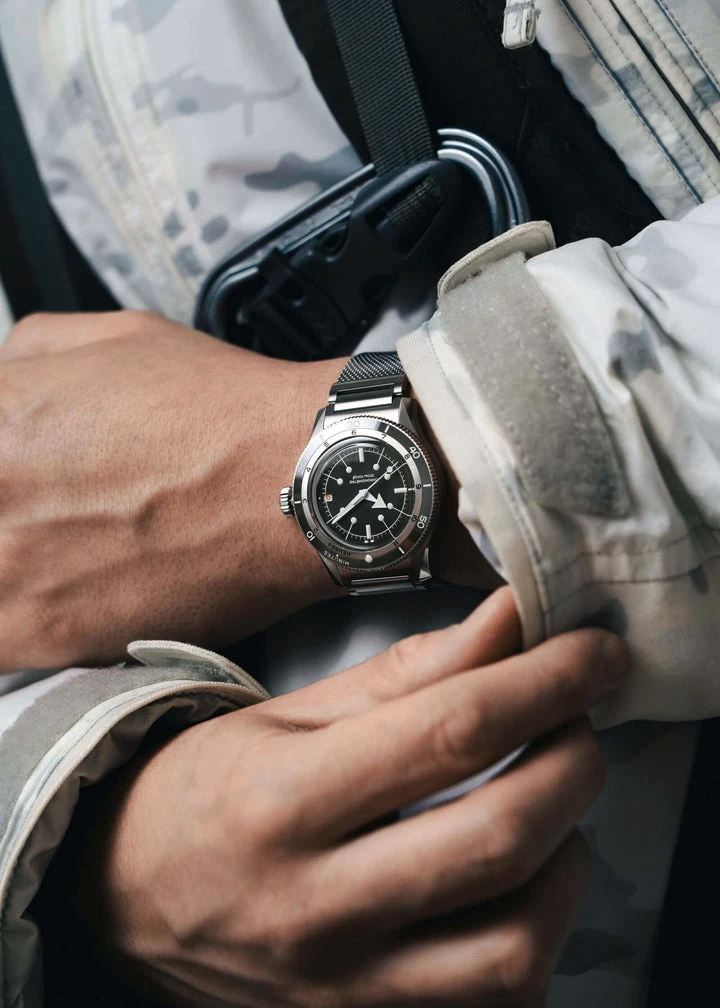
Serica was founded in France in 2019, in the same wave of European microbrands that produced Baltic and Furlan Marri, but with a personality unlike its neighbours'. Where other young brands chase an effect with every release, Serica has committed to one thing: military-inspired tool watches, with as little text on the dial as possible and changes that arrive in small increments. Thomas Calara wrote in Worn & Wound that the brand "feels like it has been around for ages" despite its youth, and put that down to the maturity of its pace.
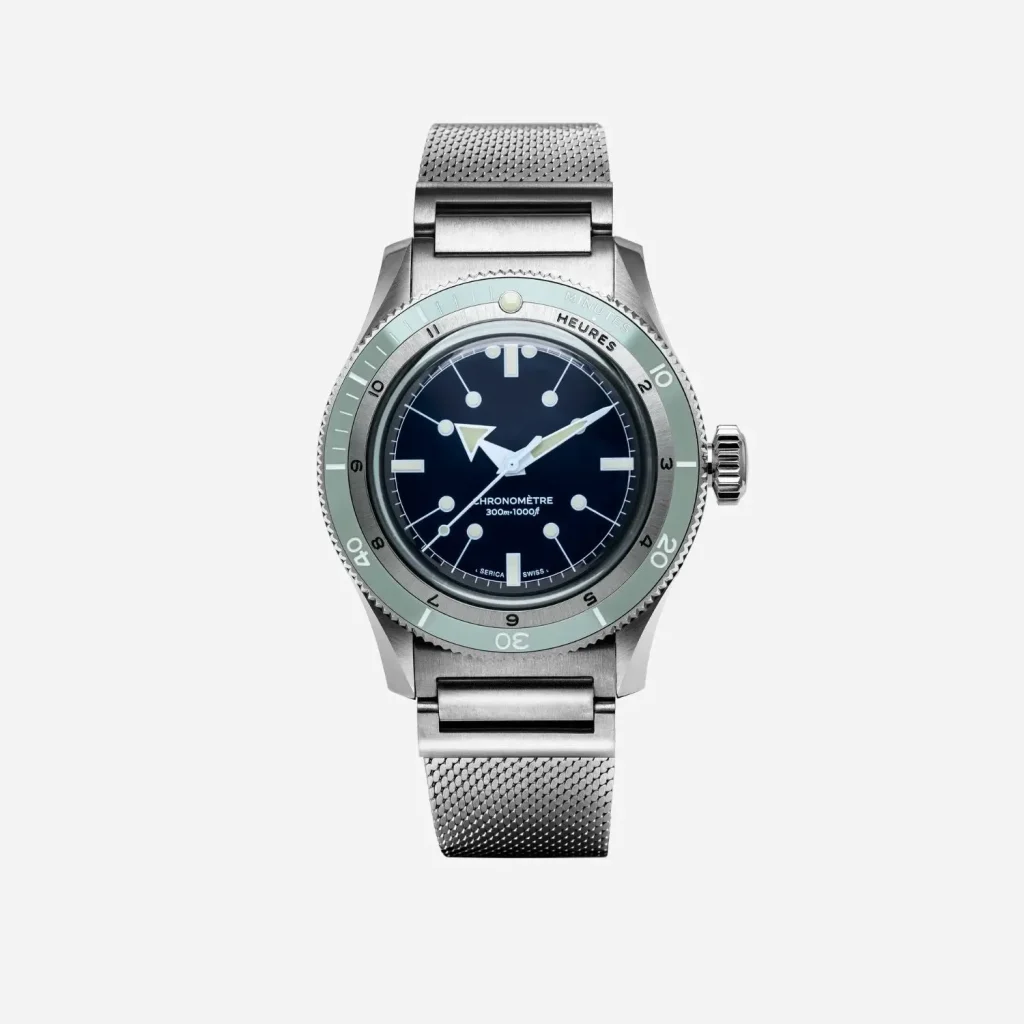
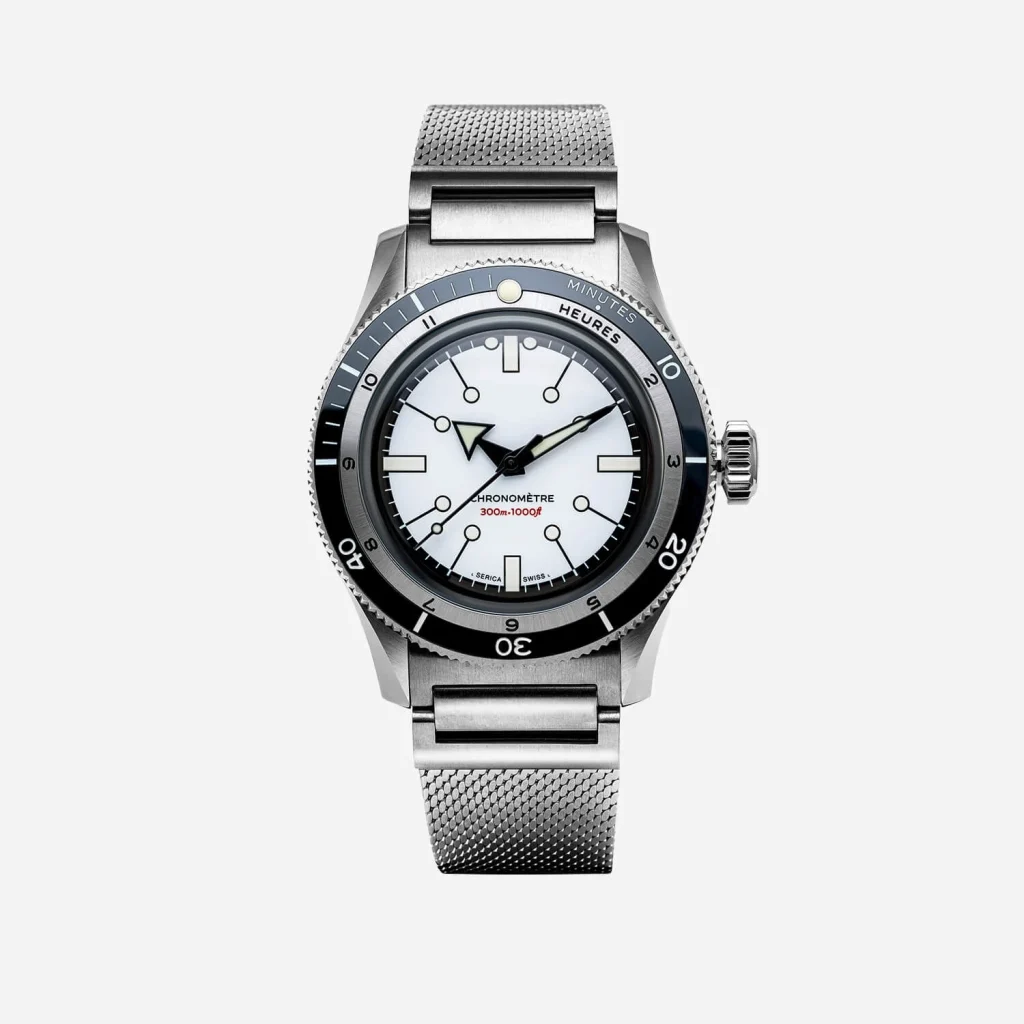
One detail gives the measure of that mindset. The 5303 has been offered with the crown at three or at nine, at no extra cost, a courtesy to left-handers that almost no brand extends and that none turns into a campaign.
The 5303 and Its Run Among Collectors
Serica's diver did not arrive finished, and its story is that of a watch improved from the inside out without changing on the outside.
Early versions were called the 5303 S617, a designation taken from the name of a French submarine, as Worn & Wound explained at the time. It ran a Soprod Newton P092 and already had the case it still has: 39mm across, 46.5mm lug to lug, 12.2mm thick and water-resistant to 300 metres, proportions that in the age of the 42mm diver sounded almost like a statement of principle.
The leap came in 2023. Serica swapped the movement for a Soprod M100, whose 3.2mm height freed roughly 1.4mm inside the same case, and spent that space on what mattered: a soft-iron movement holder, a soft-iron dial and a soft-iron inner caseback. The result was magnetic resistance of 50,000 A/m, more than ten times the usual Swiss standard of 4,800 A/m. The same operation brought COSC chronometer certification and, on top of it, the house's own Grand Chronomètremark, under which Serica states it retests accuracy, power reserve and shock resistance once the watch is fully assembled. The price rose by about three hundred dollars, and the watch stopped being a likeable alternative and became a hard proposition to argue with.
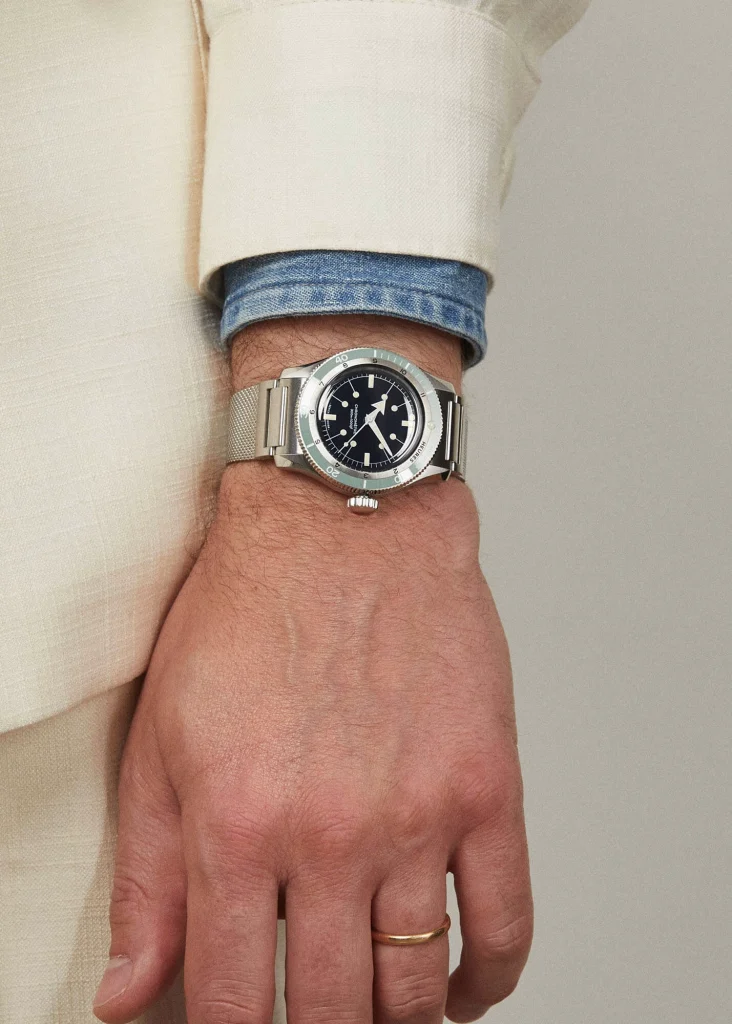
That is why the 5303 has become the watch enthusiasts mention when someone asks what to buy for under two thousand dollars. It is not because of a spectacular dial or a marketing narrative, but because it combines official precision certification, industrial-grade anti-magnetic protection, and 300-meter water resistance within a 39mm case that suits almost any wrist. It is also worth noting that the watch's design makes the brand instantly recognizable—even though the brand name does not appear anywhere on the dial—and it is precisely this clean, balanced aesthetic that has made it a favorite among collectors.
There is one more detail rarely mentioned that explains much of the attachment. The 5303's bezel carries a double scale: a countdown for elapsed time on the outer ring, and twelve hours on the inner one. Turning it tracks a second time zone without touching the crown or paying for a GMT calibre. It is the kind of solution an owner discovers a week in and never forgets.
The Window, and How It Is Cut When Someone Thinks About It
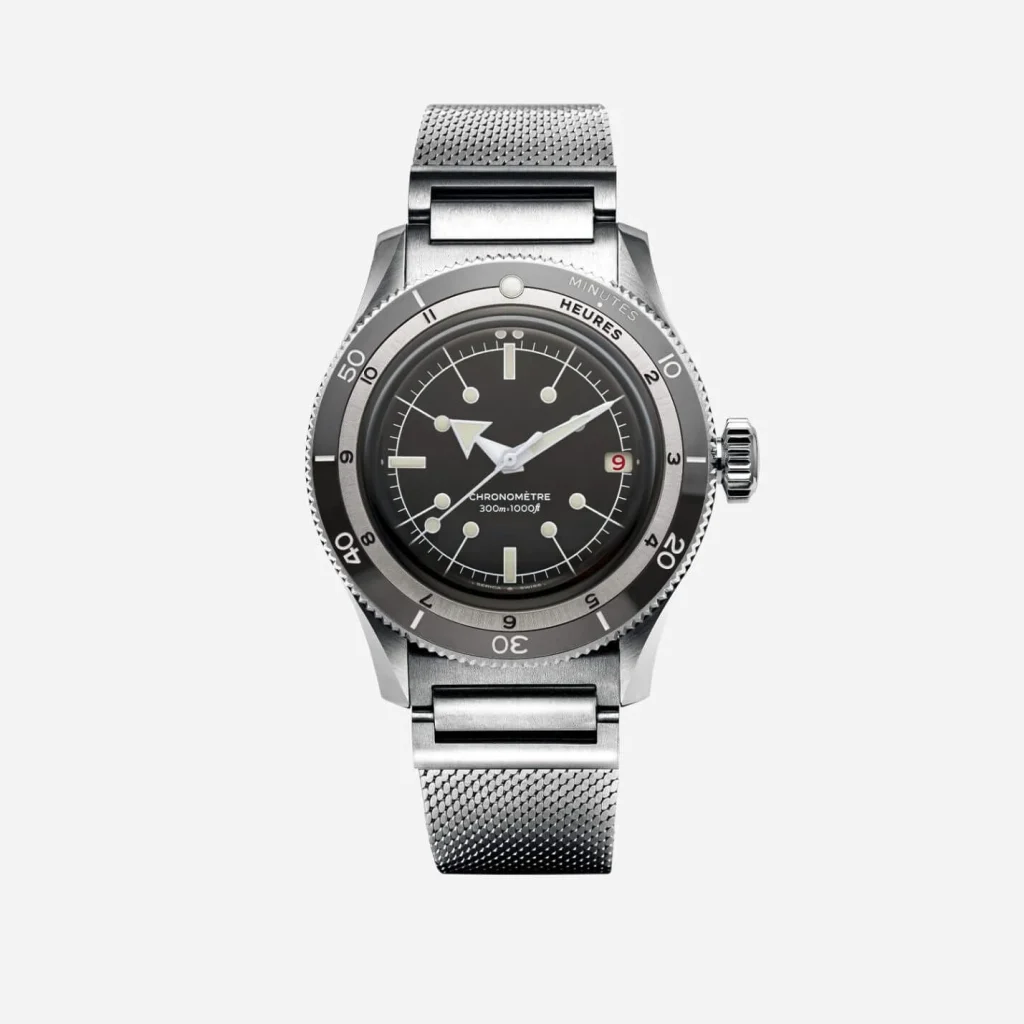
The 5330 shares the case with the 5303, along with the water resistance, the COSC certification, the 50,000 A/m antimagnetic protection and the Soprod calibre family. What changes begins at the dial.
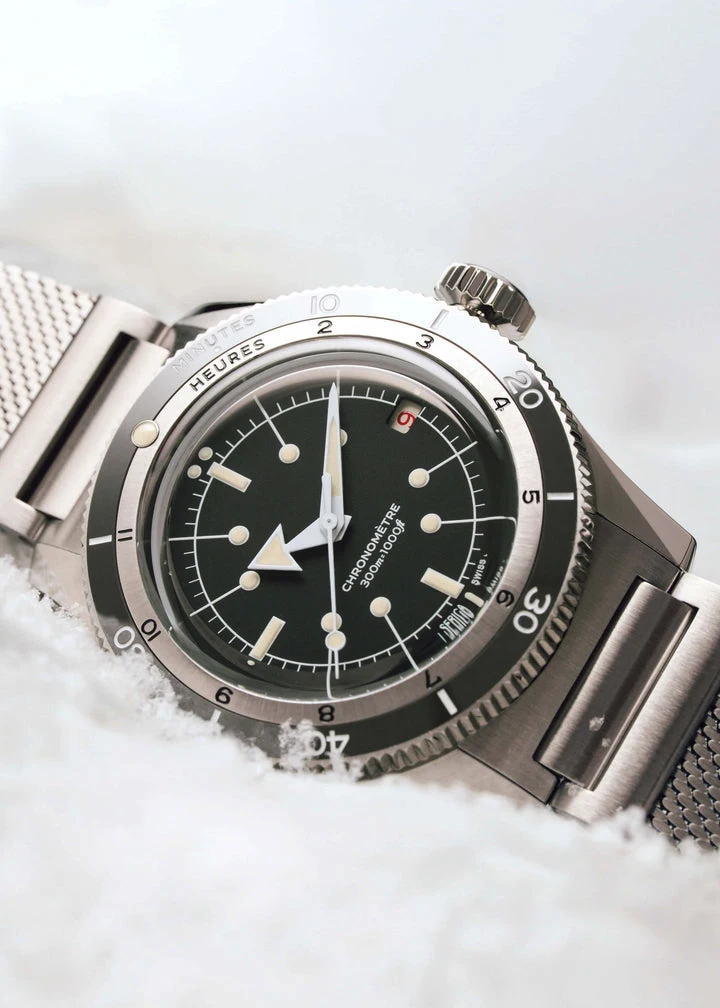
Serica describes the problem on its own page, under the heading "PRESERVING HARMONY": integrating a date into an existing design means "maintaining harmony despite the natural imbalance of an indication that has no axial symmetry". That is an elegant way of admitting what anyone can see. A symmetrical dial reads as an object at rest, because the eye finds nowhere to settle when every point carries the same weight, and that stillness is a large part of the 5303's appeal. A hole at three introduces a permanent vanishing point, and the eye will go there even on days when nobody cares what the date is. Engineering does not compensate for that.
What can be judged is the quality of the cut, and here is a lesson that travels well beyond this watch. Serica recentred the entire minute track and set the aperture "positioned as a mirror of the 9 o'clock index", meaning at the same distance from the centre as the marker opposite it, so it works as a counterweight rather than an accident. And it shaped the opening so that it "preserves the 14' and 16' markings, guaranteeing legibility without compromise". That is precisely the detail most brands sacrifice without a second thought: the window swallows its neighbouring minutes and the track is mutilated for good.
What Else Changes
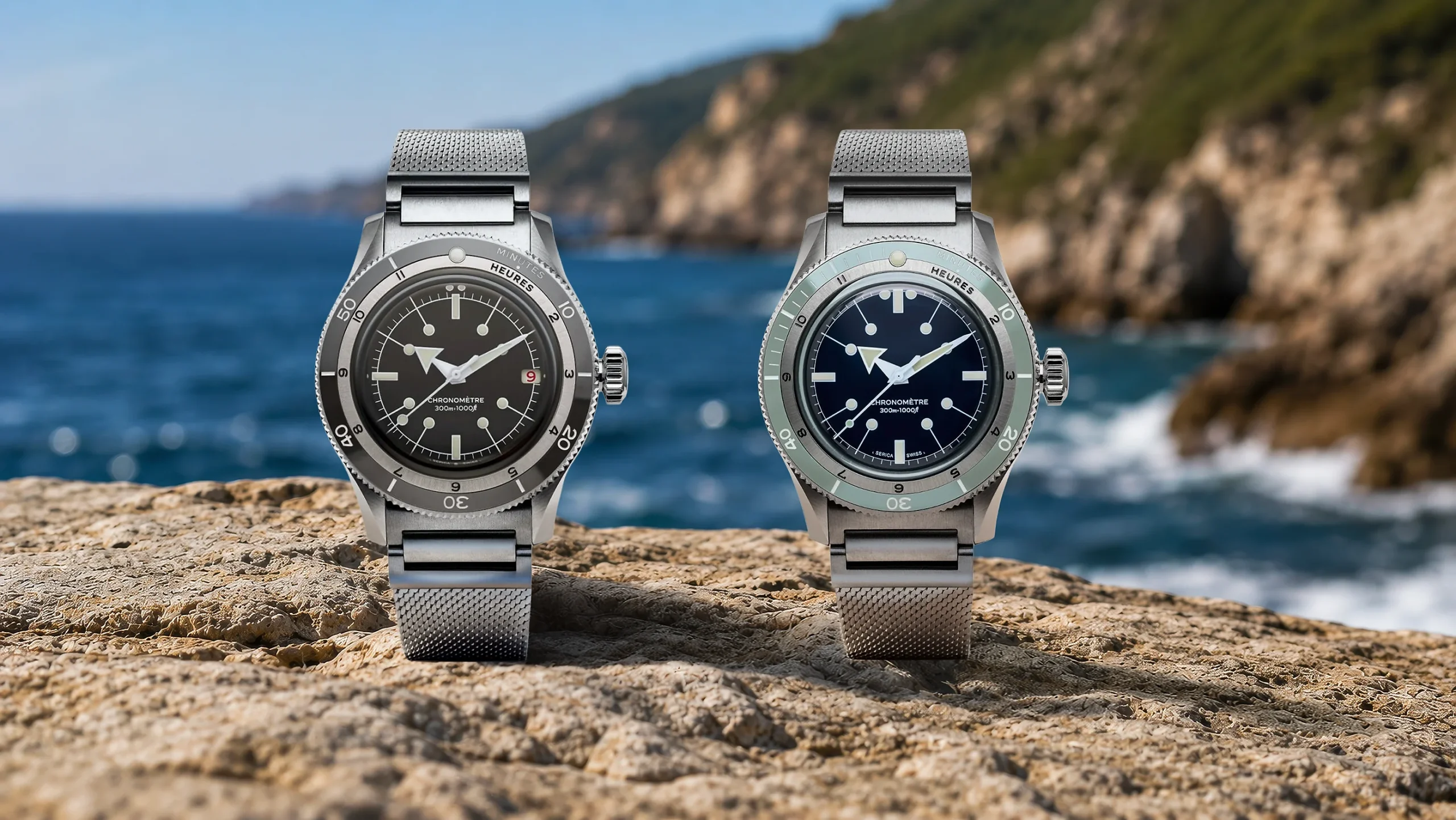
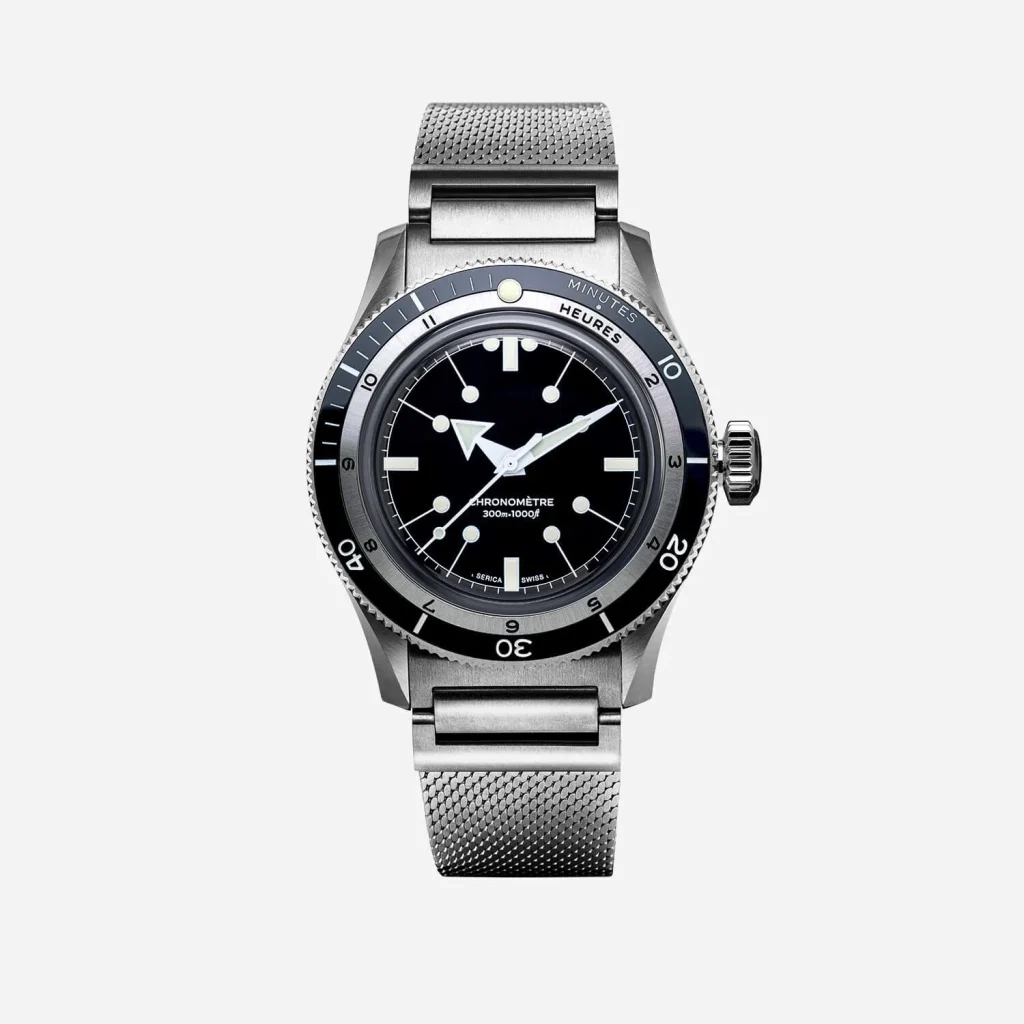
The 5303's dial has an enamel-like finish, with depth and gloss; the 5330's is matte black, more restrained and more of a tool. The 5303's bezel graduates a countdown on the outer ring; the 5330 moves to a count-up 60-minute scale, the classic diving read, on a polished anthracite-grey ceramic ring with a faded effect the other model does not have. Brice Goulard, who handled it for Monochrome, described its action as among the smoothest and most precise he had tried in a long time, and that is the kind of detail no photograph or spec sheet conveys.
In short: the 5303 is the more elegant of the two and the 5330 the more openly sporting. The date is the visible difference; the dial finish is the one you notice in use.
The Two Watches, Briefly
Serica Ref. 5303, no date. Steel case measuring 39mm across by 12.2mm thick and 46.5mm lug to lug, brushed with polished accents and polished chamfers on the twisted lugs. Unidirectional 120-click dual-scale bezel, countdown on the outer ring and twelve hours on the inner. Double-domed 2mm sapphire with internal anti-reflective coating, screw-down crown, screwed steel back, 300m. Enamel-like dial finish, full axial symmetry. Antimagnetic to 50,000 A/m via a soft-iron movement holder, dial and inner caseback. Soprod M100 automatic, COSC-certified, 28,800 vibrations per hour, 42-hour power reserve, hacking seconds. 20mm steel mesh bracelet tapering to 16mm at the clasp. Three dial variants at the same price: Enamel Black, Porcelain White and Crystal Blue.
Official price: 1,590 euros, tax included. In the Mexico store: 33,773 pesos, with shipping and import taxes already included.
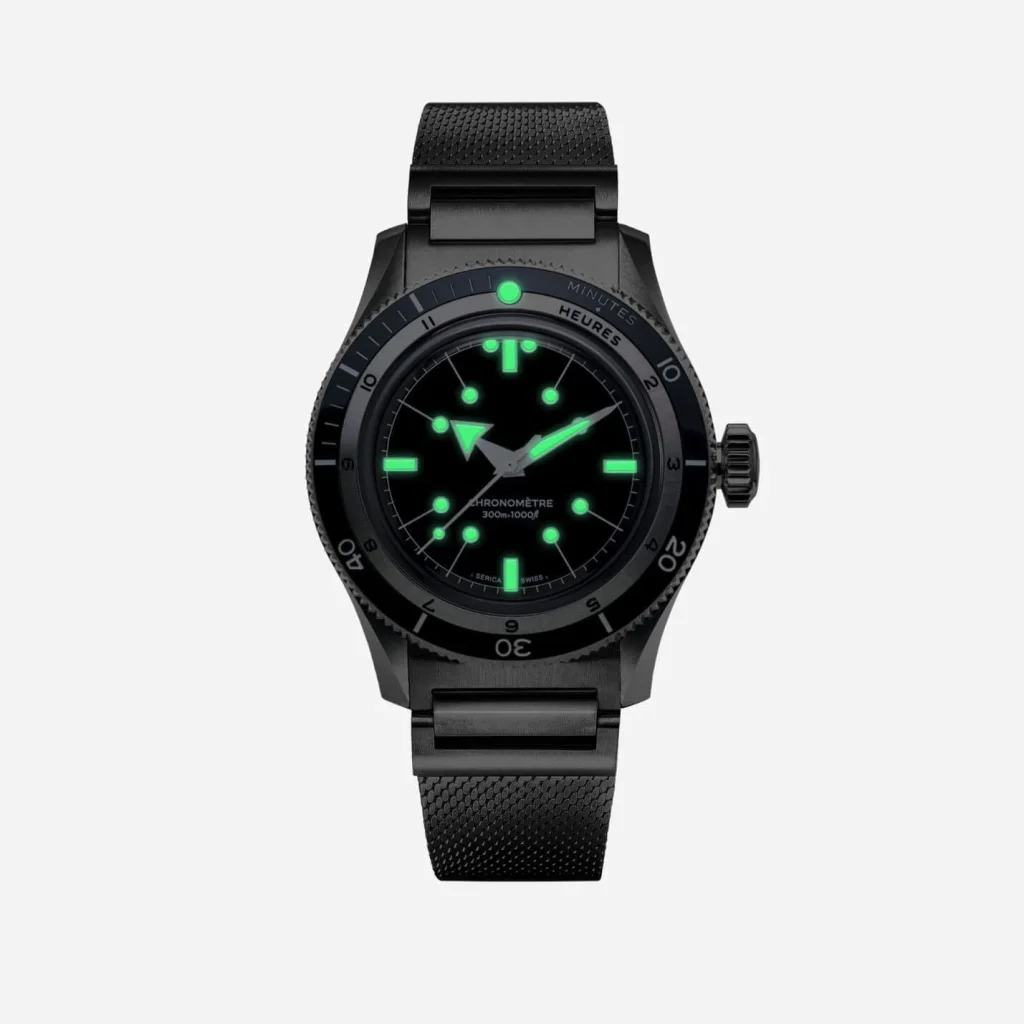
Serica Ref. 5330, with date. The same 39 x 12.2 x 46.5mm case, the same 300m, the same 50,000 A/m antimagnetic protection and the same COSC-certified Soprod M100, here in its date version with 25 jewels and the same 42 hours. Unidirectional 120-click bezel with a two-material insert: polished anthracite-grey ceramic outer ring with a count-up 60-minute scale, radially brushed steel inner ring with a 12-hour scale. Matte black dial with a date window at three, white disc and red numerals, lollipop markers, broad arrow hands and cream-toned Super-LumiNova. Flat-mesh Vesper steel bracelet in three lengths, plus a white and red elastic nylon strap.
Official price: 1,690 euros (tax included) or 1,990 dollars, according to the figure published by Monochrome. In the Mexico store, 35,897 pesos, with shipping and import taxes already included.
Comprarlo desde nuestra región
Serica has no distribution in the region and sells online from France, with two details that set it apart from most European microbrands shipping to Latin America. The first is that its website has a Spanish version. The second, and the more useful, is that the shop displays a final price for Mexico with shipping and import duties already included: MXN 33,773 for the 5303 and MXN 35,897 for the 5330. No calculating customs blind, no surprise invoice at the door, which is the most uncomfortable part of buying from an independent brand from here.
Converted to pesos, the hundred-euro difference comes to about 2,100. That figure buys a well-resolved date window, a ceramic bezel that looks costlier than it is, and a second strap. It gives up the enamel-like dial finish, the complete symmetry and the bezel's countdown scale. There is no winner because there is no single question: anyone after the more versatile everyday watch has the 5330; anyone buying for the still dial that made the brand's name has the 5303, and pays less for it.
What remains constant between the two is the arithmetic—and that is precisely why they are worth examining from this perspective. A COSC-certified chronometer with 300-meter water resistance and 50,000 A/m antimagnetic protection, all for under 1,700 euros. To put that in perspective: the Tudor Black Bay 58—the obvious benchmark for a diver’s watch with independent precision certification and 200-meter water resistance—retails for around 5,000 dollars. Serica has spent seven years defining its identity through a perfect balance on the dial. The 5330 demonstrates that experimentation can also be approached thoughtfully and deliberately, a process that helps cultivate one's own discerning taste.
Serica also appears this week in our article on FounderFest, the Time+Tide festival with seven exclusive watches, with its Ref. 7505 "Sunburst".