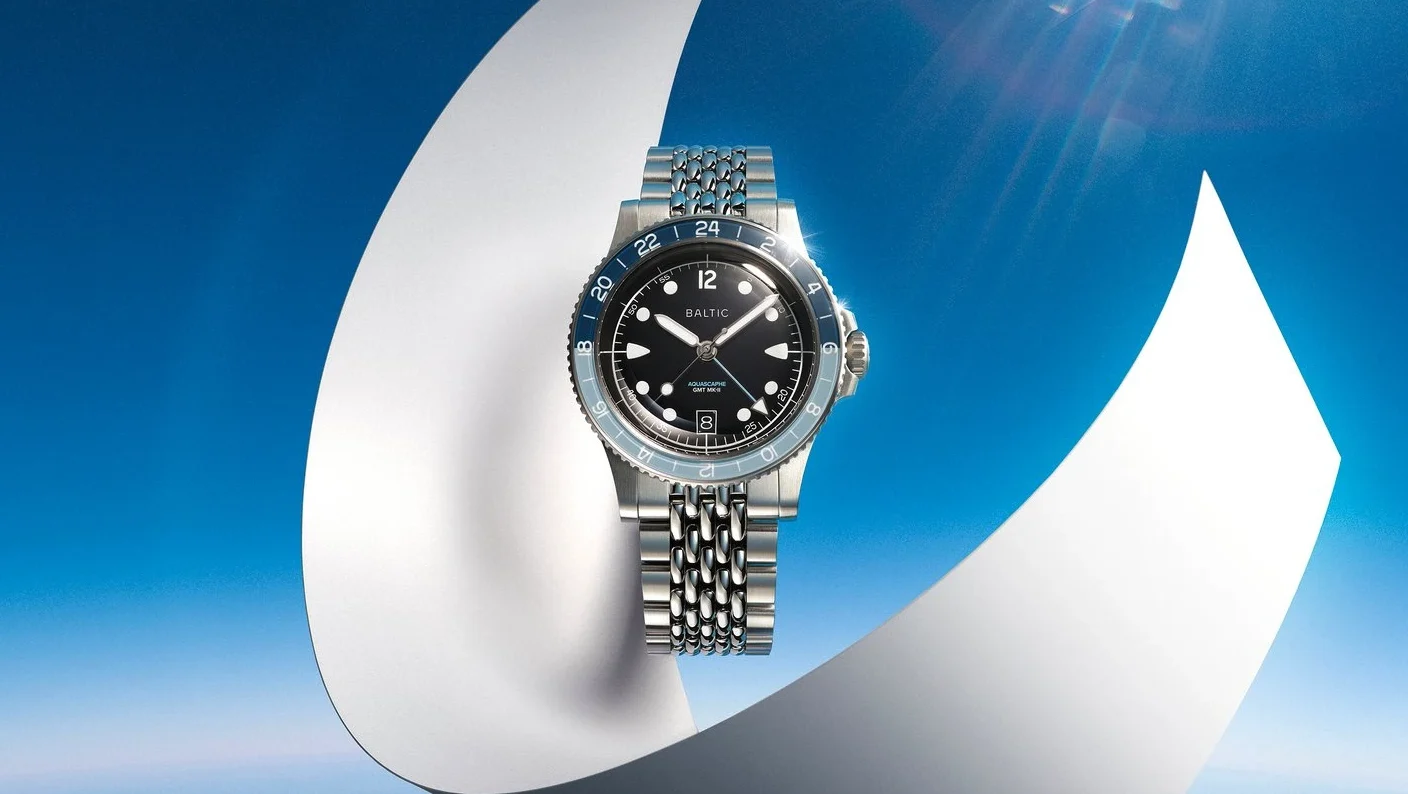

The second generation replaces the Swiss calibre with a Japanese Miyota that allows time-zone changes without stopping the watch, and doubles water resistance to 200 metres.
Baltic introduced the Aquascaphe GMT in 2020, and for six years it was one of the obvious answers whenever someone asked about an affordable GMT: a compact dive watch with sixties styling, a Swiss Soprod C125 inside, and a price no established brand was matching. Its page is still online, archived, with a note that it sold until July 2026.
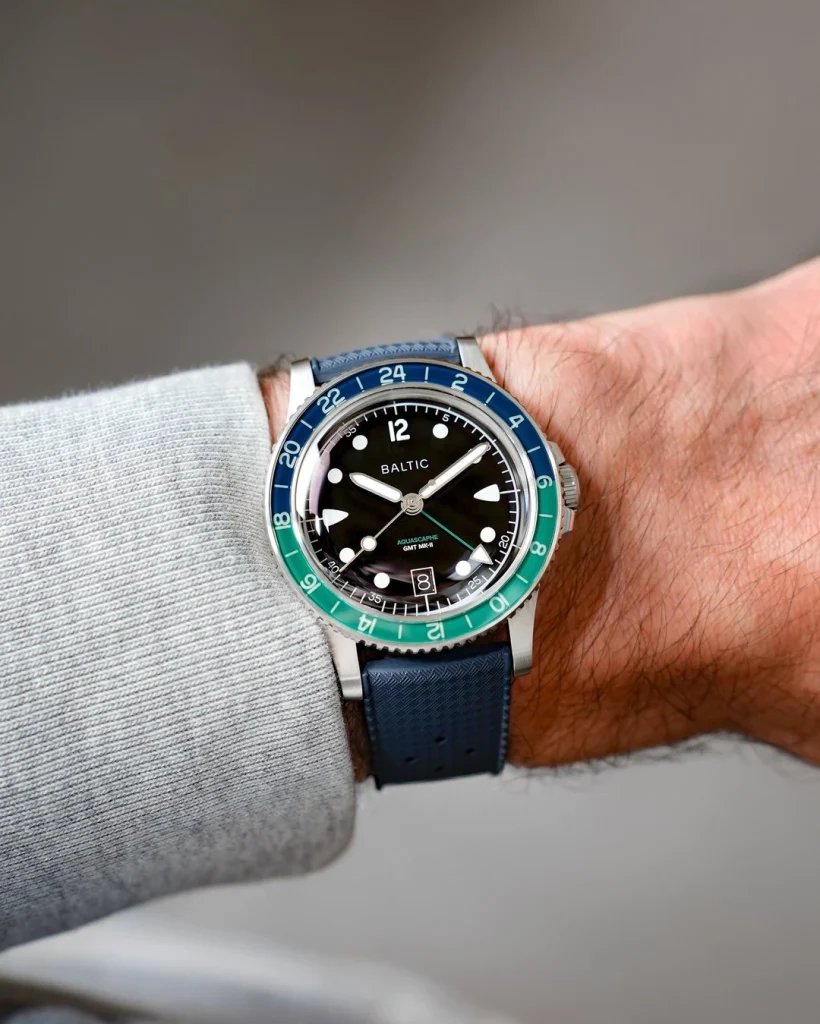
The replacement arrived in early September carrying the same name and the same silhouette, but a different calibre. The difference shows up on landing: the Aquascaphe GMT MK-II lets you walk the hour hand to the new time zone while the rest of the watch keeps running, where the previous generation required stopping it and setting the time again.
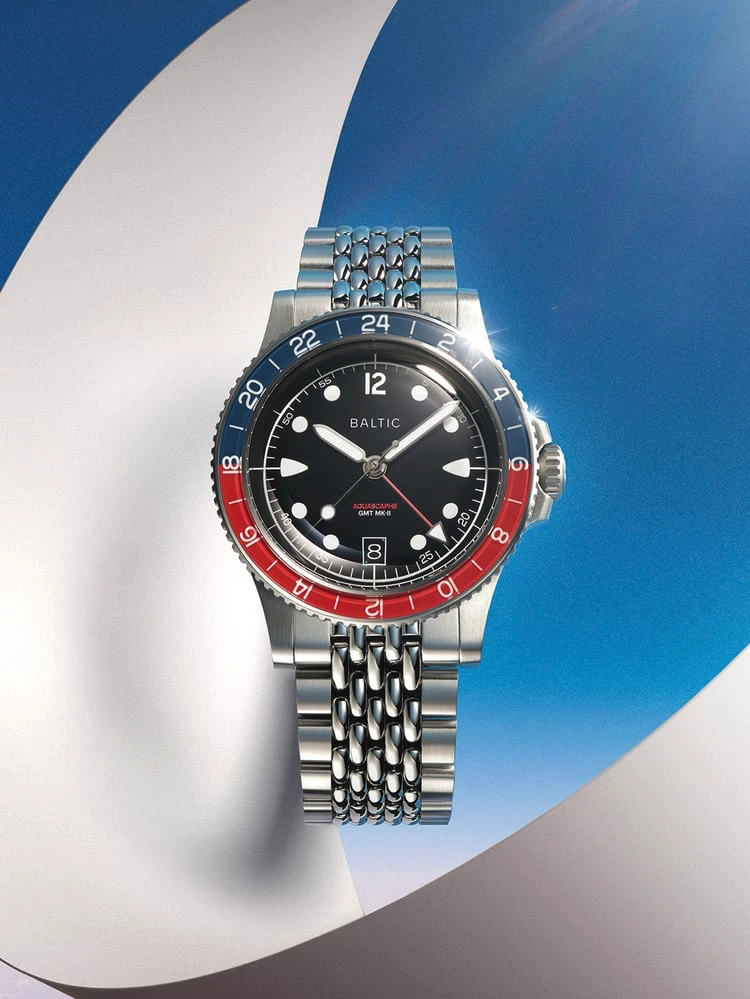
Technical Specs
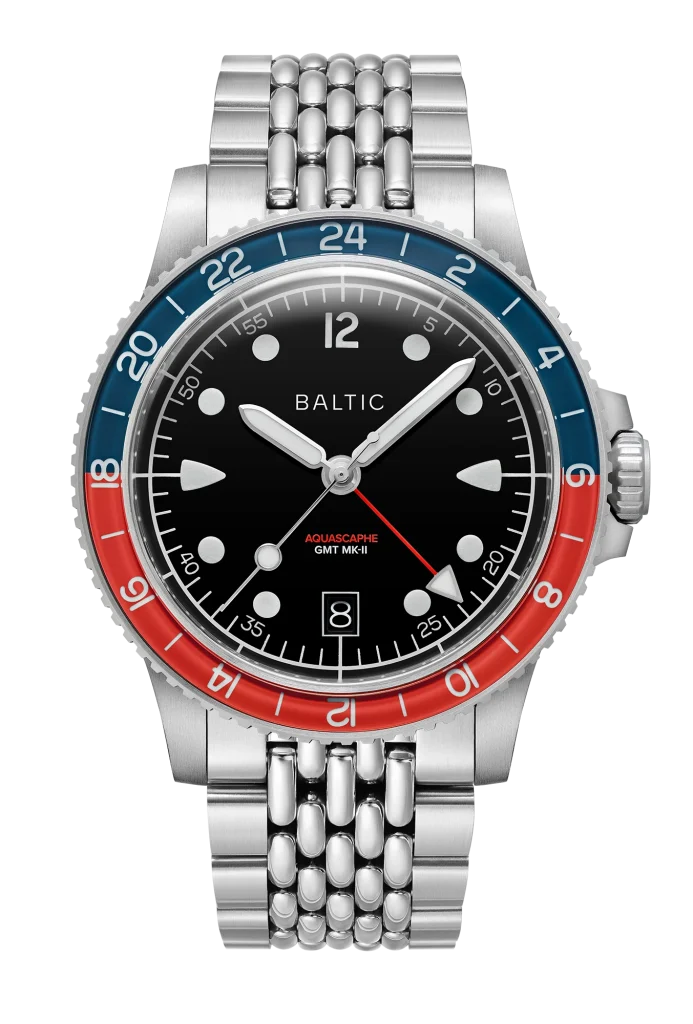
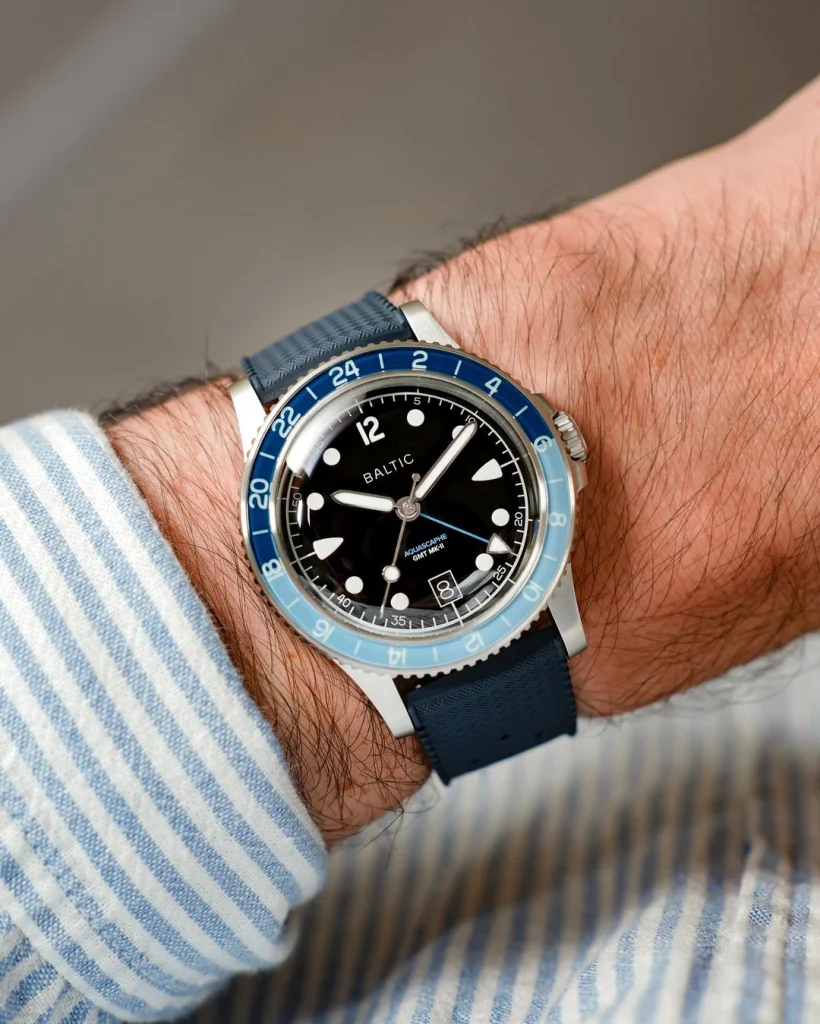
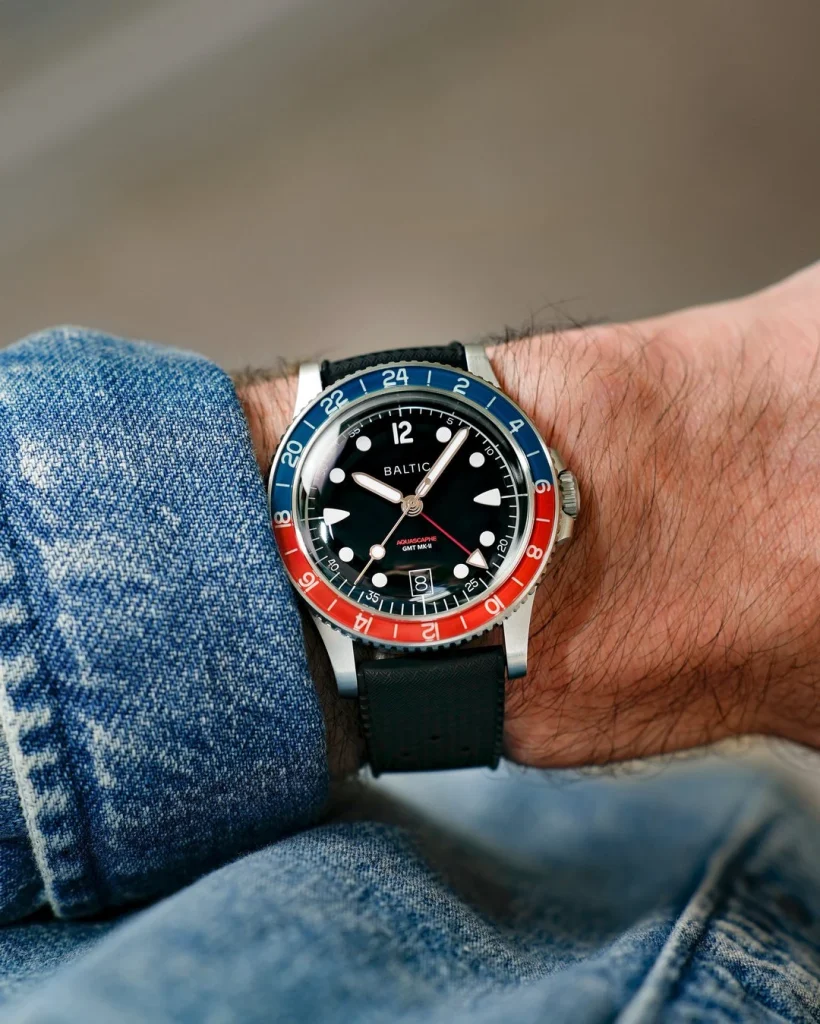
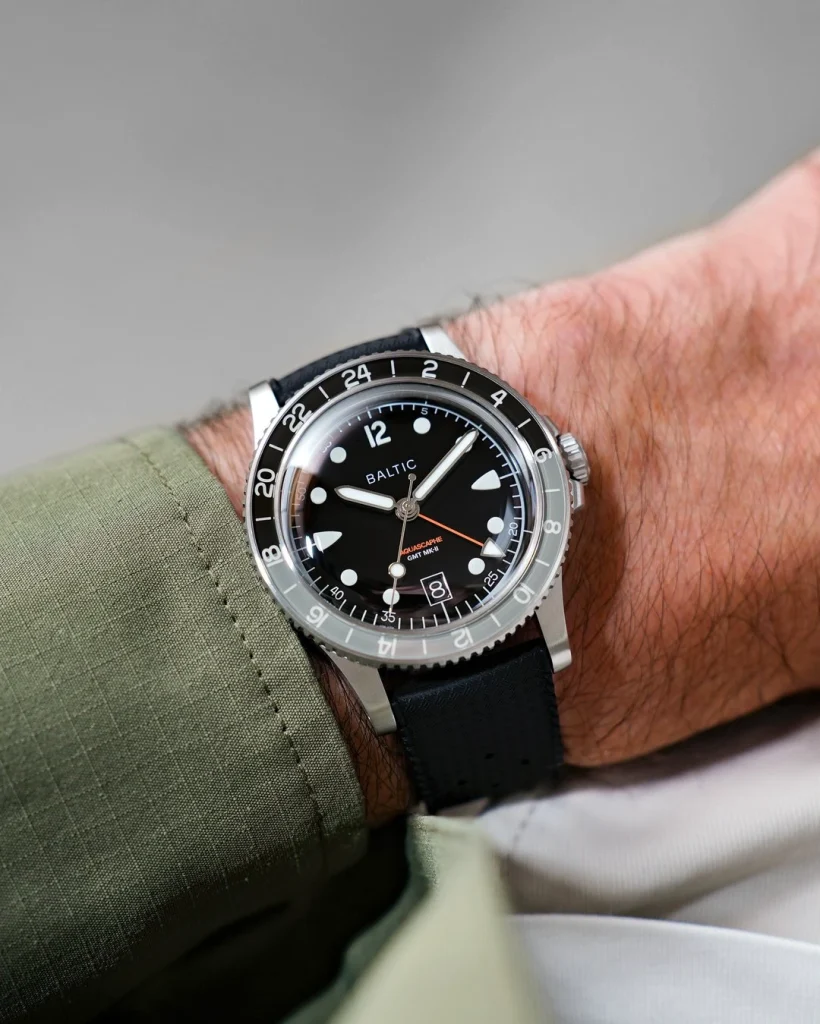
| Model | Aquascaphe GMT MK-II, in four versions: Blue, Red, Grey and Green |
| Case | 316L stainless steel, 39.5mm diameter |
| Thickness | 13.8mm (12mm without the crystal) |
| Lug-to-lug | 47 mm |
| Lug width | 20 mm |
| Bezel | Bidirectional, 48 clicks, 24-hour scale, sapphire insert |
| Crystal | Double-domed sapphire with internal anti-reflective coating |
| Dial | Glossy black, Super-LumiNova BGW9 indexes |
| Hands | Faceted and lumed, with central GMT hand |
| Date | Window at 6 o'clock, colour-matched date disc |
| Crown | Screw-down, with crown guard |
| Caliber | Miyota 9075, automatic, true traveller GMT |
| Frequency | 28,800 vph (4Hz) |
| Jewels | 24 |
| Power reserve | 42 hours |
| Stated accuracy | -10 to +30 seconds per day, per Miyota |
| Water resistance | 200 m (20 ATM) |
| Strap and bracelet | Vulcanised FKM rubber, or steel beads-of-rice or flat-link bracelet, with quick-release spring bars |
| Price | EUR 850 on rubber; EUR 915 on bracelet |
| Availability | Permanent collection; first deliveries mid-September 2026 |
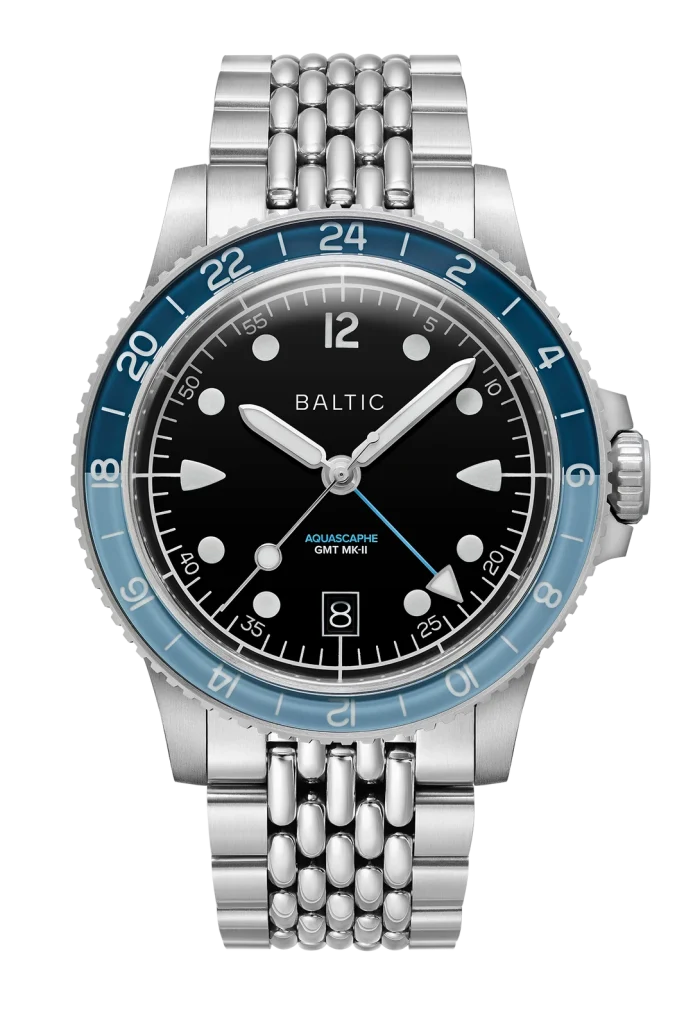
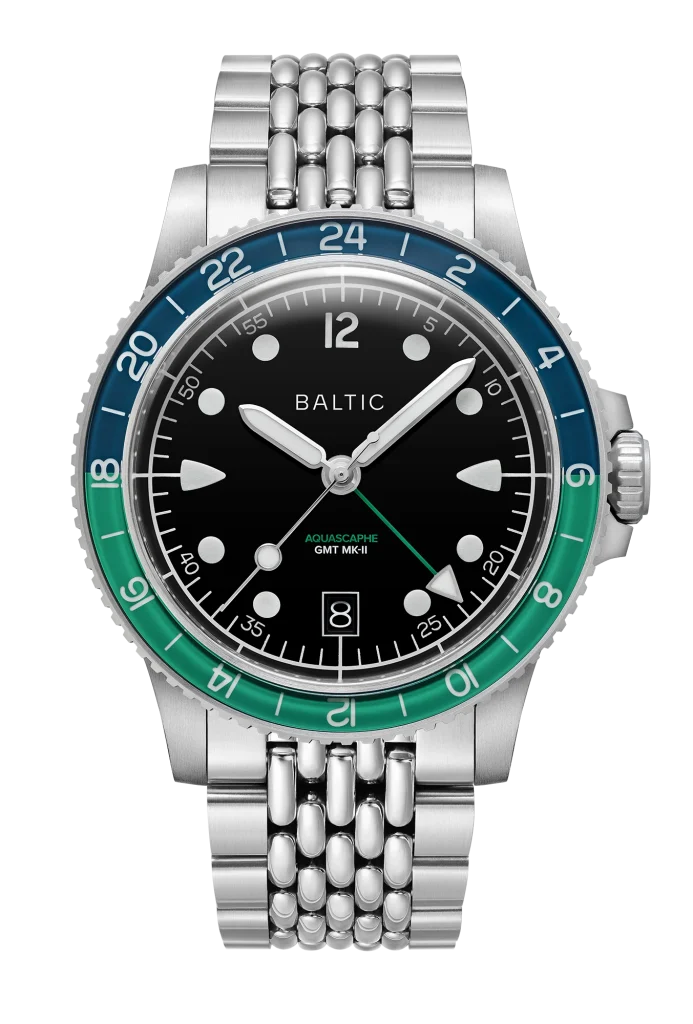
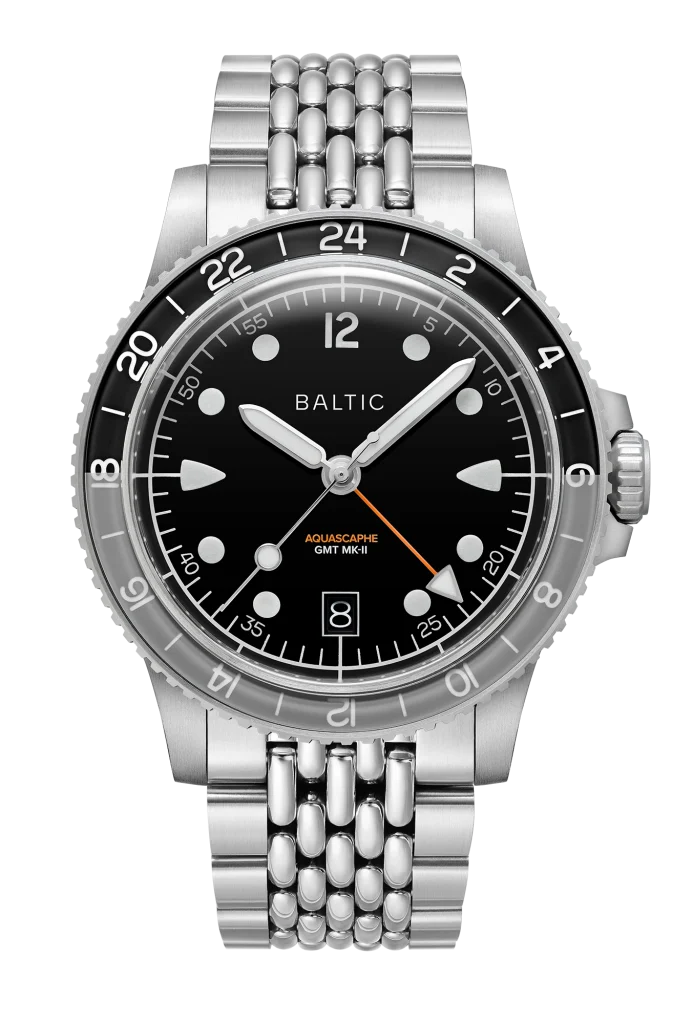
A New, More Airtight and Slightly Larger Box
The case grew from 39mm to 39.5mm across and from 13mm to 13.8mm thick. Lug-to-lug held at 47mm, the measurement that decides whether a watch sits properly on the wrist, so the piece covers the same footprint as before and what increased was the height. The growth has an explanation: water resistance doubled from 100m to 200m, the crown gained a guard and the lugs are wider.
Even so, 13.8mm is a lot on a 39.5mm dive watch, and it registers in daily wear. Baltic measures 12mm without the crystal dome, a figure of limited practical help, since the crystal is precisely what catches a shirt cuff. The bezel doubled its clicks, from 24 to 48, so the 24-hour scale lines up twice as finely. The lume moved from Super-LumiNova C1 to blue-emitting BGW9, and the hands were redrawn with facets over the same glossy black dial as ever.
The Miyota 9075 calibre
The first generation's Soprod C125 was an office, or callerGMT: the 24-hour hand adjusted separately, while the local hour hand always moved together with the minutes. It worked for keeping an eye on a Madrid office from Mexico City without touching the main time, which is where the name comes from. The awkwardness arrived when travelling. Going from nine in Madrid to one in Mexico City meant pulling the crown all the way out, which stopped the seconds, moving hours and minutes together, and then resynchronising the seconds against some reference once the crown went back in.
The Miyota 9075 swaps the roles of those two hands. The crown has an intermediate position from which the hour hand jumps in single steps, forwards or back, while the minute and seconds hands keep running and the 24-hour hand holds home time. Changing time zones stops being a full reset and becomes a three-second adjustment, made standing in the passport queue.
The change of calibre carries a drawback as well, and it appears in stated accuracy. Miyota specifies a margin of -10 to +30 seconds per day for the 9075, a wide range, and it is the only area where the second generation does not improve on the first. In exchange, Baltic gained the complication the watch had needed for six years. On a piece bought to cross time zones, thirty seconds of daily deviation is less of a nuisance than stopping the watch at every airport. The same mechanical solution lies behind the Traska Venturer GMT, another microbrand offering this complication for under a thousand dollars.
Availability in our region
Baltic sells directly from France and ships almost worldwide by DHL, with three-to-five-day delivery and free shipping above EUR 80. The brand's retailer page lists 23 cities, none in Spain or Latin America, which leaves buying online as the only realistic route for readers across the region.
List price is EUR 850 on the rubber strap and EUR 915 on a steel bracelet. According to figures published by Monochrome, the previous generation started at EUR 920, which places the new one below the watch it replaces, an uncommon move in an industry that usually raises prices with every update.
In Spain, the calculation is straightforward because, as the sale takes place within the European Union, the brand includes taxes in the purchase price. Outside the European Union, taxes and duties are not included; DHL collects them prior to delivery, and the brand itself acknowledges that it cannot predict the exact amount. In Mexico, this surcharge typically hovers around 36 percent—combining VAT and customs duties—an approximate figure that is best confirmed with the customs broker before making a purchase.
The two-year warranty is covered by Baltic's workshop in France, and since the region has no service point, any repair means shipping the watch to Europe and paying the freight. On an EUR 850 watch, that eventual expense weighs as much as the duty.
The verdict from ORELO
The Aquascaphe GMT MK-II corrects the only serious objection the first generation carried, and arrives with double the water resistance, better lume and a more precise bezel besides. At EUR 850 there are few cheaper ways to own a traveller GMT with a sapphire bezel and crystal and 200m of water resistance, and for anyone crossing time zones several times a year that matters more than the Swiss origin of the movement. Anyone who travels rarely and wants the best possible accuracy for the money will find stronger candidates among Swiss automatics in the same bracket.
A GMT watch is often associated with an executive crossing the Atlantic, but in the Spanish-speaking world, the second hand rarely shows local time in a boardroom. Instead, it points to the time back home, in Guadalajara, Cali, or Buenos Aires, and the right moment to call there.