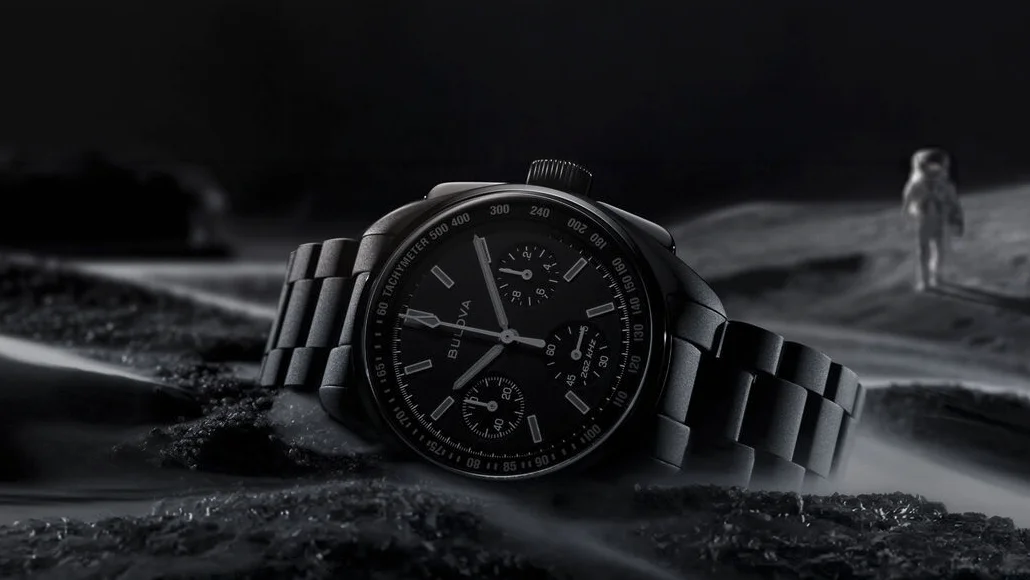

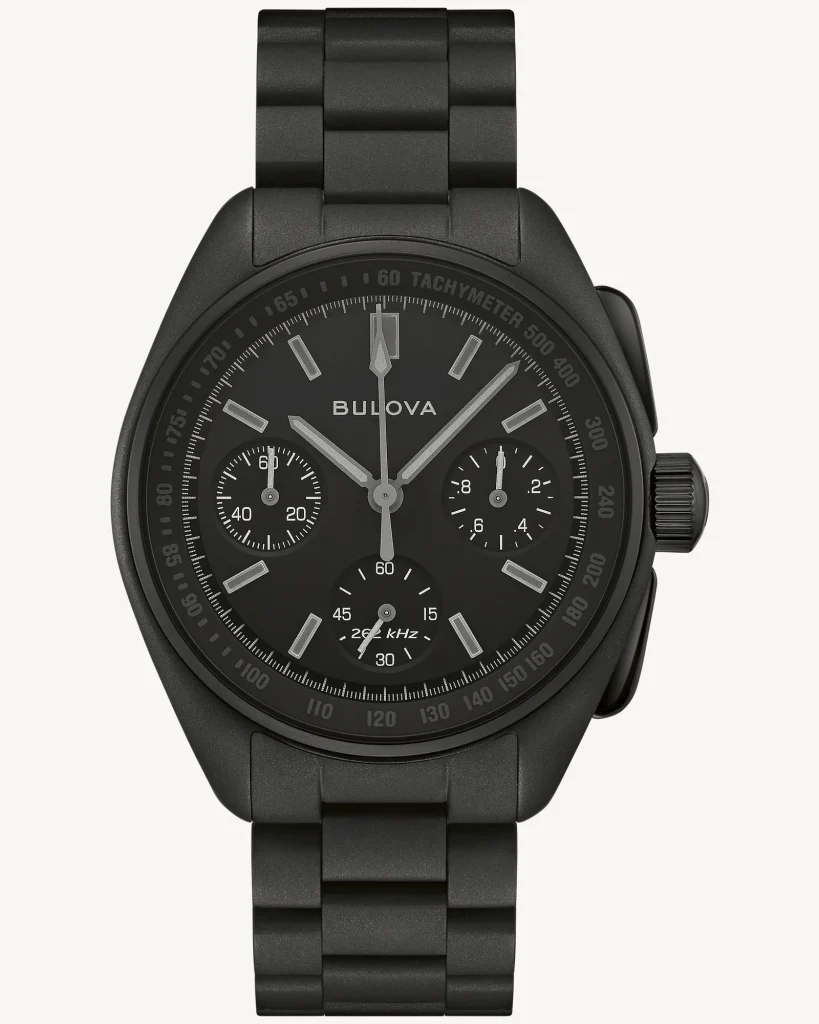
The Black Hole edition brings the descendant of the chronograph that reached the lunar surface on Apollo 15 into the most restrained case of its modern history, with a Musou-painted dial and Bulova's high-frequency quartz calibre.
When David Scott returned to the lunar module after Apollo 15's second moonwalk, he found that the hesalite crystal of his Omega Speedmaster Professional had come away. For the third excursion, on 2 August 1971, he strapped on the watch he had packed in his personal kit: a Bulova chronograph the brand had given him privately to test, and one that appeared nowhere in NASA's certified equipment.
The prototype nobody authorized
That watch stayed with Scott through the entire third moonwalk, the two days in lunar orbit that followed, the journey home, re-entry and splashdown. For decades the backup was assumed to have been a Waltham, and only in 2014 did Scott himself confirm it as a Bulova chronograph, model 88510/01. The following October it sold at RR Auction for 1.625 million dollars, and it remains the only watch worn on the lunar surface still in private hands.
Bulova's relationship with the space programme went back further and ran through more official channels: from 1960 NASA built the Accutron's tuning-fork technology into its spacecraft instrumentation, which placed the brand on the panels of crewed missions long before it reached a wrist on the Moon. Aboard Apollo 15, by contrast, the Bulova travelled by the commander's decision rather than the agency's.
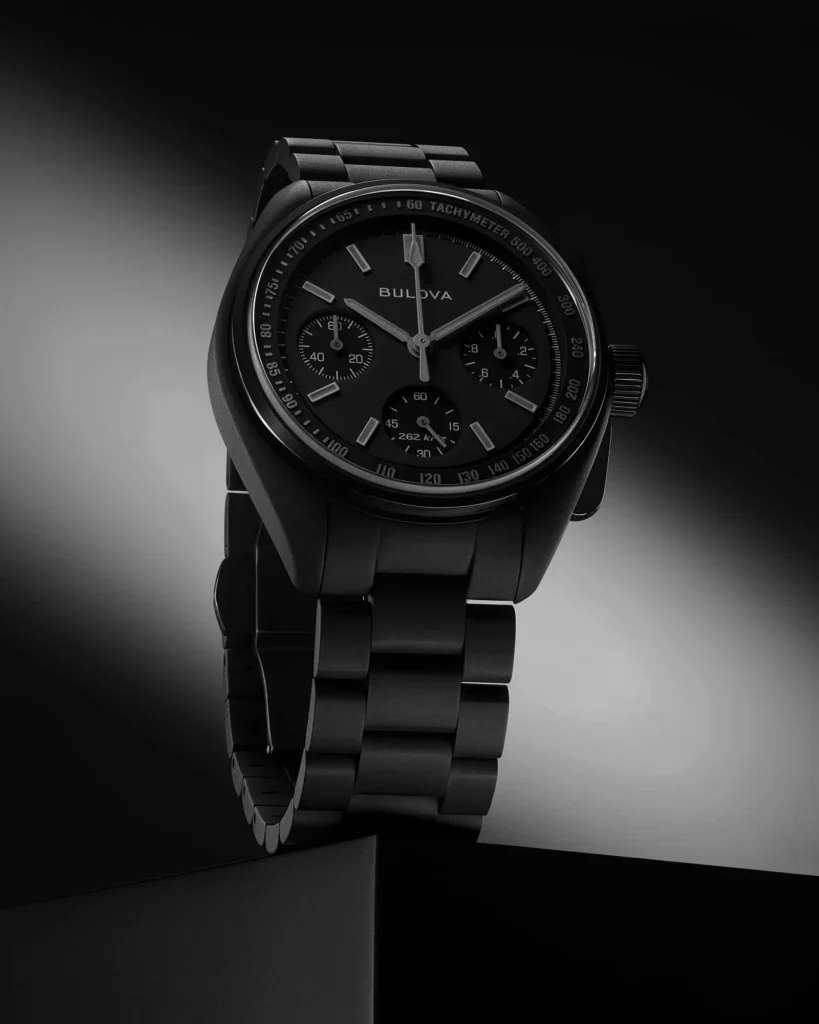
New dimensions: 41mm after a decade
The modern Lunar Pilot revival arrived ten years ago in a 45mm case, a size that answered the taste of its moment rather than the 1971 original, and that left out a good share of the enthusiasts drawn to the history but not to those proportions. Bulova partly corrected course with a 43.5mm version, closer to the original and free of the date window that had been added, though still a large watch. This edition comes down to 41.2mm, two and a half millimetres below the current collection, and marks the first time the model has been offered at this size.
If the 41mm case sells well, it is hard to imagine Bulova reserving it indefinitely for a limited edition with a black dial. The brand has announced no other reference in this size, so for now the prospect remains just that, but the case already exists and the request for smaller proportions has been repeated for ten years by those who follow the collection.

Technical Specs
| Reference | 98A335, Archive Series |
| Case | Black ion-plated stainless steel, matte finish, polished bezel, 41.2 mm |
| Lug width | 20 mm |
| Crystal | Flat sapphire |
| Water resistance | 100 m |
| Dial | Black Musou paint, gunmetal tachymeter scale, applied markers and grey hands with Super-LumiNova |
| Sub-dials | 1/20-second chronograph counter at 3, running seconds at 6, 60-minute counter at 9 |
| Caliber | Bulova NP20 high-precision quartz, 262 kHz, six hands |
| Bracelet | Three-link steel with matching black ion plating, push-button deployant clasp |
| Weight | 165 g |
| Production | 6,000 pieces worldwide, of which 600 numbered for Mexico |
| Price | 1,650 USD |
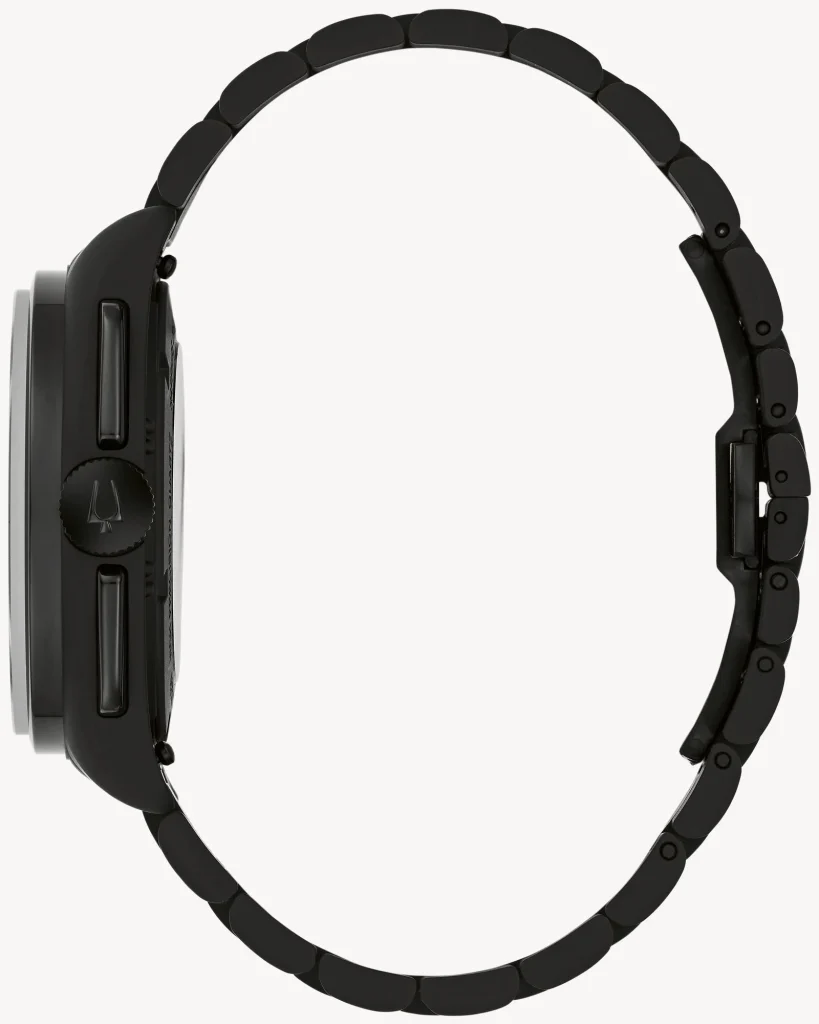
Musou paint and contrast in grey
The Musou paint on the dial absorbs, according to Bulova, 99.4 per cent of the light that reaches it. In practice this means that under almost any lighting the dial returns no reflection and reveals no relief, leaving a flat void from which the markers protrude. Those applied markers, together with the hands and the tachymeter scale, share a muted metallic tone that would look washed out over conventional black and reads effortlessly over this one.
The finish carries two costs that show up in daily wear. A dial of absolute black betrays every particle of dust in direct light, and grey Super-LumiNova glows less brightly than white or green when there is no other light source. To that can be added an inconsistency from the brand itself: the American site credits the paint with 99.4 per cent absorption while the Mexican site, for the same reference, says 98. Until Bulova clarifies which applies to the 98A335, both figures warrant caution.
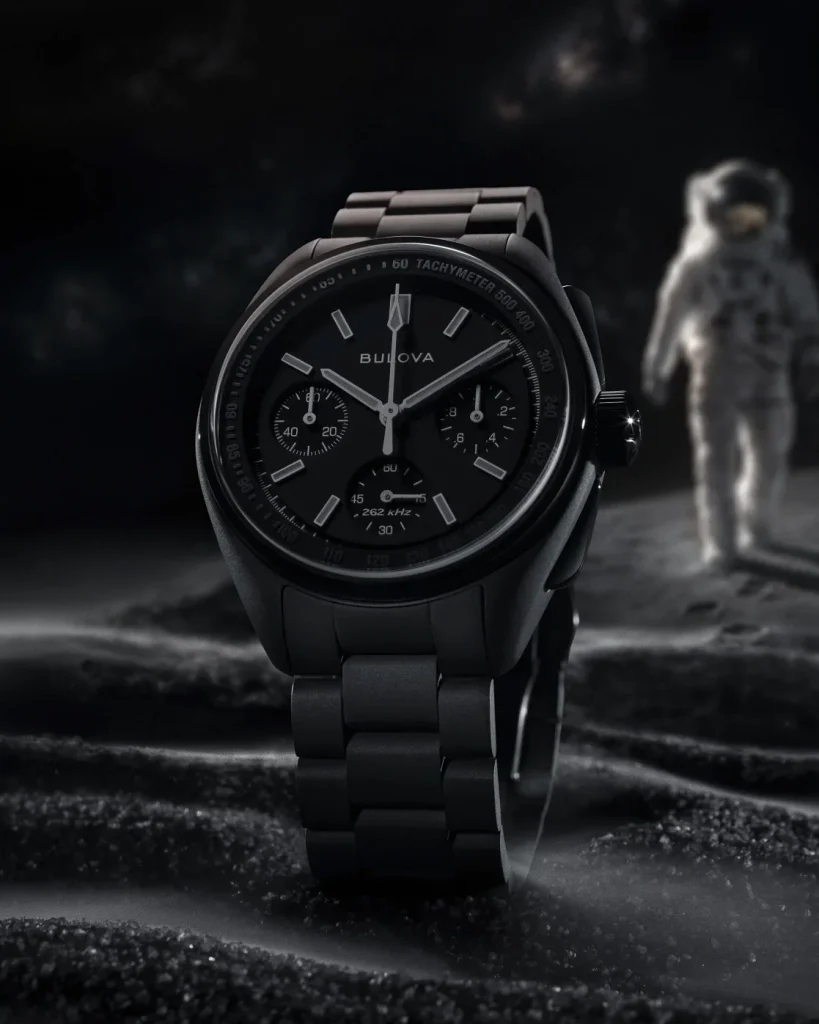
The NP20 calibre and the tuning-fork inheritance
The NP20 is a quartz movement, and for a good share of enthusiasts that fact alone ends the conversation. The mechanism, however, bears little resemblance to ordinary quartz: where a conventional oscillator vibrates at 32,768 hertz, the NP20 crystal runs at 262,144, eight times faster, by way of a three-pronged geometry in place of the usual two.
An oscillator vibrating faster divides the second into more fractions, so each individual deviation weighs proportionally less on overall timekeeping; a higher-frequency crystal is also less affected by temperature shifts and shocks, the two usual causes of an inexpensive quartz movement losing time. The effect shows in two details: the chronograph hand sweeps rather than ticks, a behaviour normally associated with mechanical movements, and timing runs to a twentieth of a second, with the sub-dial at 3 snapping into position when the count stops. Bulova publishes no official tolerance for this calibre; specialist press places it in the region of one minute a year, a figure the brand has not confirmed.
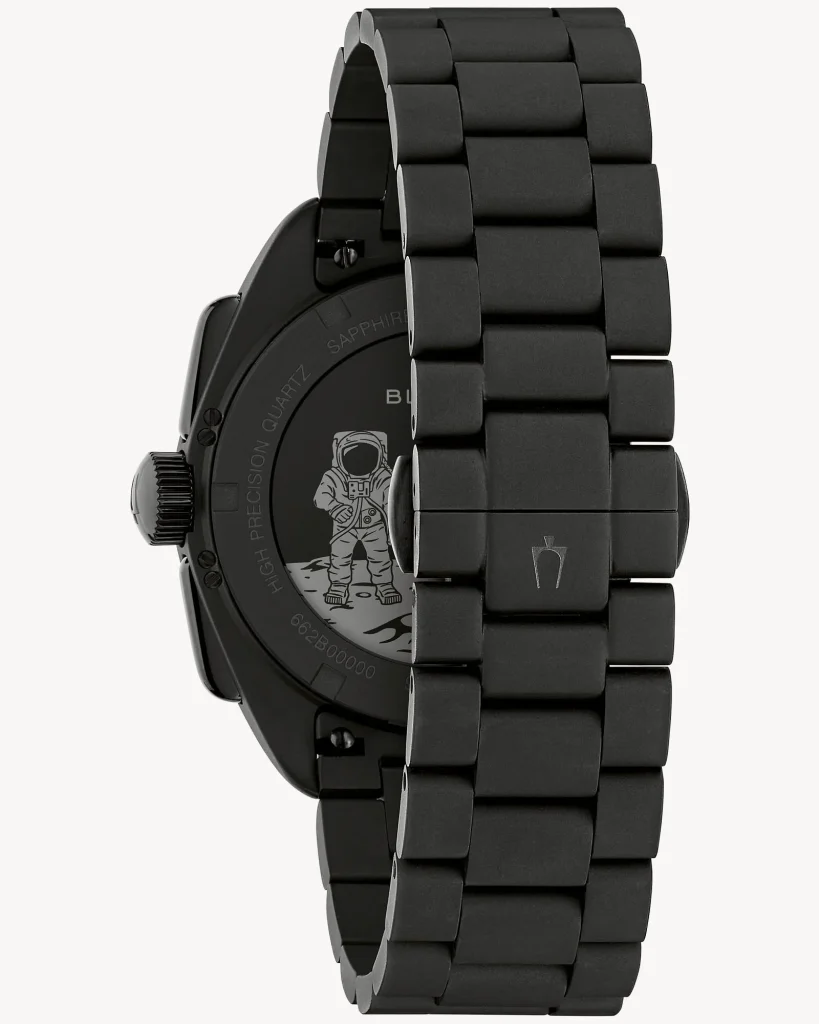
The approach is not new to the company. The Accutron tuning fork of 1960 vibrated at 360 hertz, roughly a hundred and fifty times faster than a mechanical balance wheel, and that idea of gaining accuracy by raising frequency is the same one underpinning the NP20 sixty-six years later. Bulova's logo remains a tuning fork, engraved here on the bracelet clasp.
Availability in our region
In Mexico the watch is sold directly through bulova.com/mx, with 600 numbered units allocated to the country, a price of 32,500 pesos including tax and free shipping. Once the tax is removed that figure matches the American list price, so importing from the United States produces no saving and leaves the buyer without warranty service in the country. For Colombia, Argentina and Spain the picture is less clear: it is not confirmed that the 600-piece allocation extends beyond Mexico, the Mexican store does not ship abroad, and the realistic route runs through the American site with each country's duties and taxes added to the 1,650-dollar list price.
The verdict from ORELO
The Lunar Pilot Black Hole is built for the collector who places documented provenance above the type of mechanism inside, and who has spent a decade waiting for this case. The Apollo 15 history is one no other brand can claim, the 41.2mm case corrects the proportions the collection had carried since its revival, and the NP20 delivers the accuracy quartz ought to deliver. At 1,650 dollars there are mechanical chronographs with movement finishing this one does not offer, and anyone who wants that should look at them first. For everyone else, this is the most complete version the Lunar Pilot has had since it returned to the catalogue.