
Of the seven new versions of the 38 mm Speedmaster, one restores the black no-date dial of the automatic chronograph Omega sold from 1988 to 2010, the Reduced.
The Speedmaster that reached the Moon is a hand-wound chronograph in a forty-two millimetre case, a combination that rules out a good share of the buyers who want the dial without the size or the morning winding routine. Omega addressed that audience in 1988 with the 39 mm Speedmaster Automatic, a watch the brand never officially named and that collectors ended up calling the Reduced. It stayed twenty-two years in the catalogue, was discontinued in 2010 and returns now among the seven references Omega presented on 25 August 2026.
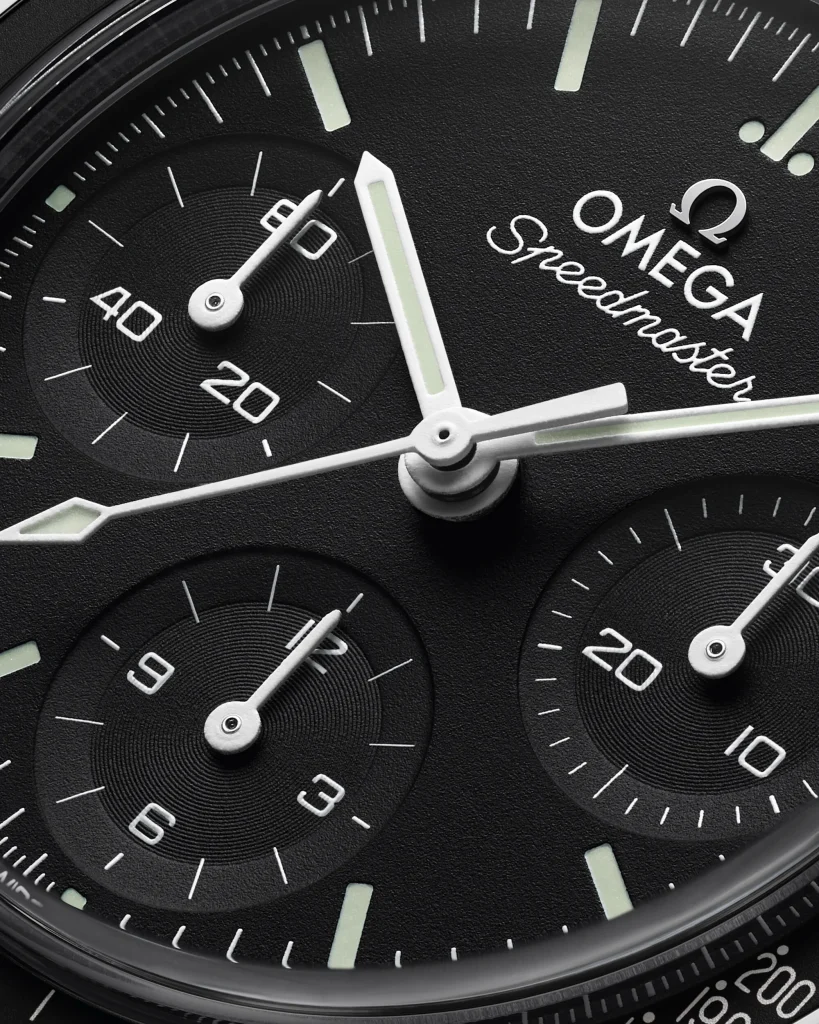
Twenty-two years in the catalogue
The first reference, ST 175.0032, arrived in 1988 with a 39 mm steel case and twisted lugs, the Professional's geometry at a smaller scale. Inside sat calibre 1140, not an in-house movement but an assembly: an automatic ETA 2890-2 base with a Dubois-Dépraz 2020 chronograph module mounted on the dial side. That construction has a consequence visible from the outside, because with the chronograph mechanism sitting above the mainplate, the Reduced's pushers occupy a different plane from the crown, stepped rather than aligned as they are on an integrated chronograph.
The movement was updated three times without changing concept. Calibre 1141 arrived in 1996, the same assembly rhodium-plated rather than gilt; calibre 1143 replaced the base with the ETA 2892-A2 in 1997; and calibre 3220 closed the series in 2000 with changes reference guides describe as largely cosmetic. Power reserve stayed around forty hours throughout production, as did the modular architecture.
The Reduced also absorbed the experiments the Professional never allowed: blue, yellow, red and chequered dials, and the references tied to Michael Schumacher during the years the driver served as brand ambassador, among them the 3810.61.41, with a red dial and yellow chronograph hands, and the 3517.30, with the word "Racing" printed over the six o'clock subdial.
The 2010 detour
The formula disappeared that year, when the smaller collection dropped to thirty-eight millimetres, gained a date and moved to a calibre derived from the Valjoux 7753, positioned towards a female audience. The 2017 update deepened the turn with oval subdials, a two-piece bezel frequently set with diamonds and calibre 3330, a column-wheel chronograph with a co-axial escapement and chronometer certification that outperformed any version of the Reduced, though by then the dial no longer resembled the Moonwatch.
Seven new references
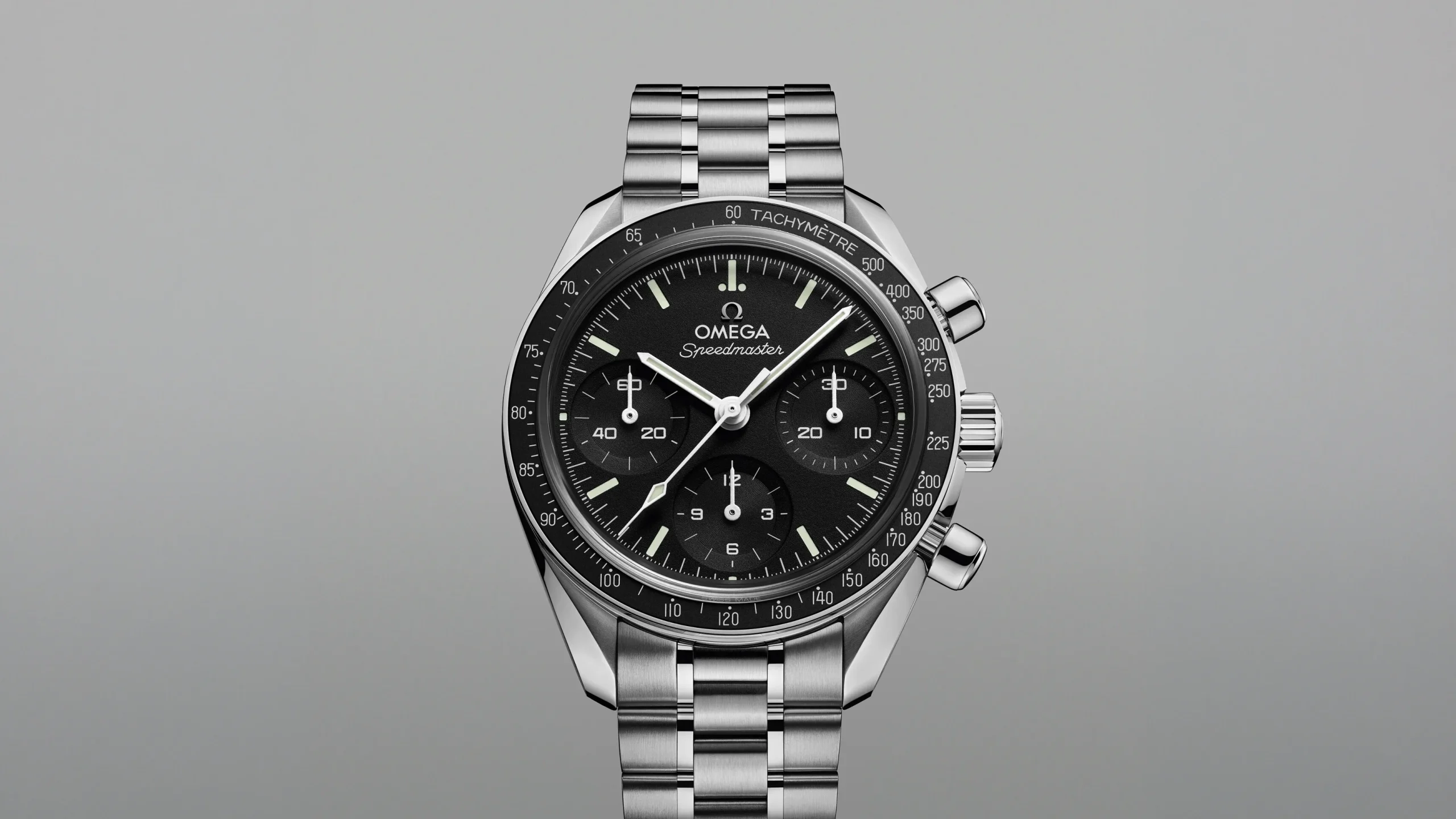
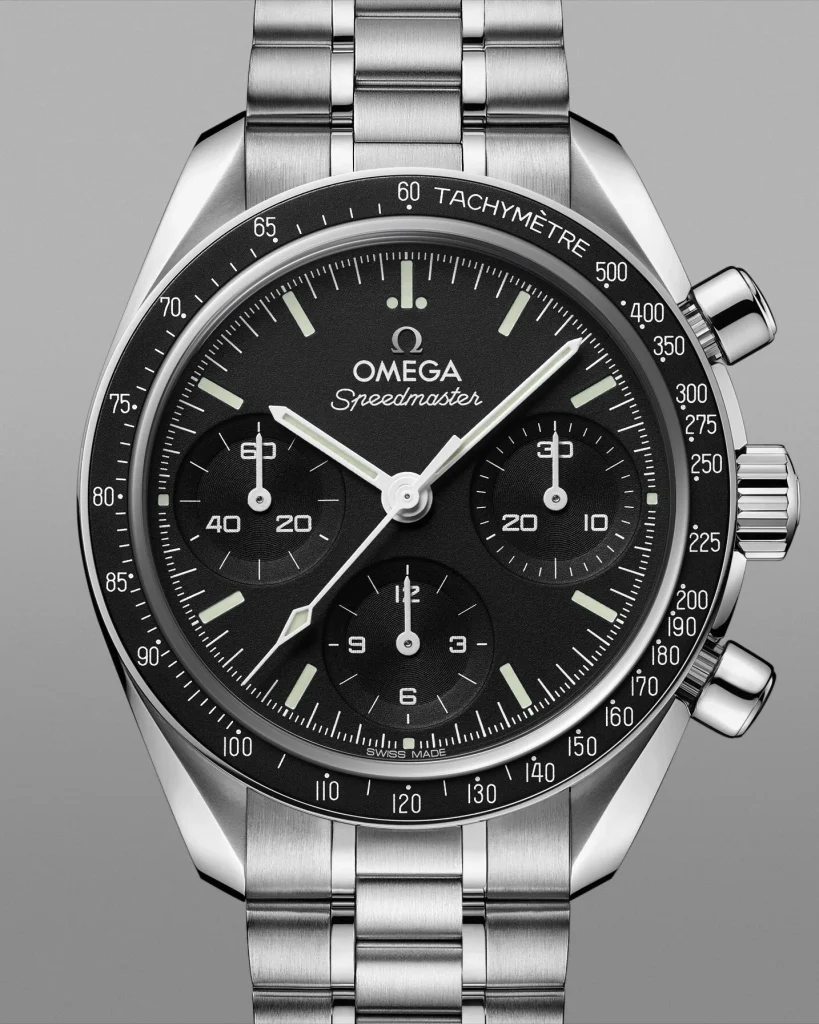
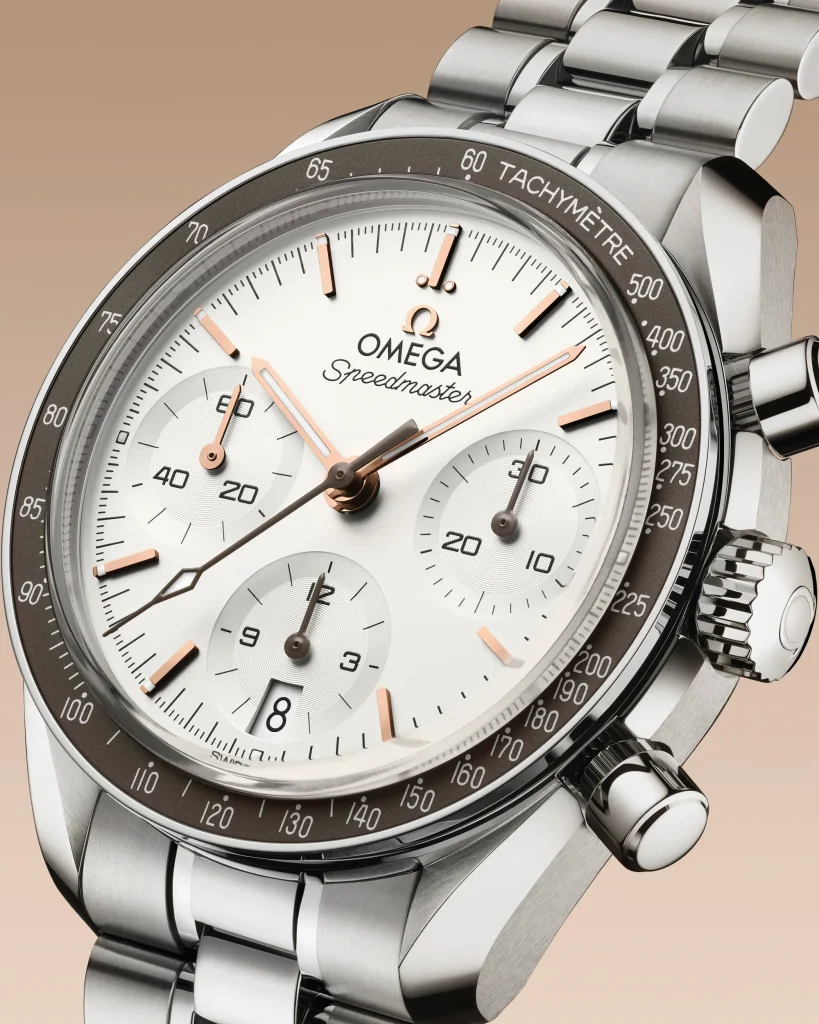
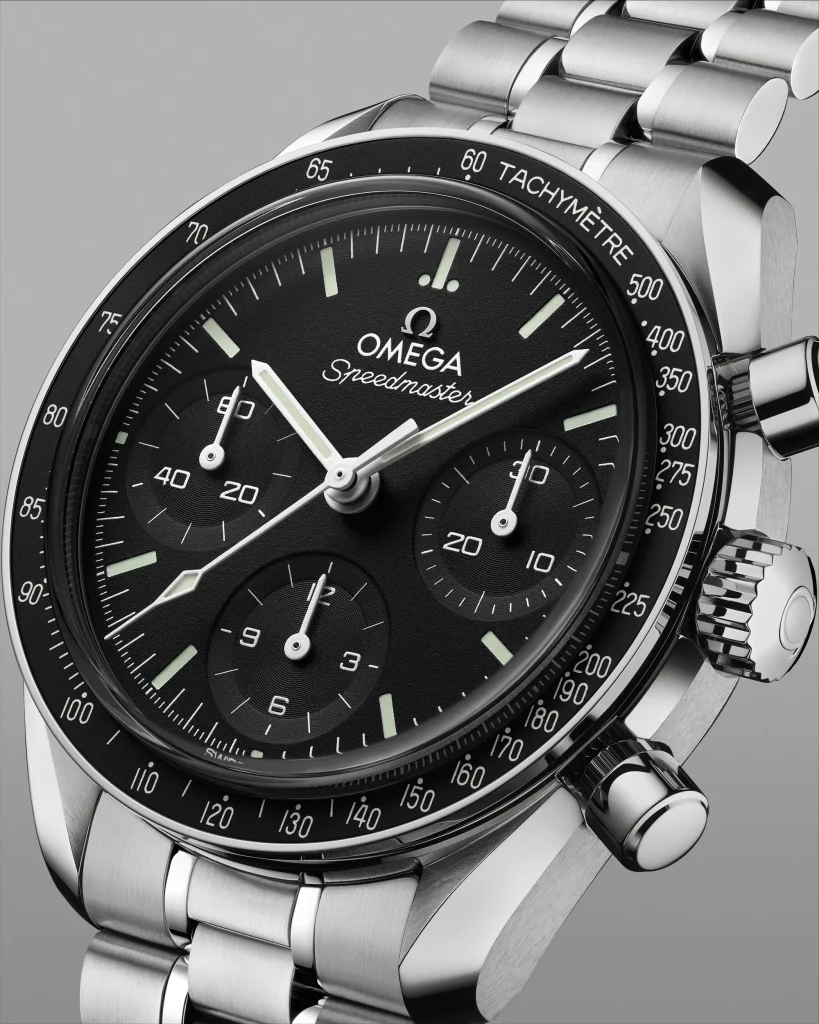
The collection announced in August settles at seven pieces sharing case, crystal, water resistance and bracelet, arranged in three groups. The three steel models are the ones that matter to anyone after a daily chronograph: ref. 324.30.38.50.01.002, matte black dial and no date; ref. 324.30.38.50.02.003, warm grey bezel and opaline silvery dial with Sedna gold hands; and ref. 324.30.38.50.04.001, blue ceramic bezel, tachymeter scale in white enamel and a lacquered white dial. European prices are EUR 6,400, 6,600 and 7,000 including tax.
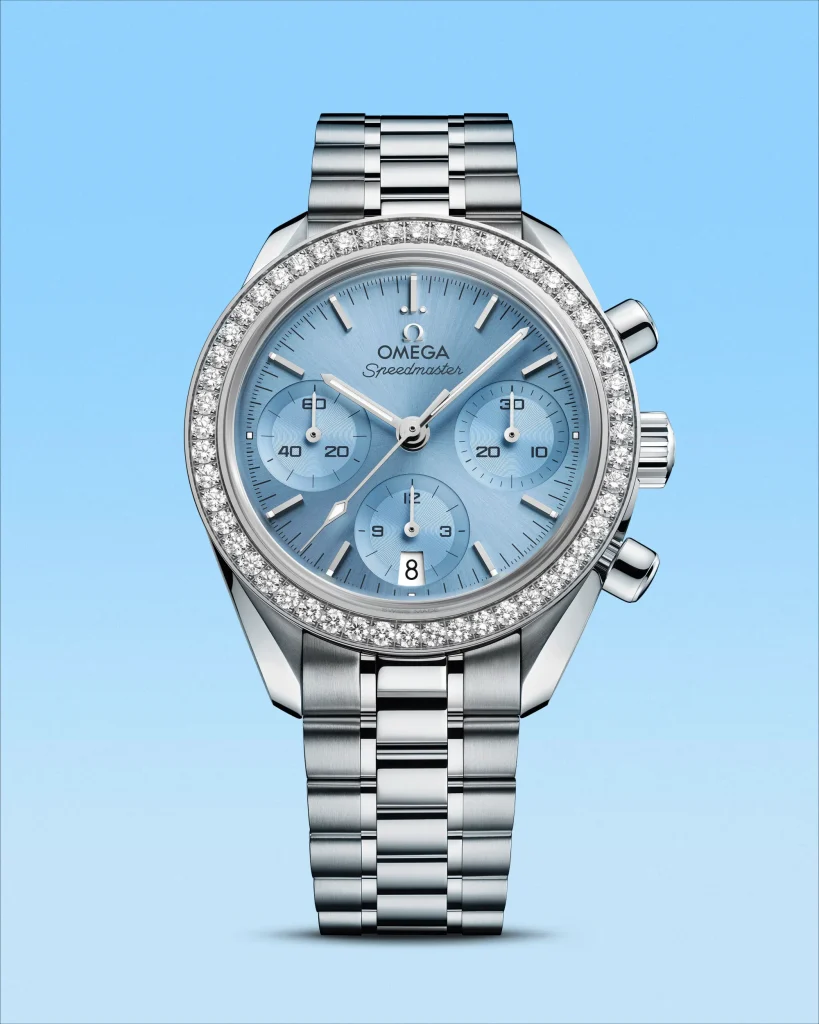
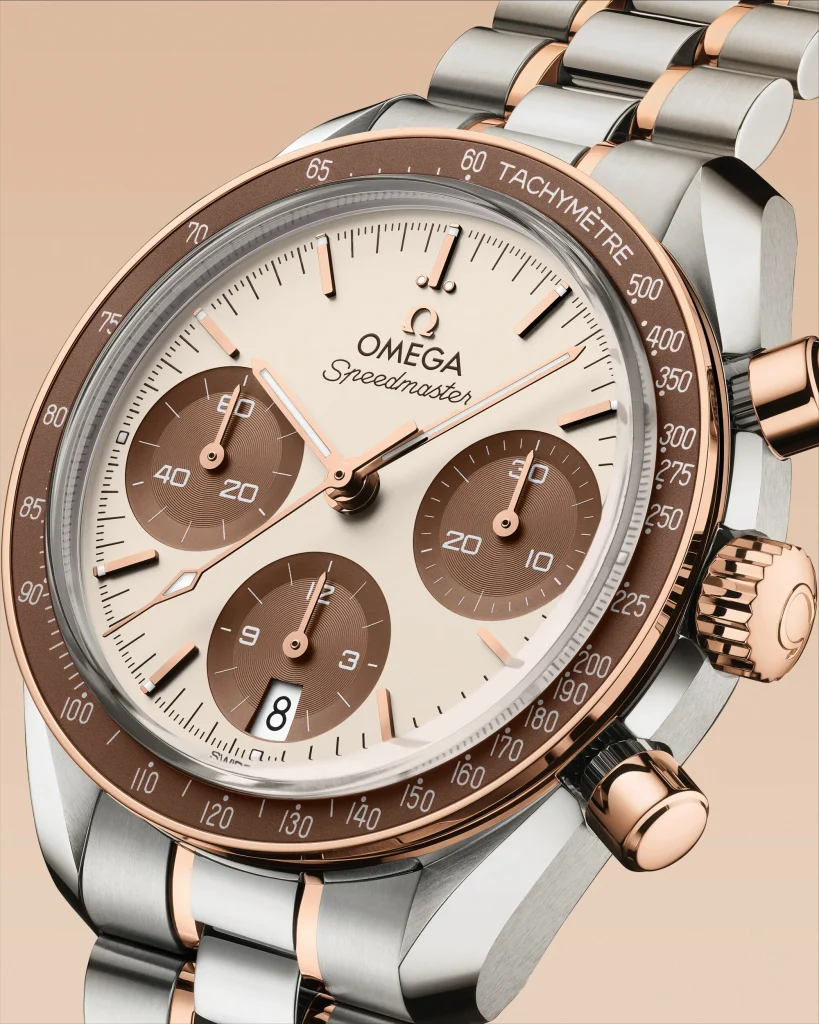
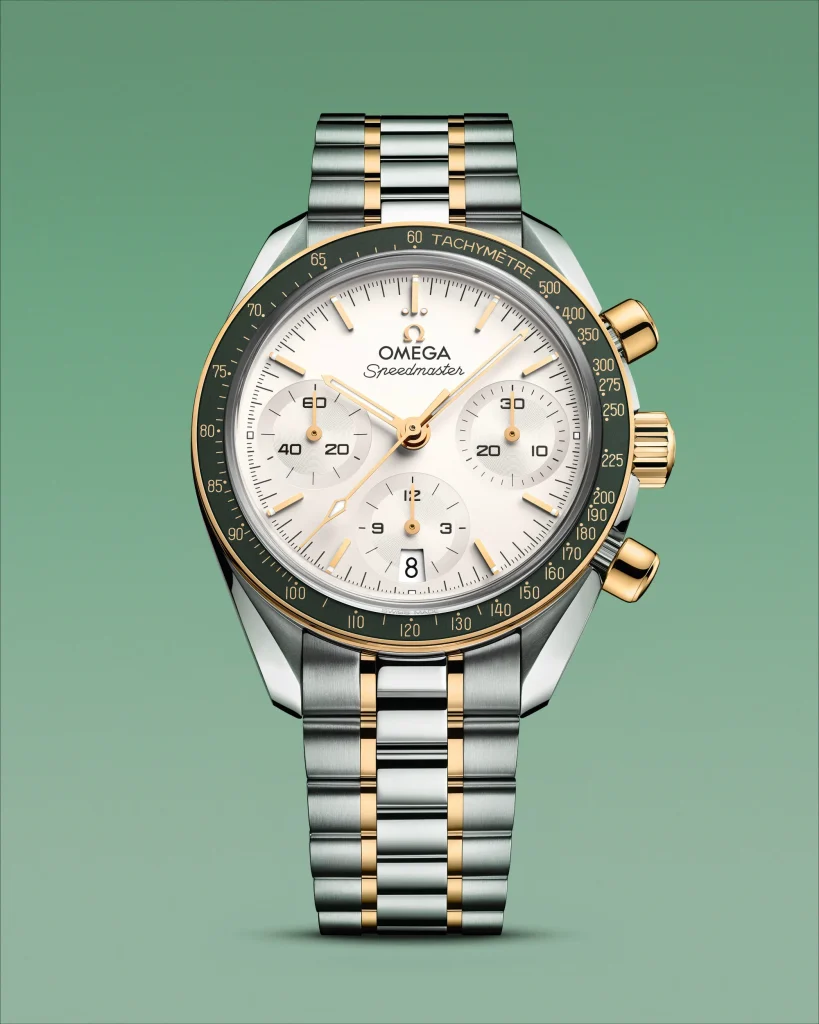
The remaining four move up a category. Two are two-tone, one in Moonshine gold with a green bezel and one reviving the ivory and brown "cappuccino" scheme, both with 18k inner bracelet links, and two carry fifty-two diamonds on the bezel over ice blue or mother-of-pearl dials. These run from EUR 11,500 to EUR 12,900.
The black no-date model is the only one of the seven to give up the calendar window, and with it recovers the Moonwatch's three-register symmetry.
Technical Specs
| Reference | 324.30.38.50.01.002 (steel, black dial, no date) |
| Case | Stainless steel, 38 mm diameter, 14.75 mm thick, 44.96 mm lug to lug |
| Bezel | Black aluminium insert, white printed tachymeter scale, dot over ninety |
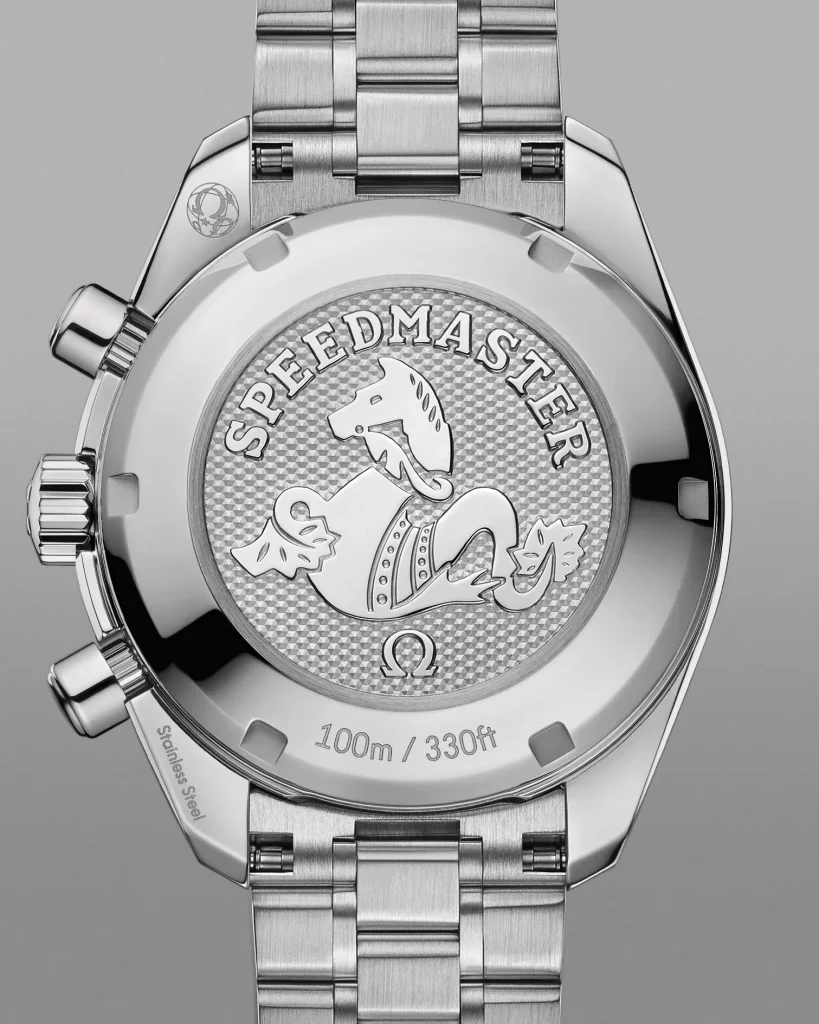
| Crystal | Box-shaped sapphire with anti-reflective treatment; solid caseback with Seahorse medallion |
| Water resistance | 100 meters |
| Dial | Matte black varnished, printed Super-LumiNova markers, white painted hands, three round subdials |
| Caliber | Calibre 3332, automatic integrated chronograph with column wheel |
| Escapement | Co-axial, free-sprung balance with silicon hairspring, 28,800 vph |
| Power reserve | 52 hours |
| Certification | COSC chronometer; not Master Chronometer |
| Bracelet | Moonwatch-style five-link, 18 mm lugs, folding clasp with two-position comfort release |
| Price | MXN 136,100 (Mexico, VAT included) · EUR 6,400 (Spain, taxes included) · USD 6,500 (United States) |
What changes against the previous generation
The subdials are circular again after nine years of oval registers, and with them the dial recovers the Moonwatch's radial balance. Dial text is down to the logo, the brand name and the word Speedmaster, without the line of certifications that used to occupy the lower half. The bezel gains thickness and adopts the historic layout, with the dot over ninety and the dot diagonal to seventy that collectors use to date a Moonwatch. The bracelet becomes the short five-link design Omega introduced on the larger model, with a two-position comfort release of 2.30 millimetres that adjusts the fit without tools when heat swells the wrist.
The dimensions did not move. The case measures thirty-eight millimetres across by 14.75 thick, the same figures as the previous generation, with 44.96 millimetres lug to lug.
The 14.75 millimetres
Thickness is the watch's weak point. The new Speedmaster 38 stands roughly a millimetre and a half taller than a sapphire-sandwich Moonwatch in a case four millimetres smaller across, and what gets in the way under a shirt cuff is the height of a case before its width. The reason is constructive, since an automatic chronograph must stack the oscillating weight and the chronograph mechanism on separate levels, and not even an integrated calibre escapes that sum. The result is a vertically tall watch worth trying on before buying.
Calibre 3332 is the no-date variant of the 3330: a column-wheel chronograph with a co-axial escapement, a free-sprung balance and a silicon hairspring, COSC-certified as a chronometer, with fifty-two hours of power reserve, enough to leave the watch on Friday evening and find it running on Monday. It does not carry the METAS Master Chronometer certification Omega applies across nearly its entire range and that this collection goes without.
Availability in our region
Omega publishes the Mexican price on its own site: MXN 136,100, recommended retail including VAT, with no online sale and an instruction to visit a boutique. In Spain the official price is EUR 6,400 including tax and the brand sells directly through omegawatches.com, with free shipping and returns. Both markets have the five-year factory warranty and an authorised service network, so the watch can be repaired without leaving the country.
The original as an alternative
Anyone who prefers the nineties watch will find it on the pre-owned market at less than half the price. A Chrono24 search on 4 September 2026 returned 134 active listings for ref. 3510.50.00, the steel black-dial Reduced; across the sixty-three readable prices on the first page, the median came to USD 3,441, with most supply between USD 2,900 and USD 3,900 and a low of USD 2,619 from Germany plus USD 189 shipping. Examples with box, papers and recent service documentation asked between USD 3,500 and USD 4,000, and the five listings located in Spain ranged from USD 2,976 to USD 4,107. These are asking prices, not transaction prices, and they exclude shipping, customs and local taxes.
Maintenance is added on top. Omega's Mexican service tariff sets a full overhaul at MXN 21,500 for a steel chronograph and MXN 25,900 for one in precious metals, and the work usually ends up in the official channel, because the dial-side Dubois-Dépraz module is the part many independent watchmakers will not open. An example with recent service documentation defers that outlay for several years; one without it still owes it. What remains to check is the acrylic crystal, which scratches with wear, and whether dial and hands are original, verifiable against the family's reference guides.
The differences between the two can be checked one by one. The Reduced measures thirty-nine millimetres and the new watch thirty-eight; the original runs a modular calibre with forty hours of power reserve and the current one an integrated calibre with fifty-two; the older model's specifications list thirty metres of water resistance against the hundred of the 2026 reference. The new watch leaves the boutique with a five-year factory warranty, and the nineties one arrives with whatever history the seller can document.
The three figures that settle the decision are all public: MXN 136,100 for the new watch at a Mexican boutique, around USD 3,400 for a pre-owned example on the open market and MXN 21,500 for a full overhaul through Omega's official channel. Every buyer can run the sum with the numbers of their own country.