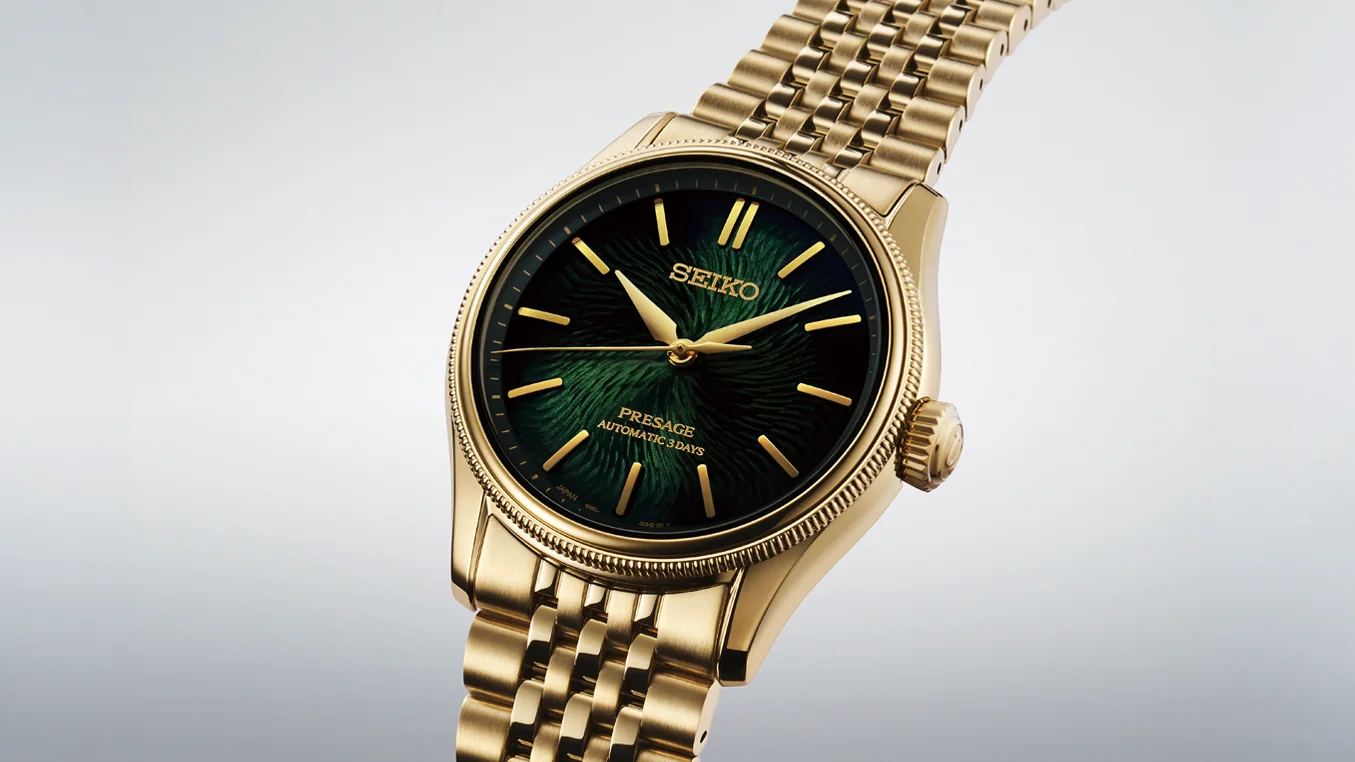

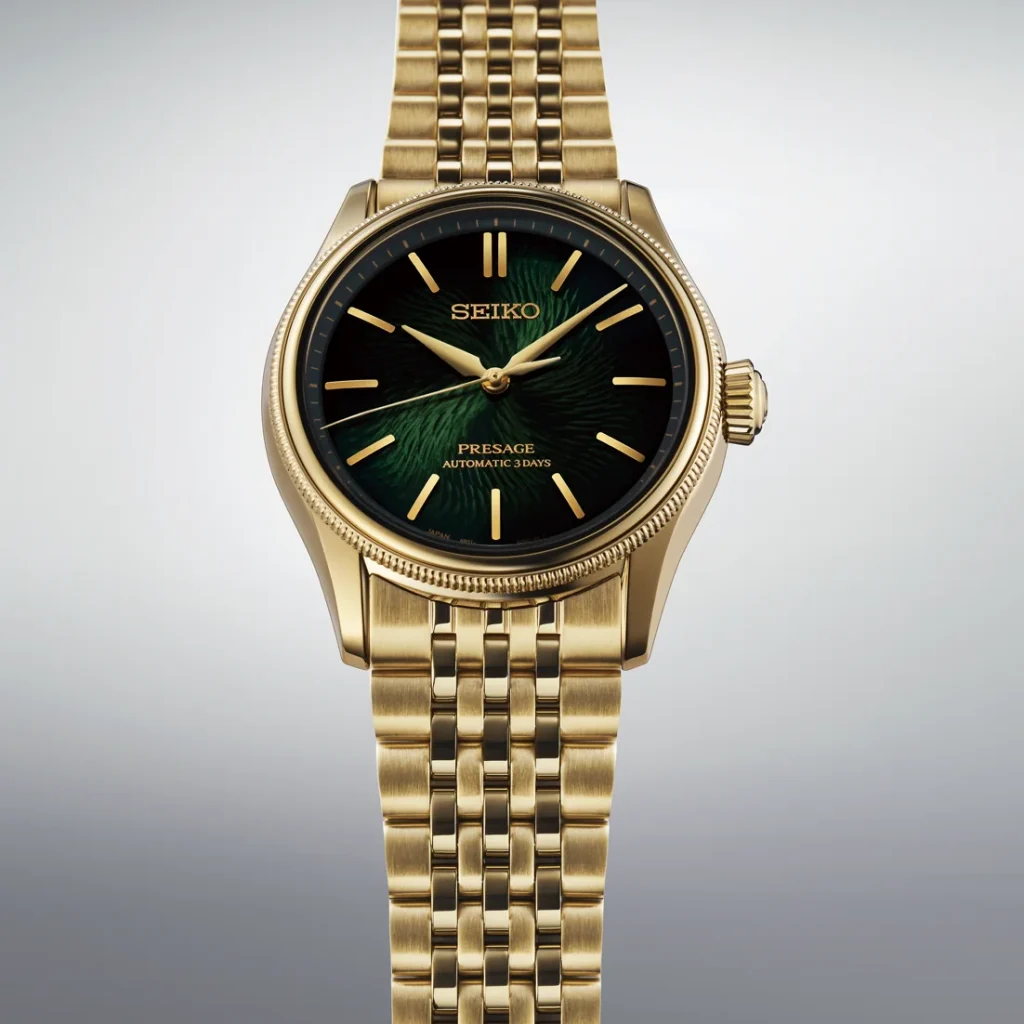
A dial carrying the relief of aged black pine bark, the in-house 6R51 and 100 metres of water resistance for USD 1,350. Two thousand units is a lot for an edition that calls itself limited.
For decades, the Presage collection was sold only in Japan. When Seiko took it international in 2016, the line became the brand's showcase for the country's traditional crafts: fired enamel, Arita porcelain, urushi lacquer. The Classic Series arrived later as the most down-to-earth branch of that family, with everyday watches, a vintage flavour and noticeably lower prices.
The HCC009J1 belongs to that branch, but it does not arrive alone. Seiko developed it alongside Tradman's Bonsai, a Tokyo collective founded in 2015 that produces bonsai and curates the spaces where they are shown, which puts it some distance from traditional gardening. What came out of that meeting is a green dial in relief and a run of 2,000 pieces.
Technical Specs
| Reference | HCC009J1 |
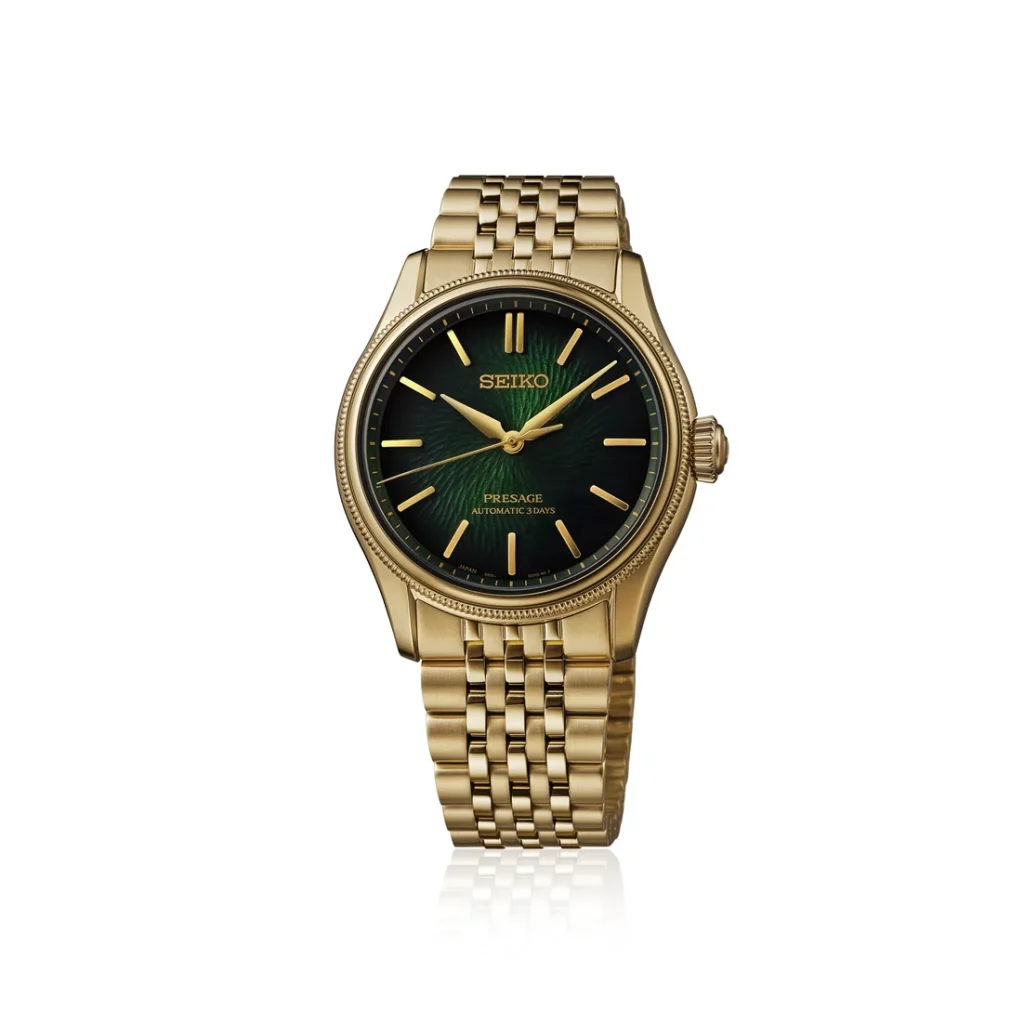
| Case | Gold-tone PVD-coated stainless steel, coin-edge bezel, oversized fluted crown |
| Dimensions | 38.0mm diameter, 12.9mm thick, 43.8mm lug to lug, 20mm lug width |
| Crystal | Dual-curved sapphire with anti-reflective coating on the inner surface |
| Dial | Matsuba-iro green with a relief texture drawn from the bark of an aged Japanese black pine, gold-toned applied indices with a double index at twelve, polished alpha hands |
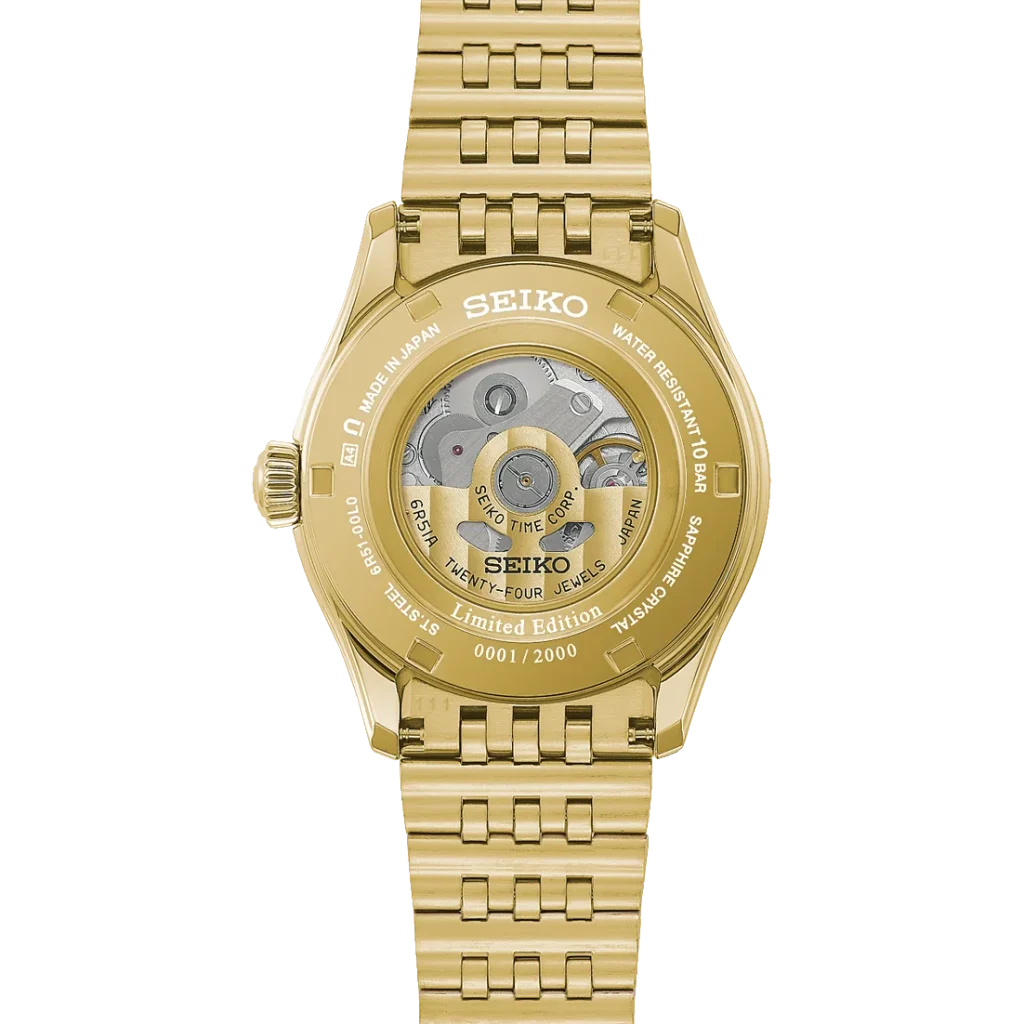
| Caseback | Screw-down sapphire display back, engraved "LIMITED EDITION" and individually numbered |
| Water resistance | 100 metres (10 bar) |
| Magnetic resistance | 4,800 A/m |
| Caliber | In-house calibre 6R51, automatic with manual winding, no date |
| Specifications | 24 jewels, 21,600vph (3Hz), 72-hour power reserve, hacking seconds, stated accuracy of +25 to −15 seconds per day |
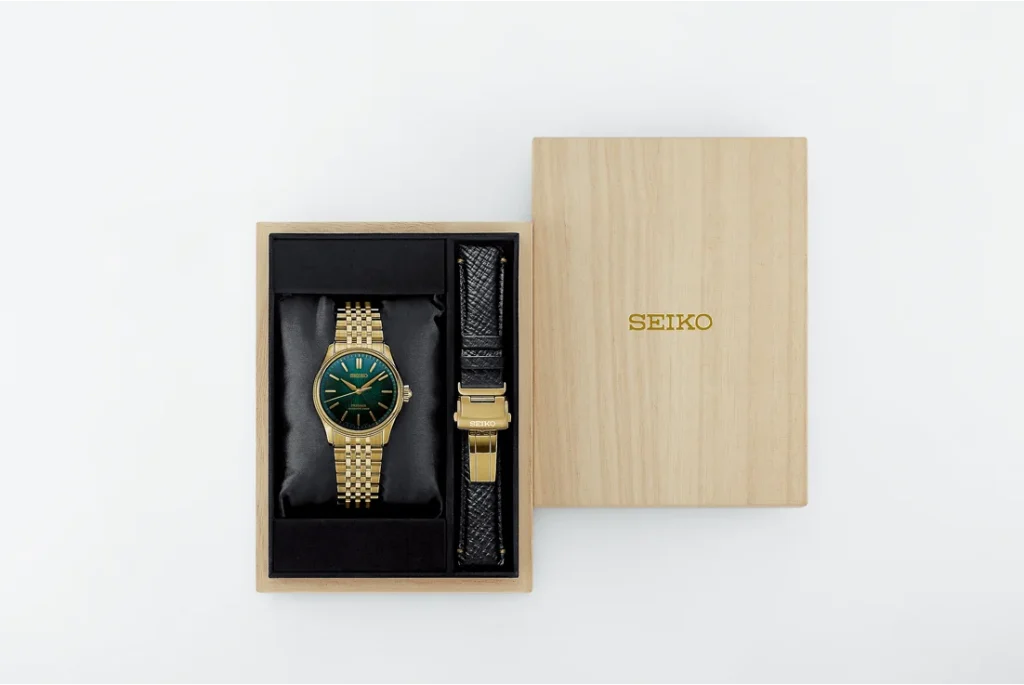
| Bracelet | Seven-row steel with matching gold PVD and a concealed triple-fold clasp. An additional black leather strap is included, embossed on its underside with the sanko-matsu motif |
| Price | USD 1,350 |
| Availability | Limited edition of 2,000 pieces, released September 2026 |
Bonsai as a Subculture Rather Than a Postcard
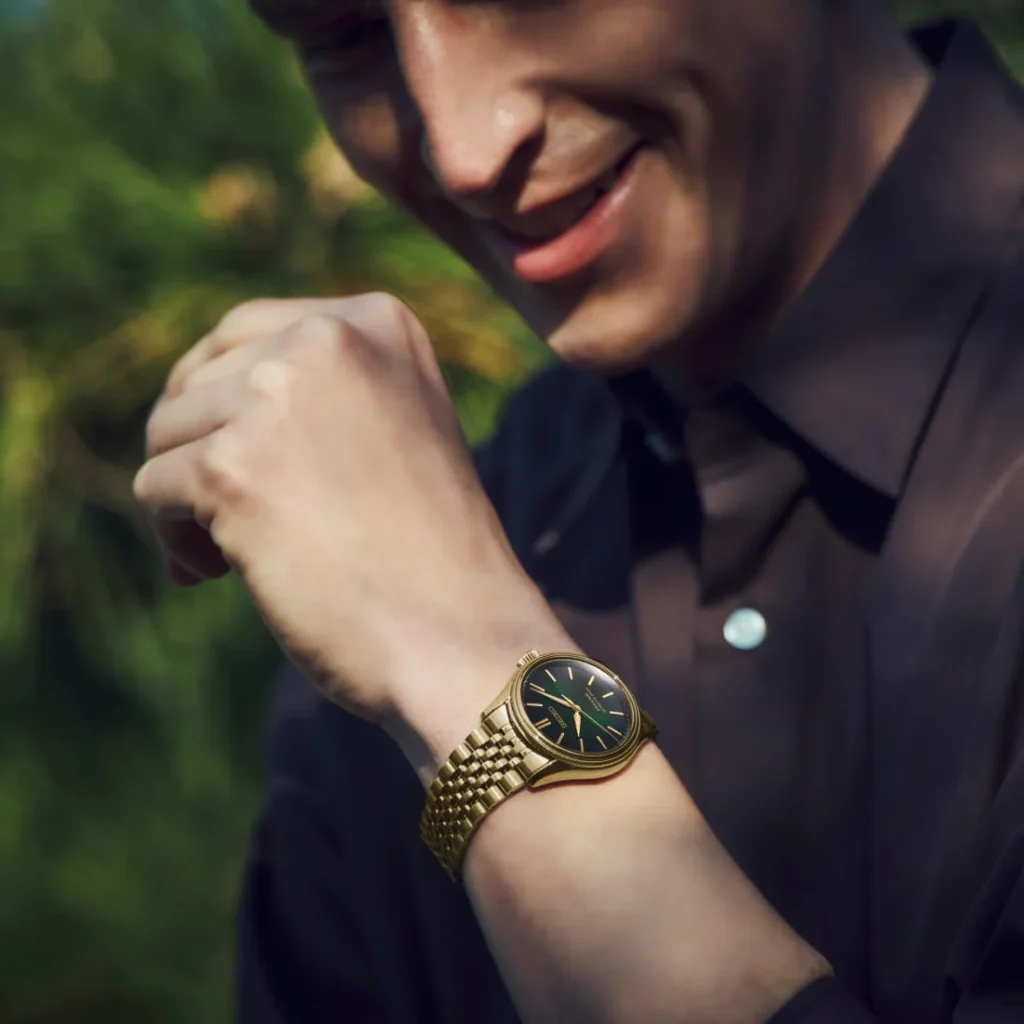
When a brand wants to evoke Japan on a dial, it usually reaches for the same handful of images: Mount Fuji, cherry blossom, a raked stone garden. Tradman's Bonsai comes from somewhere else. The collective shows its trees in clothing stores and at art fairs, works with fashion labels, and has built its identity around an idea its own mission statement puts plainly: redefining what "Japanese cool" means. In that context bonsai is not the patient hobby of an older man but an object of contemporary urban culture, and that difference is what makes the collaboration worth paying attention to.
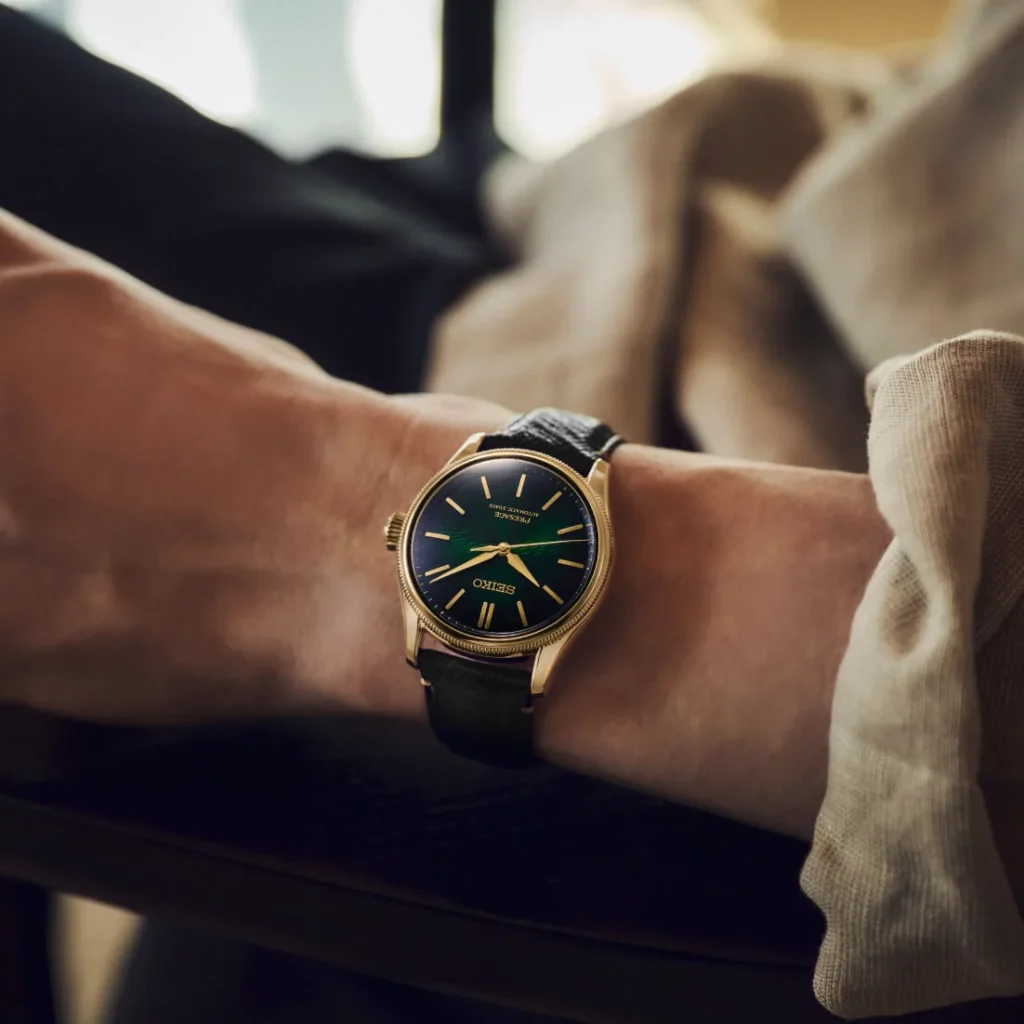
The dial picks up the idea with more care than these exercises usually manage. Matsuba-iro is the traditional pine-needle green, a colour Japanese tradition associates with longevity, and the relief reproduces the cracked bark of an old black pine rather than the smooth surface of a young one. The texture changes character depending on the angle you view it from and the light it catches, which is exactly what real bark does.
One detail went largely unnoticed in the launch coverage. A black leather strap comes in the box, and on its underside, the face that sits against the wrist and that nobody ever sees, Seiko embossed the sanko-matsu motif, the three-pointed pine needle that Japanese tradition links to good fortune.
Two Thousand Pieces, and What "Limited" Means Now
That figure deserves some scale. Over the past two weeks ORELO has covered two limited editions: the Wren Diver One Abyss, whose first run of 100 pieces sold out within minutes, and the Blancpain Fifty Fathoms Bathyscaphe 70th Anniversary at 300. Two thousand pieces amounts to twenty Wren runs, or almost seven Blancpains.
None of which means Seiko is being dishonest. "Limited" describes a technical fact, the existence of a production ceiling, and the ceiling here is verifiable: every caseback carries its own engraved serial number and unit 2,001 will not exist. The trouble is what the word implies without stating. Two thousand examples spread across Japan, Europe, the United States and everywhere else will still be available many months after launch, and will surface on the secondary market fairly regularly. If the watch appeals to you, there is plenty of time to think it over: the urgency the label suggests does not match the reality of the run.
The 6R51 and the Number Worth Facing
Inside sits the calibre 6R51, the no-date variant of the family Seiko places at the top of its mechanical catalogue below Grand Seiko: 24 jewels, 21,600 vibrations per hour, hacking seconds and a 72-hour power reserve. Three days of autonomy carries a practical consequence you appreciate day to day, because if you leave the watch in a drawer on Friday evening, by Monday morning it is still running and still on time.
The weak point on the spec sheet is the stated accuracy, which Seiko puts at +25 to −15 seconds per day. That is a 40-second daily window on a USD 1,350 watch, against the 10-second window of a COSC-certified chronometer, which runs from −4 to +6. In practice, individual examples of the 6R family tend to behave considerably better than their specification, but what the brand guarantees in writing is that wide range, and it is worth knowing before you buy.
Two more figures deserve pulling out of the spec sheet. The first works in the watch's favour: 100 metres of water resistance is well beyond what a piece of this character usually offers, and it widens what you can do without taking it off your wrist. The second calls for a warning: 12.9mm of thickness on a 38mm case is a fair amount of volume for such a contained diameter. The 43.8mm lug-to-lug helps it settle on smaller wrists, but the watch wears more present than studio photography suggests.
Availability in our region
Seiko sets the US list price at USD 1,350. At the exchange rate on the date of publication, that comes to roughly MXN 22,900, an approximate figure to read as a floor rather than a final estimate, since it does not yet include taxes or whatever margin the local distributor applies. In Europe the reference is different: Monochrome publishes EUR 1,400, and because that price already has VAT built into it, it ends up above the US one.
Seiko maintains official distribution in Mexico, Colombia and Spain, which makes this one of the few watches we cover in this price range where buying with a local warranty is a real option rather than importing blind. One question stays open: it is not confirmed whether the HCC009J1 enters the regional assortment, or when, and some Classic Series editions have stayed in Japan and Europe. Before assuming it will arrive, the sensible move is to ask at the boutique directly.
The verdict from ORELO
This watch's most serious rival sits in Seiko's own catalogue. The Presage Laurel HCC005 costs USD 1,400, barely fifty more, and offers in return a hand-fired enamel dial signed by the artisan who kilned it. They are two very different ways of spending almost the same money: with the Laurel you pay for craft; with the Bonsai you pay for design, colour, a steel bracelet, 100 metres of water resistance and a cultural collaboration that has been properly resolved. If you want a single mechanical watch to wear every day, the Bonsai covers more ground. If what moves you is collecting handmade dials, the Laurel has no competition at that price.