

Anyone typing "Nivada" into a search engine from Mexico finds two catalogues with nothing in common. One belongs to a Swiss house selling mechanical chronographs of several hundred dollars, which has become a reference among younger collectors in recent years. The other belongs to a Mexican brand selling watches, mostly quartz and at far more accessible prices, in the country's jewellery shops. Both are legitimate, both have a right to the name, and neither warns of the other's existence.
That double life matters right now because the Swiss firm has just widened its Autochron collection with five references, and because this is the first time ORELO has covered the brand. It is worth starting at the beginning, which is in Grenchen and ends, by different routes, in Mexico City and in a Swiss workshop reopened in 2020.
The name that stayed in Mexico
The house's origins are not fully documented, and the two companies using the name today tell them differently. The Swiss site presents itself as a manufacture "since 1926" and is marking its centenary this year; the Mexican account traces the story to a small family firm founded in Grenchen in 1879 and places in the 1920s the moment Jacob Schneider formalised the brand as Wüllimann Schneider Nivada S.A. Neither version rests on public primary sources.
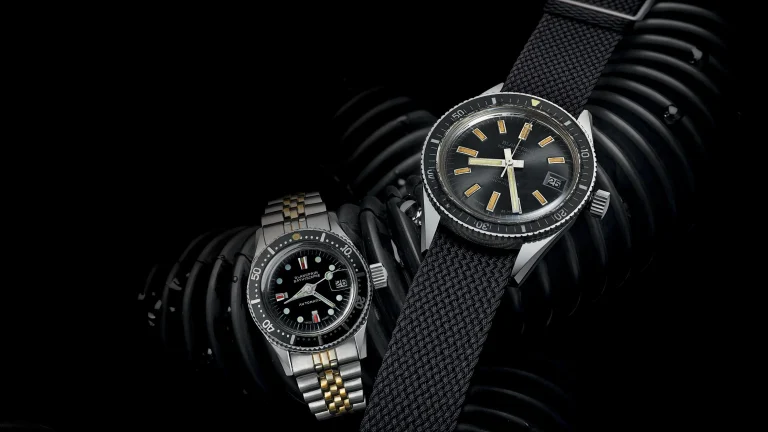
What is documented is what came next. In the 1950s, Nivada equipped the U.S. Navy's Operation Deep Freeze I, during the International Geophysical Year, with an antimagnetic and water-resistant watch it named the Antarctic. In the 1960s it launched the Chronomaster, a 200-metre diving chronograph whose dial carried the three words that defined it, "Chronomaster, Aviator, Sea Diver", and which stayed in production until the late seventies. The exact date is disputed too: the official Mexican history places it in 1963, while Guillaume Laidet, the entrepreneur who relaunched the Swiss brand, places it in 1961, in partnership with Croton, the firm's American distributor.
Then the quartz crisis arrived and Nivada stopped operating. That is where Holzer y Cía., the Mexican jewellery and watch house, comes in. The story was told in Spanish by Tiempo de Relojes in June 2020: the rights to Nivada belong to Andrés Holzer, the company's president, who bought the dormant firm after years of distributing brands such as Omega, and the brand has been present in Mexico as a local brand for around three decades. A search of the Mexican trademark registry, IMPI, confirms that Nivada, Nivada Swiss and Nivada Grenchen are registered in the country to Holzer y Cía. With that name, the company built a catalogue of its own, with families that do not exist in Switzerland, among them Millionaire, Skymaster, Moonmaster, Rockefeller and Abyss Master, and in 2015 it released a retro-flavoured chronograph of its own, called, precisely, Nivada Grenchen.
The Swiss revival
In 2020, Laidet and Rémi Chabrat put the brand back into production in Grenchen with Sellita movements. According to that same Tiempo de Relojes piece, Nivada Grenchen operates under licence and as an independent brand, with no direct interaction with the Mexican company; the terms of the licence are not public. The commercial strategy was to sell online and skip the distributor, which is what allows Swiss chronographs to be offered below a thousand dollars.
It is that Swiss operation that has put the name back on the international radar, and it has done so with a clear method: reissuing the pieces that gave the house its identity. The Chronomaster returned first, alongside the Antarctic; then came the Depthmaster, the integrated-bracelet F77 and even a series built around period Valjoux 23 calibres. The Autochron joined that list in 2024, and it is the only one that revives not a commercial success but a discarded experiment: a chronograph Nivada assembled in the late 1970s with a Singer dial, a graduated rotating bezel and a tachymeter scale, built in fewer than twenty examples and never sold in shops.
Five new references
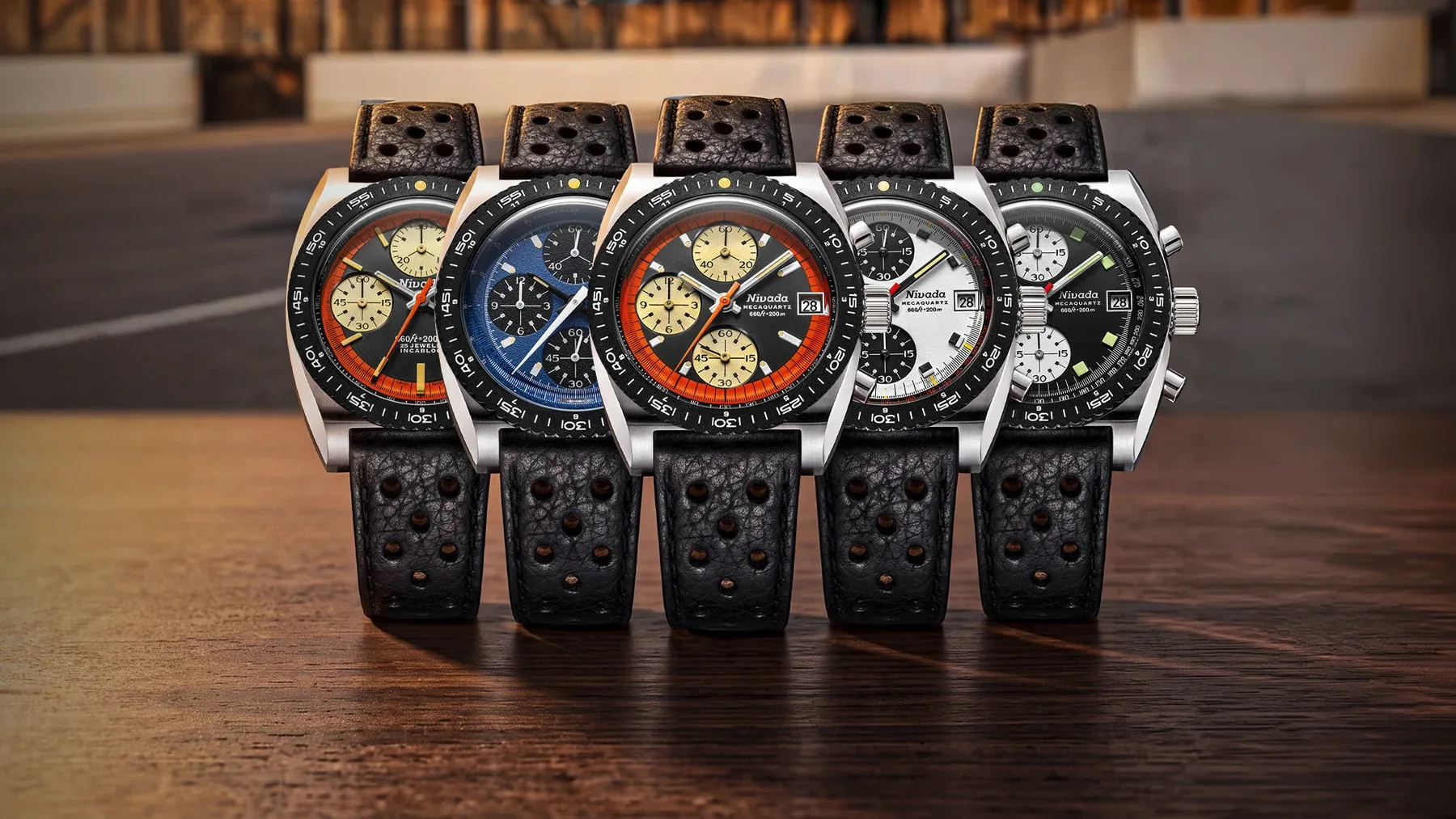
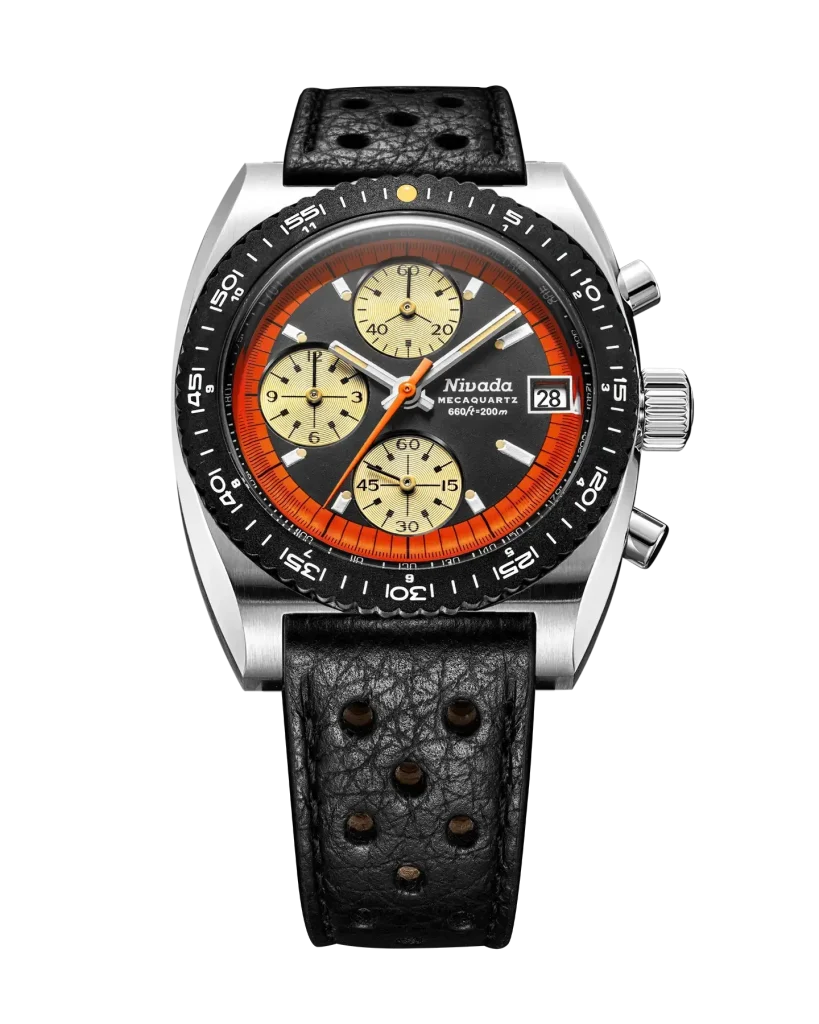
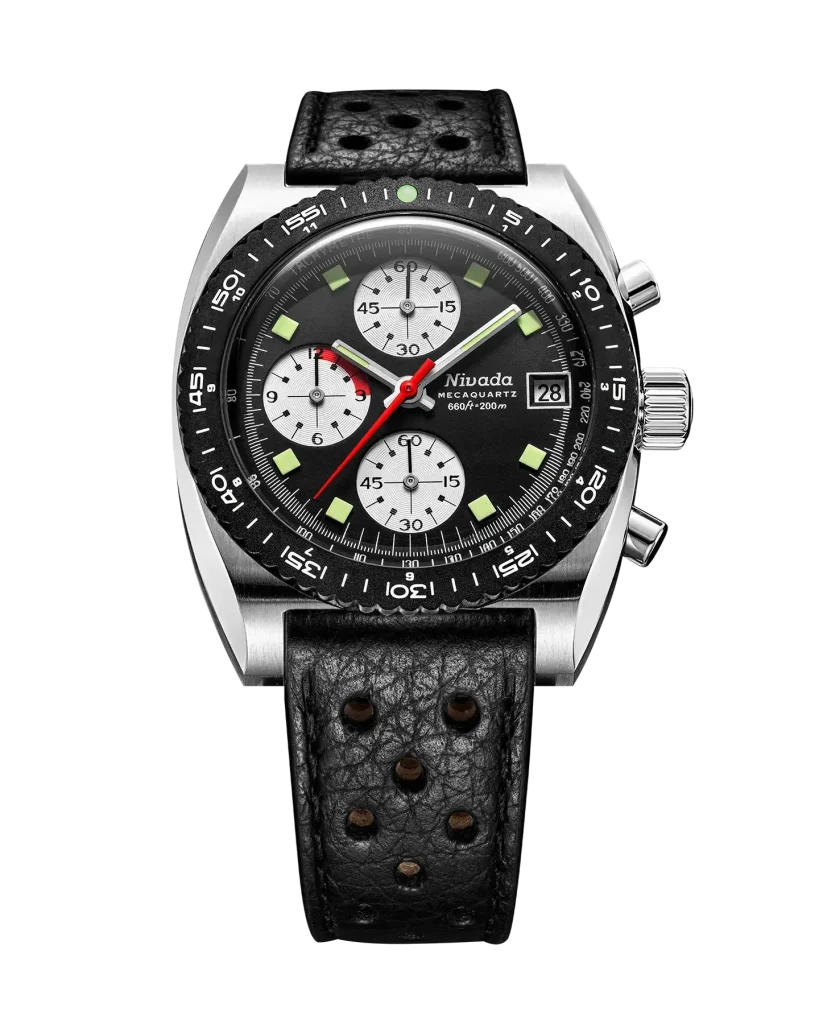
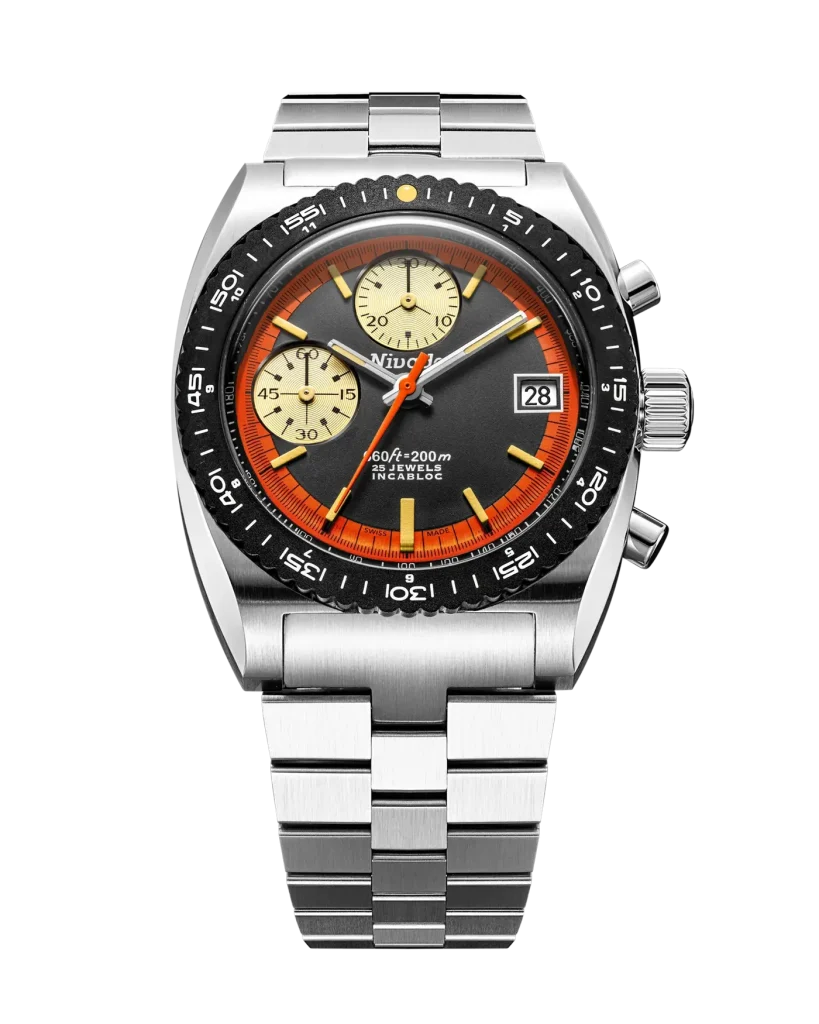
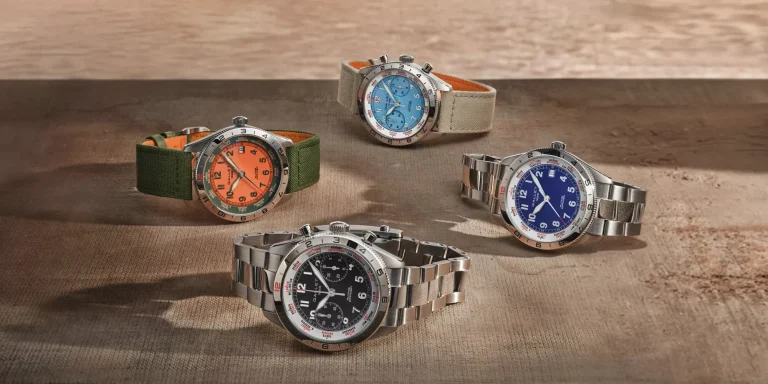
he 2026 additions are built on the same 38 mm 316L steel case the model introduced in 2024, with double-domed sapphire and 200 metres of water resistance. Leading the group is the Autochron Orange Automatic, with a matte black dial fading into vivid orange, beige counters, applied luminous indexes and a 37 mm aluminium bezel with 120 clicks, the most visible change against earlier versions because it turns a decorative feature of the original into a control that is actually used. Inside runs the ETA Valjoux 7750 automatic with date.
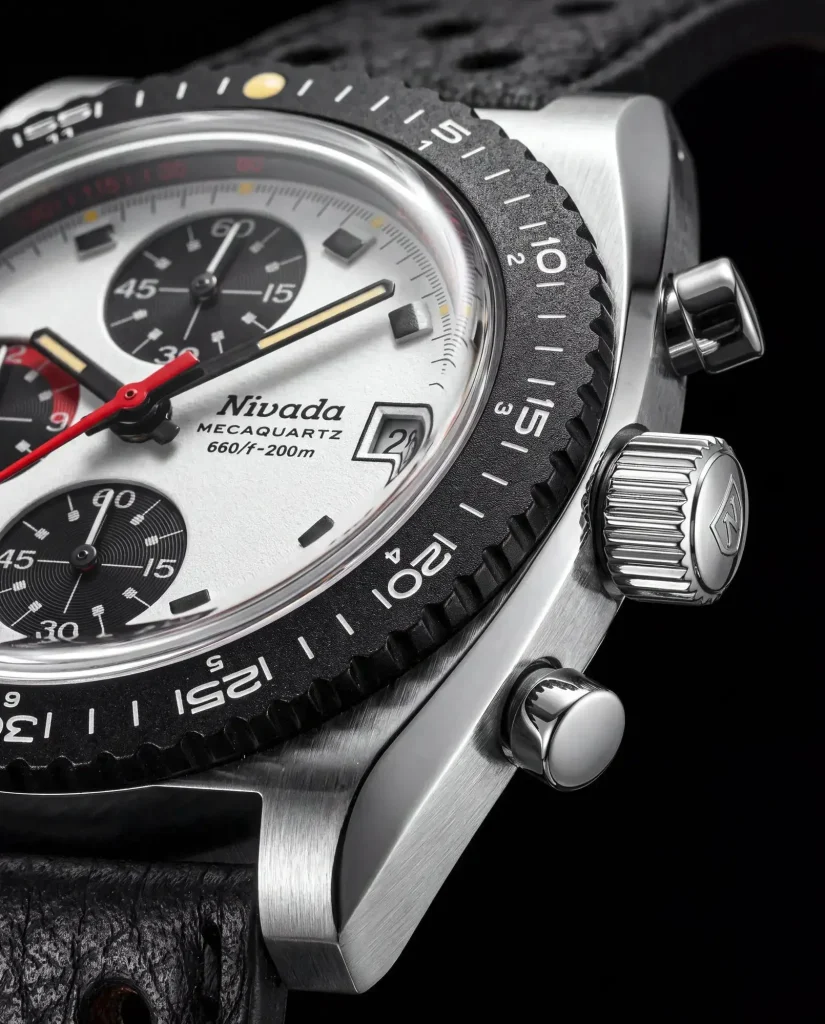
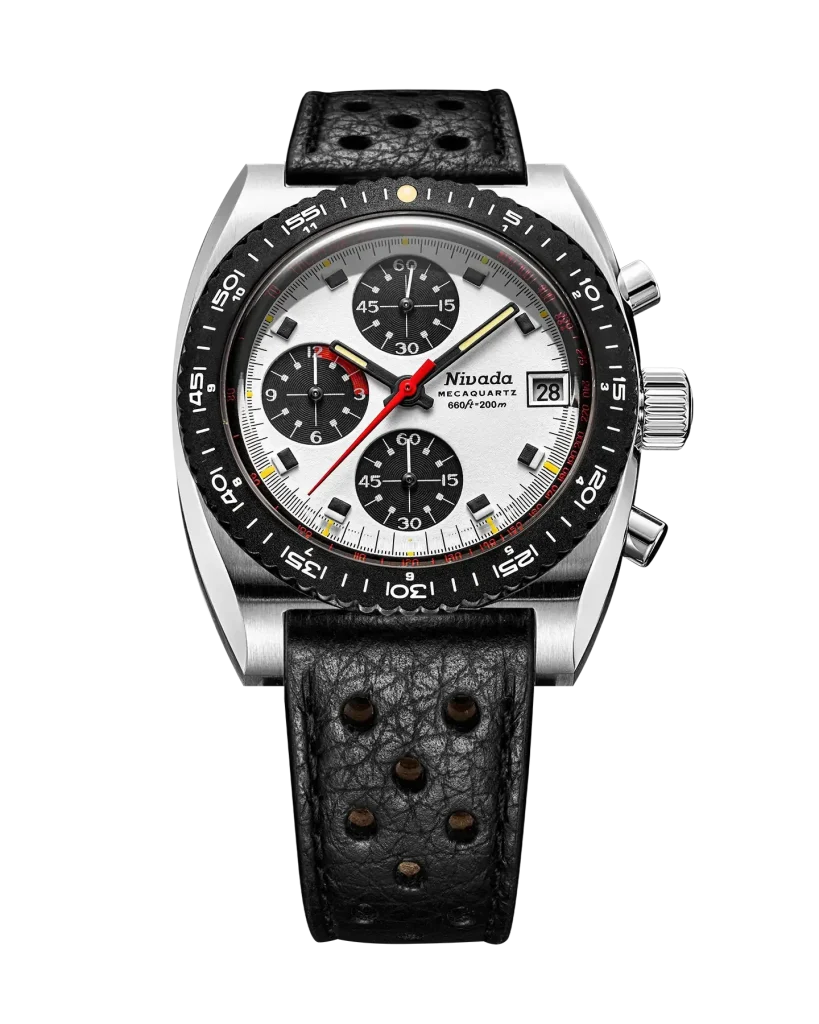
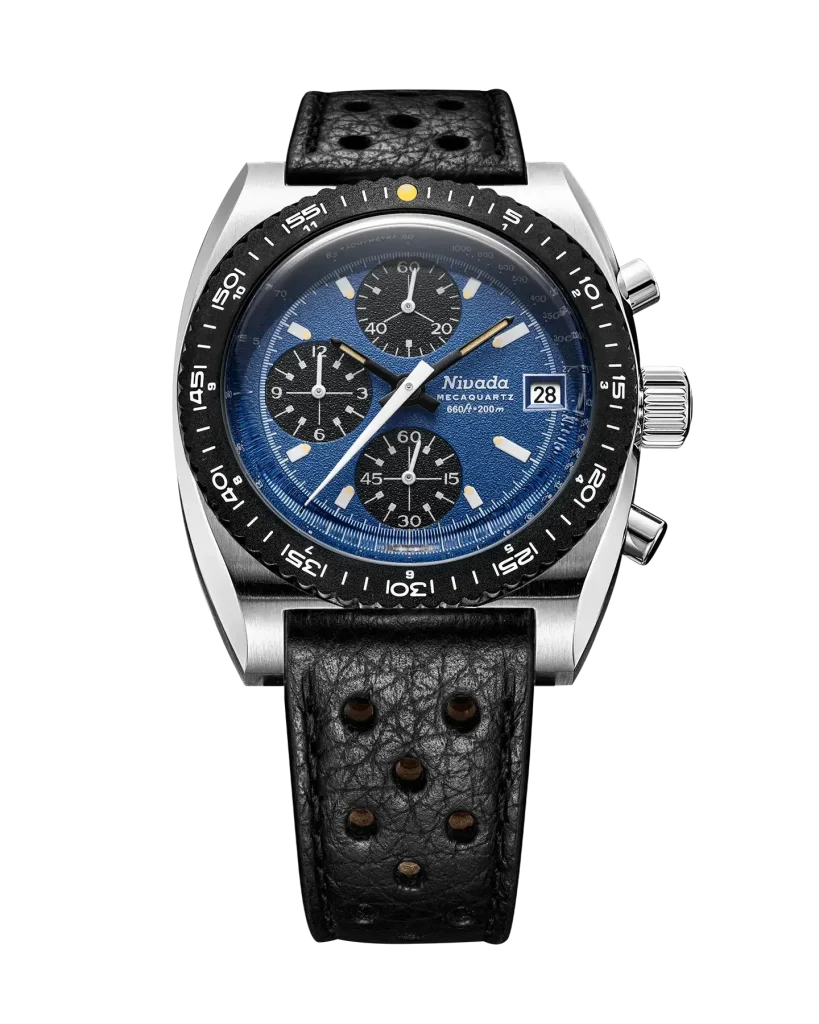
The other four references are meca-quartz, running the Seiko VK67, in four dial configurations: panda, reverse panda, blue and orange. The case stays at 38 mm and the chronograph action is genuinely mechanical, with pushers driving a mechanical module over a quartz base, which is why the chronograph seconds hand sweeps rather than ticks.
Two things deserve mention that the press material does not highlight. The first is thickness: the automatic's official specification sheet declares 12.7 mm without the crystal and 15.2 mm with it, a substantial figure for a 38 mm case that will sit higher on the wrist than studio photography suggests. The second is the 7750's 48-hour power reserve, correct for the calibre but modest in 2026, when much of the competition in this bracket already offers 60 or 70 hours. Neither observation cancels the watch, but both are part of what is being bought.
Swiss made, though not across the catalogue
There is a distinction worth checking before paying. The automatic Autochron's product page carries the words "Swiss made" above the movement line. The meca-quartz page does not, and its calibre is the Japanese Seiko VK67. The Swiss designation requires, among other conditions, a Swiss movement, so a chronograph with a Japanese calibre cannot carry it however thoroughly it is designed, assembled and guaranteed from Switzerland.
That does not make the meca-quartz a poor watch. At 530 dollars, with a steel case, double-domed sapphire, screw-down crown and 200 metres, it is a defensible proposition. But the shop's cart header displays the phrase "Swiss Made" across the whole catalogue, and that is where a buyer can form the wrong idea of what they are choosing.
Technical specifications: Autochron Orange Automatic
| References | 77004A10 (racing strap), 77004A45 (bracelet), 77004A27 (Tropic rubber) |
| Case | Vertically brushed 316L steel with polished details, 38 mm, 12.7 mm without crystal (15.2 mm with crystal), 44.3 mm lug to lug |
| Crystal | Double-domed sapphire with anti-reflective coating |
| Dial | Matte black with orange gradient, beige counters, applied luminous indexes |
| Bezel | 37 mm aluminium, 120 clicks |
| Caliber | ETA Valjoux 7750 automatic chronograph with date, 28,800 vph (4 Hz), 48-hour power reserve |
| Functions | Hours, minutes, small seconds, 60-second chronograph, 30-minute and 12-hour counters, date |
| Crown | Signed, with embossed shield logo |
| Water resistance | 200 m (20 ATM) |
| Strap | 20 mm; flat-link steel bracelet, black racing strap or orange Tropic rubber |
| Price | 2,295 USD on strap; 2,495 USD on bracelet |
Technical specifications: Autochron Meca-Quartz
| Case | 316L steel, 38 mm, 10.8 mm without crystal, 44.3 mm lug to lug |
| Crystal | Double-domed sapphire |
| Dial | Textured black, Art Deco sub-dials, Super-LumiNova |
| Bezel | Bidirectional fluted aluminium with tachymeter scale |
| Caliber | Seiko VK67 meca-quartz with date, ±20 s/month, battery approx. 3 years |
| Functions | Hours, minutes, small seconds, 60-second chronograph, 30-minute and 12-hour counters, date |
| Crown | Screw-down |
| Water resistance | 200 m (20 ATM) |
| Strap | 20 mm; steel bracelet, leather, rubber or racing strap |
| Price | 530 USD on strap; 730 USD on bracelet |
Latin America and Spain Perspective
The Autochron sells direct from nivadagrenchenofficial.com , and the new references are on pre-order with shipping announced for early September. The shop offers free shipping above 200 dollars, a two-year warranty and free returns, but orders are fulfilled by an international seller, so buyers in the region absorb their own country's tax and duty. In Mexico, VAT plus the general tariff can approach 36% on top of the dollar price, an estimate worth confirming with a customs broker before treating it as final; on 530 dollars, that means budgeting closer to 720. In Spain, inside the European Union, the burden is limited to VAT. No authorised Nivada Grenchen point of sale was located in Mexico, Colombia or Argentina, so online purchase is the realistic route today, with everything that implies: warranty handled from Switzerland and no counter to walk into.
That leaves a caution that is not about the watch but about the name. It pays to check the domain and the declared movement before paying, because two legitimate companies share the same surname in this region and sell very different things, and anyone searching an online marketplace gets both at once. The chronograph reviving a discarded 1970s prototype and the Mexican catalogue that has been in the country's display cases for decades are not competing with each other; they simply share a history that forked fifty years ago and that almost nobody has bothered to explain.
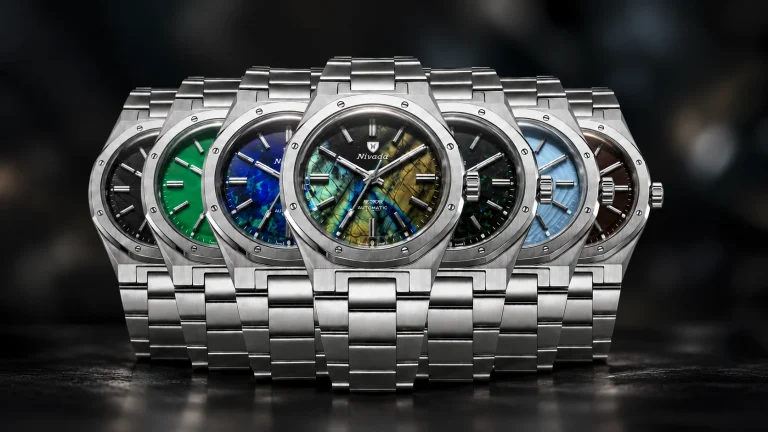
[…] En México, además, el nombre Nivada pertenece a Holzer y Cía., la casa mexicana de joyería y relojes, que vende bajo esa marca un catálogo propio, en su mayoría de cuarzo. Nivada Grenchen opera de forma independiente, por lo que los relojes Nivada que se encuentran en las joyerías del país no forman parte del catálogo suizo ni incluyen el F77. La historia completa está en el artículo que ORELO publicó en agosto sobre los Autochron. […]
[…] podría afectar también a otras marcas que usan calibres de la misma familia, como el VK67 del Nivada Grenchen Autochron de […]