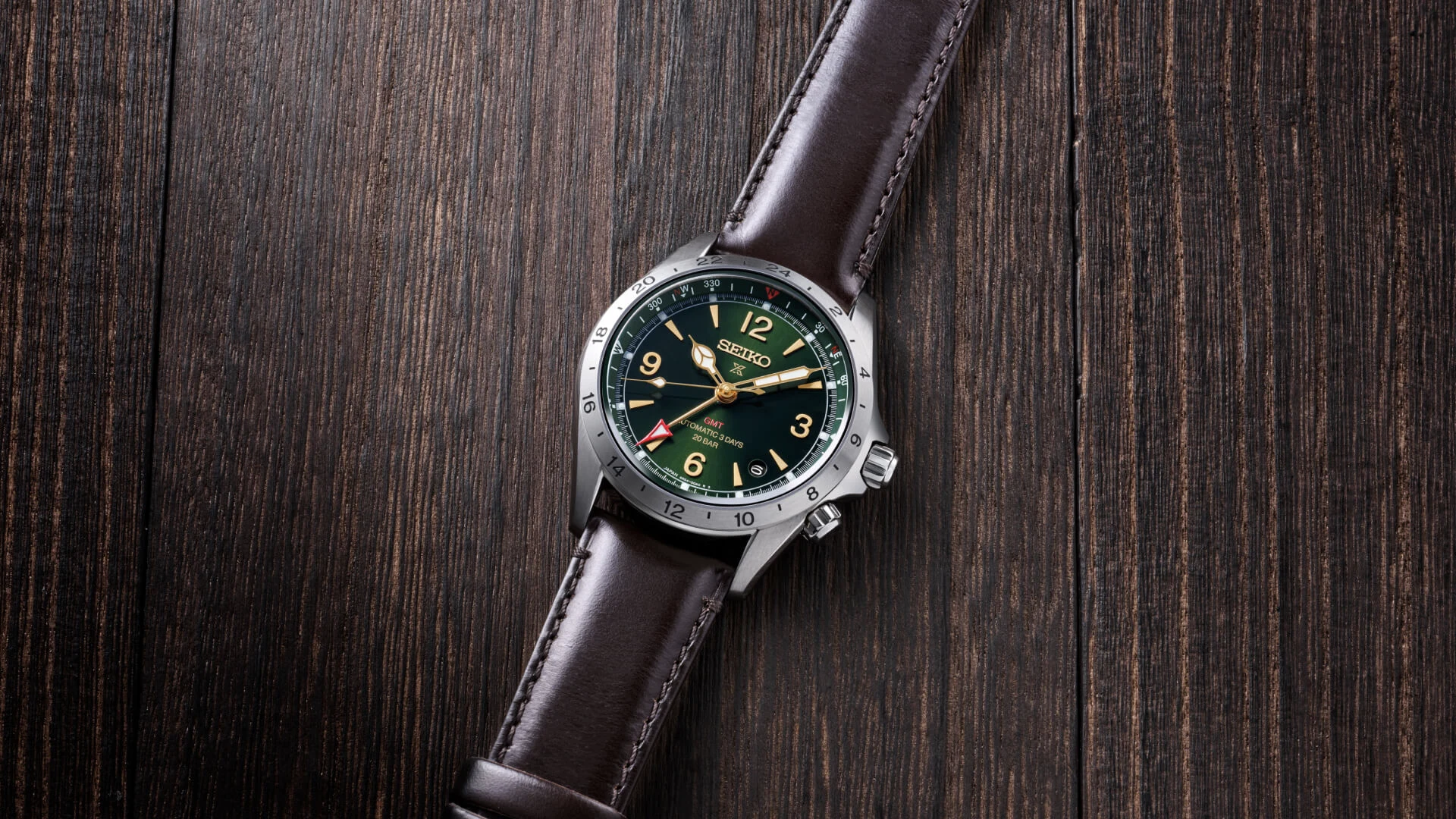

The green version of Seiko's Alpinist GMT, a field watch with an internal compass ring sold only in Japan since 2023, is now offered in the United States and Spain.
Seiko introduced the Laurel Alpinist in 1959. It was the brand's first watch designed for sport, aimed at mountaineers and outdoor enthusiasts in Japan, with a screw-down caseback to keep out dust and sand and markers at 3, 6, 9 and 12 that stood for the four cardinal points. Seiko revived the name in later generations, among them the SARB017, which had a green dial, gold numerals and an internal compass ring.
In 2023, Seiko added the Alpinist GMT to the family, powered by the automatic Caliber 6R54 and fitted with a 24-hour hand for reading a second time zone. Outside Japan, the permanent collection offered it with a blue dial (SPB377) or a black one (SPB379), while the green version, reference SBEJ005, was sold only in the Japanese market. In mid-2026 Seiko announced its international version, the HBC007, part of the Land series of the Prospex collection. At the end of October it began arriving at authorized dealers in the United States.
Technical Specs
| Reference | HBC007J1 |
| Case | Stainless steel with Diashield hardened coating; 39.5 mm diameter, 13.6 mm thick, 46.4 mm lug to lug; 20 mm lug width |
| Crystal and back | Curved sapphire with anti-reflective coating on the inner surface; screw-down steel caseback with sapphire display window |
| Crowns and bezel | Screw-down main crown for time, date and 24-hour hand; crown at 4 o'clock for the rotating internal compass ring; fixed bezel with 24-hour scale |
| Water resistance | 200 m (20 bar) |
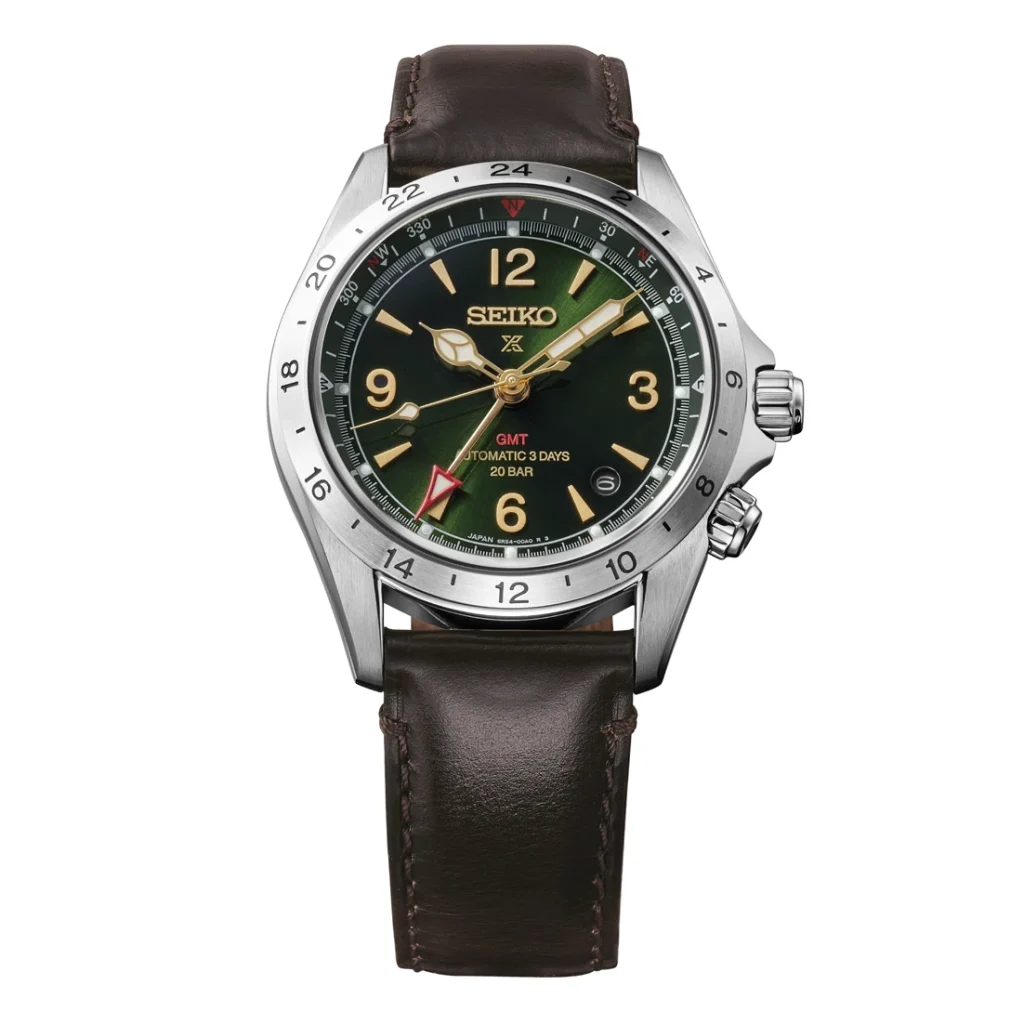
| Dial | Green sunburst; gold-tone applied indices and hands with Lumibrite; numerals at 3, 6, 9 and 12; date at 4:30; red-tipped 24-hour hand |
| Caliber | Seiko 6R54, automatic with hand winding and hacking seconds; 21,600 vph (3 Hz); 24 jewels; approx. 72-hour power reserve; accuracy of +25 to -15 seconds per day; magnetic resistance of 4,800 A/m |
| Functions | Hours, minutes, seconds, date and second time zone via an independently set 24-hour hand |
| Strap | Brown cowhide leather; steel three-fold clasp with push-button release |
| Price | USD 1,150 and EUR 1,350 |
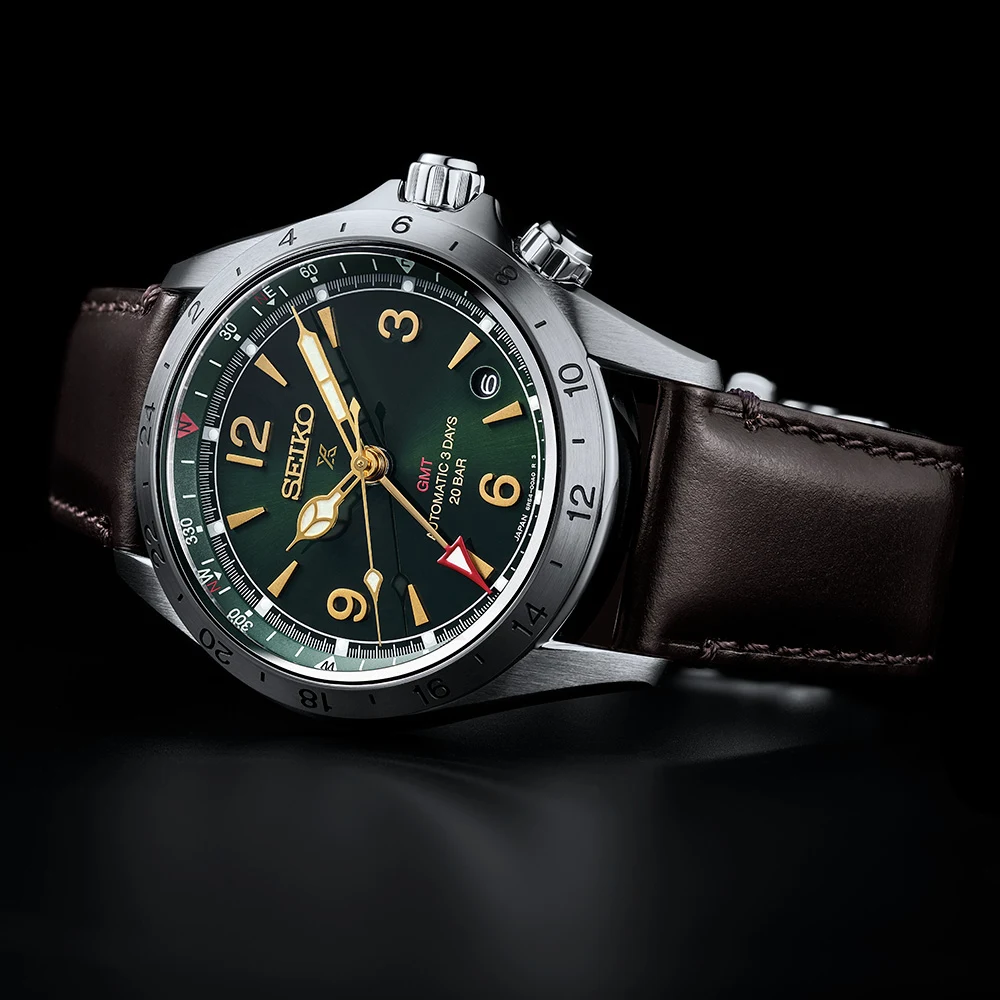
The green dial and the compass ring
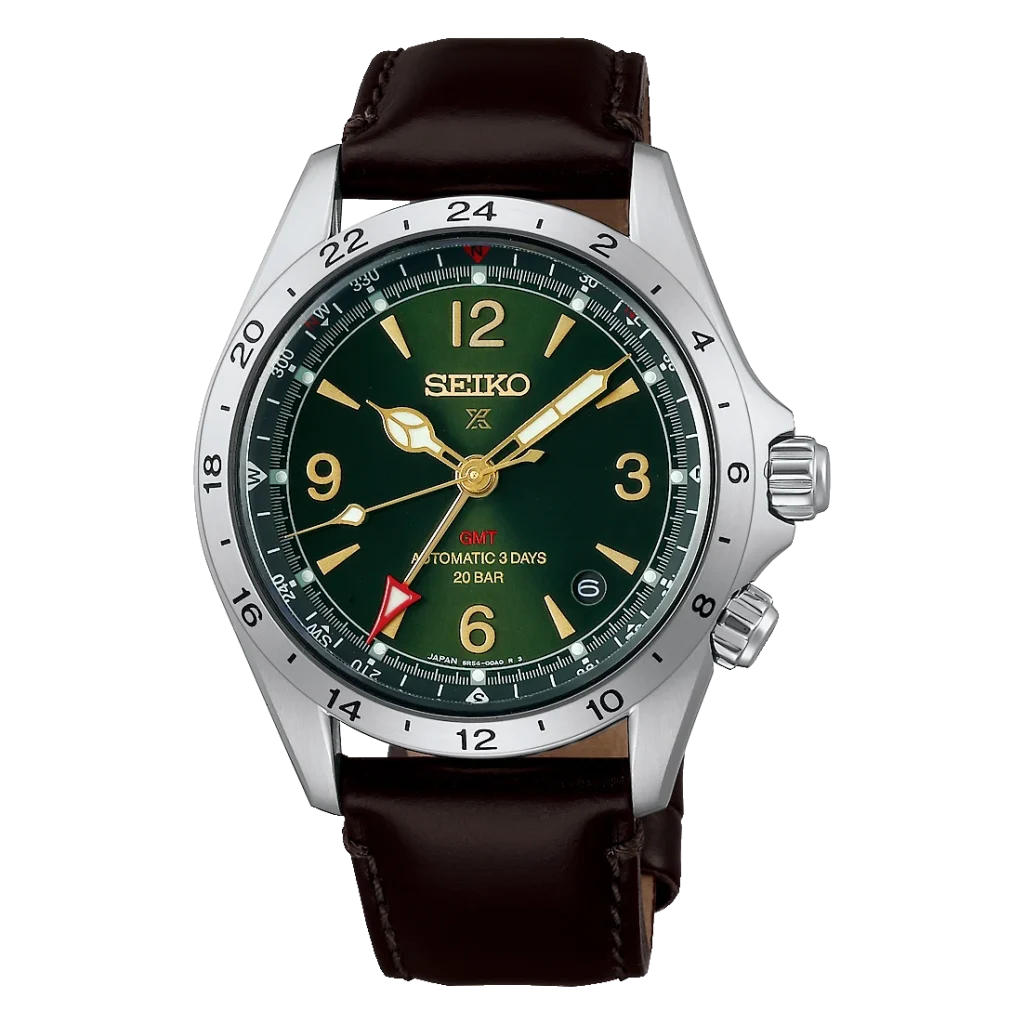
The case is the same as on the blue and black versions: steel with brushed and polished surfaces and Seiko's Diashield hardened coating, which helps the metal resist everyday scratches. The HBC007's dial is green with a sunburst finish that lightens or deepens the tone depending on how the light hits it. The applied indices and cathedral hands are gold-tone, and the numerals at 3, 6, 9 and 12 sit where the Laurel Alpinist marked the cardinal points. The green and gold give it a more classic look than the blue and black versions, close to that of the SARB017.
The crown at 4 o'clock turns an internal ring printed with the cardinal points. Seiko's manuals describe it as a rough compass that works when the sun is visible, and on a watch with a 24-hour hand the simplest method uses that hand. In the Northern Hemisphere, with the watch on local time, the ring's N goes to 12 o'clock and the 24-hour hand is pointed at the sun while the dial is held level; the ring then shows the directions. The red-tipped hand is read against the 24-hour scale on the fixed bezel.
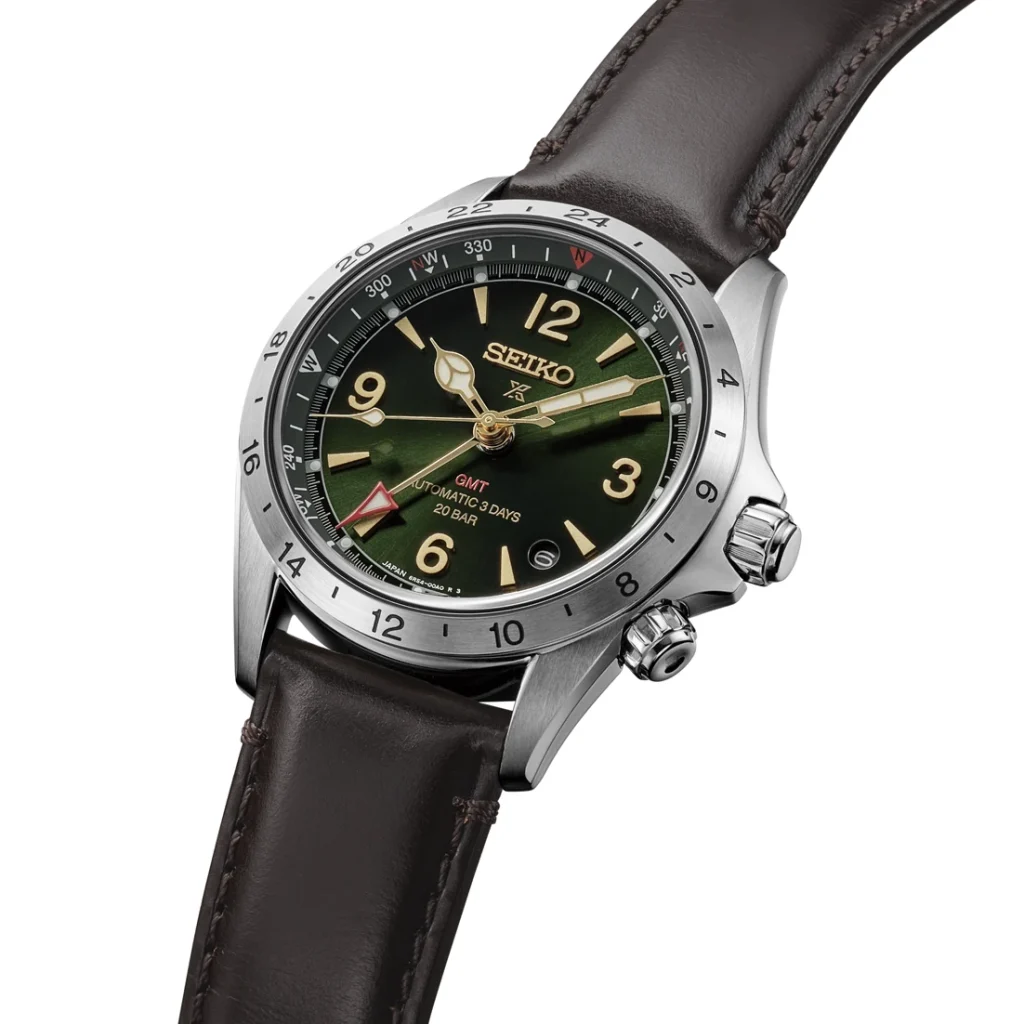
Caliber 6R54 and its 24-hour hand
The 6R54 is a Seiko automatic caliber that adds an independently set 24-hour hand to the time and date. According to Seiko's manual, with the crown in the first position, turning it clockwise advances the 24-hour hand and turning it counterclockwise changes the date. In the second position the seconds hand stops and the hour and minute hands move together. This arrangement is known as an office or caller GMT, because it is designed to track the time somewhere else, such as an office in another country, without touching local time.
On a traveler GMT, such as the Baltic Aquascaphe GMT MK-II that ORELO reviewed in September, it is the hour hand that jumps in one-hour steps without stopping the watch. On the Alpinist GMT, changing local time after landing in a new time zone means pulling the crown to the second position, which stops the seconds hand while the hour and minute hands are moved. The watch can also be used the other way around, with the main hands on home time and the 24-hour hand on local time, read on the bezel scale; that way only the 24-hour hand is adjusted when crossing time zones, and the watch keeps running.
Pricing and distribution by market
In Spain, Seiko lists the HBC007 at EUR 1,350, 50 euros more than the blue SPB377; in the United States both versions carry the same price. Seiko's Latin American website includes the HBC007 in the Alpinist catalog, without a price, alongside a locator for authorized dealers. In Mexico, the Prospex collection is sold in department stores such as El Palacio de Hierro, and the locator can be used to ask dealers in Mexico, Colombia or Argentina whether they will receive the HBC007.
A green Alpinist with a second time zone
The HBC007 brings together the green dial and gold numerals of the SARB017 and the 24-hour hand of the Alpinist GMT. Here that hand does two things. It tracks the time in another country, and with the internal ring it gives a rough bearing from the sun. Its 39.5 mm diameter and 200 meters of water resistance, suitable for swimming and recreational diving, are those of an everyday field watch.
Sixty-seven years after the Laurel Alpinist, the HBC007 keeps that first model's screw-down caseback and cardinal points, and adds a second time zone.