
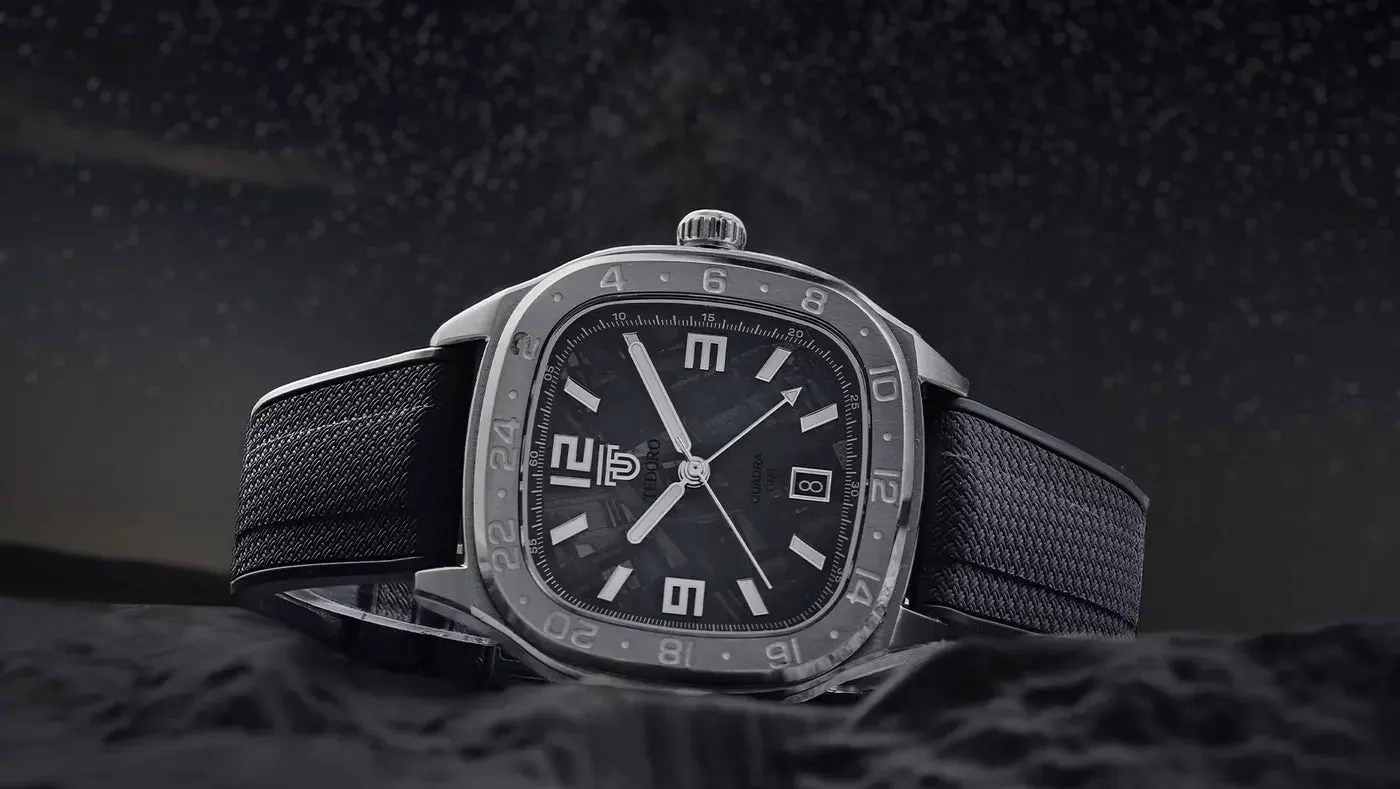

The iron in this dial is as old as the solar system. Metallic meteorites come from the cores of rocky bodies that formed some 4.5 billion years ago and were later shattered by collisions; what eventually reaches Earth are fragments of those cores. Tedoro cuts them into wafers under a millimeter thick and mounts them behind a set of hands.
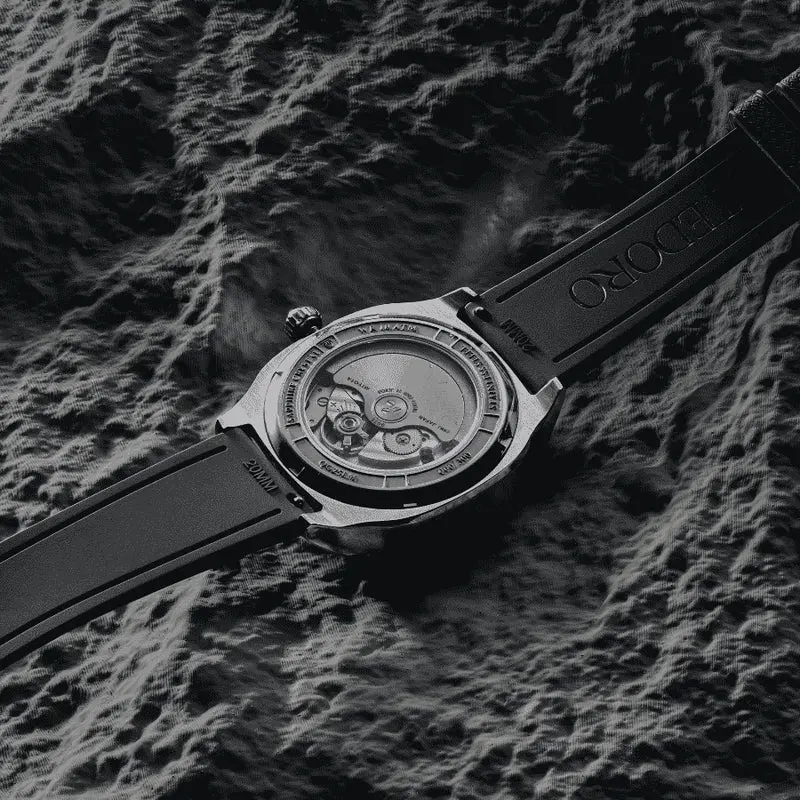
The Quadra's other unusual quality is at its perimeter, not its center. The case is square. Scroll through a year of sub-$1,000 microbrand releases and the catalog is overwhelmingly round: divers, pilots, field watches, GMTs, all circular. The square case exists, but it lives in a narrow niche.
Where the Material Comes From
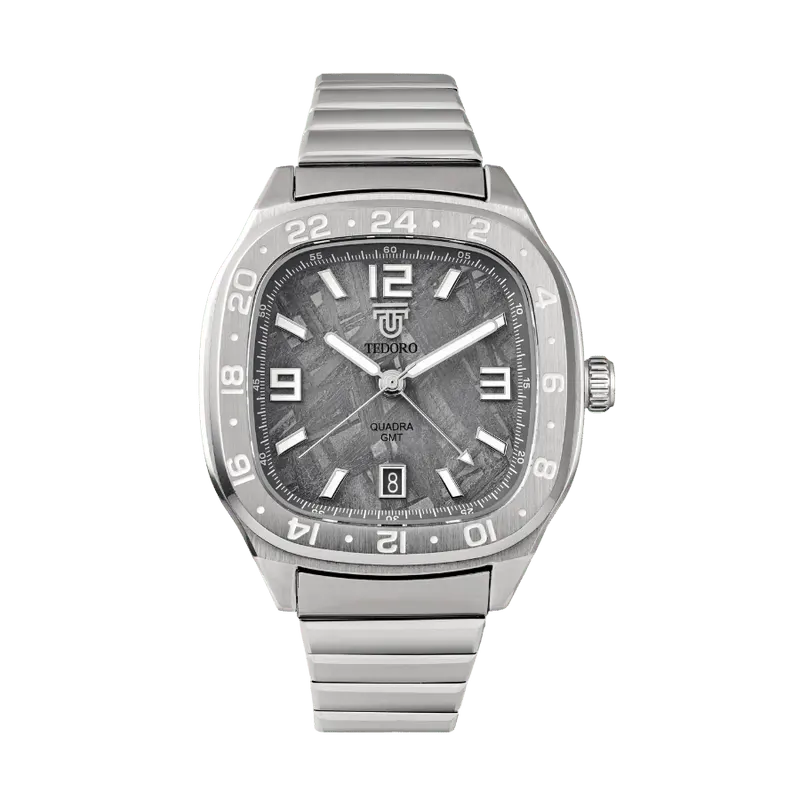
The reference material in watchmaking is Gibeon meteorite, sourced in Namibia and prized for the clarity of its Widmanstätten pattern: the angular lattice of iron and nickel crystals that runs across a cut surface. It isn't a finish, isn't a print, and can't be manufactured. It forms only when an iron-nickel alloy cools over millions of years, inside an asteroid-sized body, in the vacuum of space. No terrestrial furnace can sustain that process.
That material sits in the catalogs of Rolex, IWC, and Patek Philippe, in references that start well above $5,000. Tedoro is asking $890.
It comes with a caveat worth stating plainly: iron meteorite rusts. Standard practice in watchmaking is a galvanic treatment, usually rhodium, to stabilize the surface. I couldn't confirm what treatment Tedoro applied to this reference, so I won't assume. Either way, this is not a watch for swimming or prolonged humidity, whatever the water resistance figure turns out to be.
The Shape the Market Left Behind
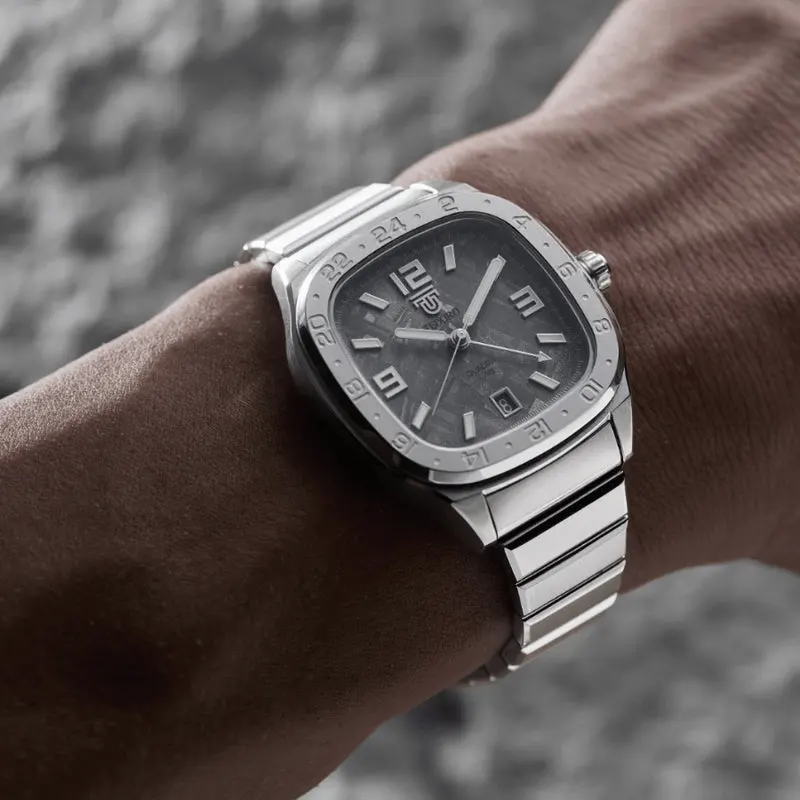
The square case is nothing new. The Cartier Tank dates to 1917, the Reverso to 1931, and the 1970s produced an entire wave of square and TV-screen profiles from Seiko, Rado, and Omega. What happened next is that the dive watch became the dominant sports-watch archetype, and a diver is round out of functional necessity: a rotating bezel wants a circumference. Four decades of that archetype left the square case as a minority aesthetic decision.
That's where its appeal lies, and its problem too. A 40mm square case doesn't wear like a 40mm round one: the corners extend the footprint across the wrist, so real presence runs noticeably larger than the number suggests. On a slim wrist, this may simply be too much watch. It's the kind of spec worth checking against the official sheet before buying blind, because there's no boutique where you can try one on.
The Movement
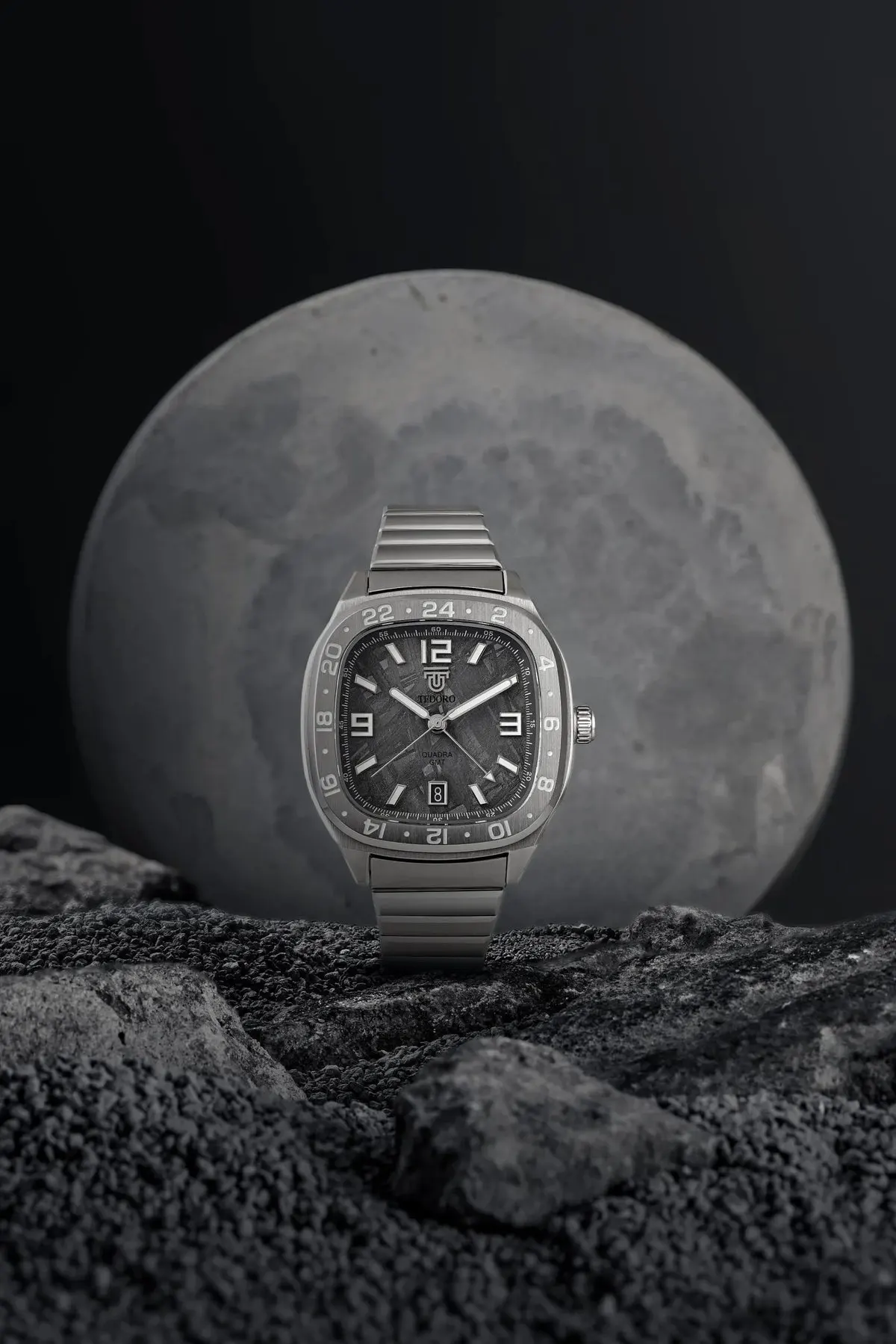
The Miyota 9075 is a Japanese automatic with an independent GMT hand: you set the second time zone without touching local time. It beats at 28,800 vph (4 Hz) with roughly 42 hours of power reserve. It isn't a glamorous caliber, there's no manufacture architecture to narrate and no decoration to admire, but it has globally accessible service and a well-documented durability record. At this price, a certified Swiss caliber would be hard to justify. The question isn't whether the 9075 is the ideal movement, but whether it delivers what this watch promises. It does.
The edition is limited to 300 pieces. The $890 price applies to the pre-order window, with shipping scheduled for October 2026, three months after launch. That wait is the right moment to review Tedoro's delivery record on previous releases; microbrands vary widely here, and anyone committing $890 plus duties deserves to check.
| Case | Stainless steel, 40mm, square (verify exact dimensions) |
| Dial | Natural iron meteorite with Widmanstätten pattern |
| Caliber | Miyota 9075, automatic, independent GMT, ~28,800 vph (4 Hz), ~42h power reserve |
| Price (MSRP) | $890 USD |
| Production | Limited edition, 300 pieces |
| Availability | Pre-order active; shipping October 2026 |
Latin America and Spain Perspective
There's no official regional distributor: the only route is the brand's website with international shipping. The $890 is the starting point. Add shipping (the brand publishes no rate; I estimate $30 to $60 depending on destination, unconfirmed) plus import duties, which vary by country. In Mexico, the watch tariff plus VAT can add 15% to 30% on the declared value, putting real cost in an estimated $1,050 to $1,200 range. These are unverified estimates for this specific reference: run the numbers with your courier before confirming an order. Colombia and Argentina follow the same pattern, with no local warranty or authorized regional service. In Spain, 21% VAT applies to imports from outside the European Union.
A watch measures time in one-second increments. The material on this dial has been cooling for four and a half billion years. There's something disproportionate about carrying both scales on the same wrist, and that is probably exactly the point.
[…] frente a los golpes y, en el caso del meteorito, frente a la humedad. ORELO reseñó en julio el Tedoro Quadra Meteorite GMT, un GMT de caja cuadrada con esfera de meteorito, y en septiembre el Nivada Grenchen F77 MKII 100 […]