
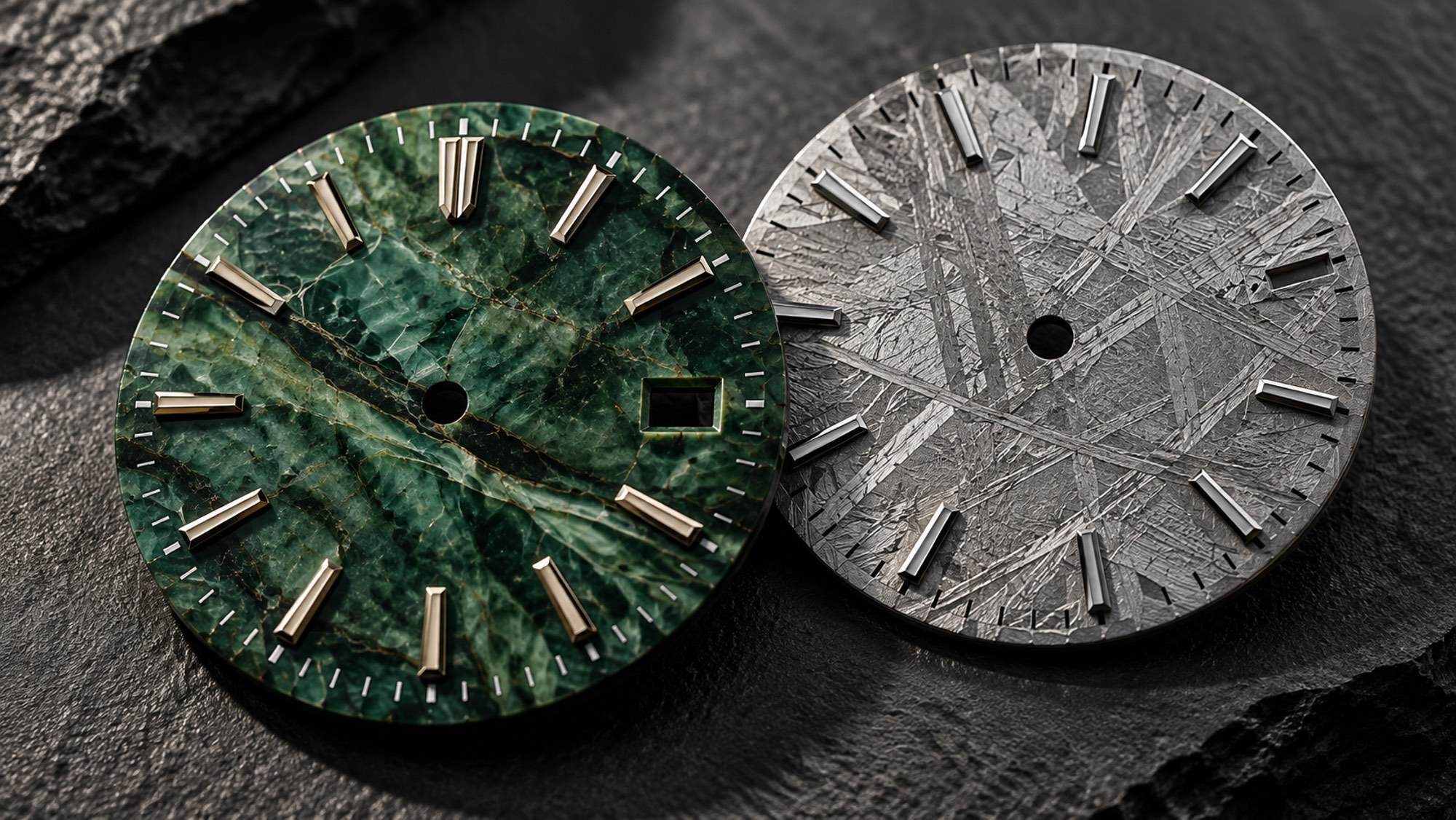

Stone and meteorite dials are very thin slices mounted on a metal base, which makes every watch a one-off and calls for care of its own.
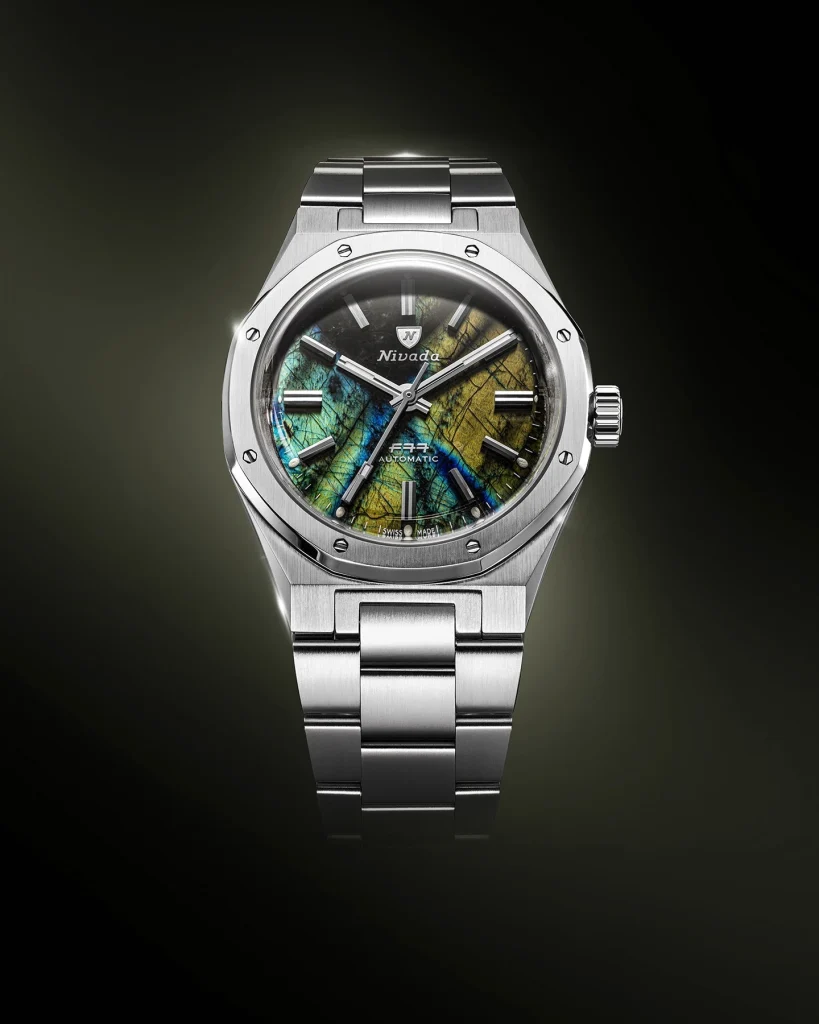
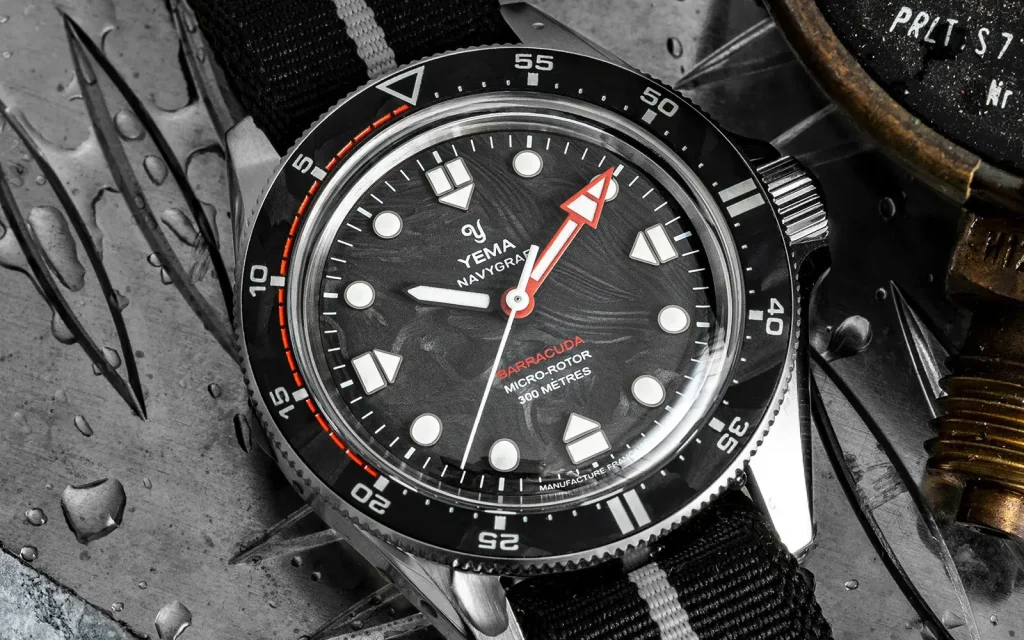
A watch with a stone or meteorite dial raises two questions before purchase: how fragile the slice is and what the meteorite is made of. Two examples arrived in September: Nivada Grenchen released a stone-dial edition of its F77 to mark the brand's centenary, and Yema announced a Navygraf featuring a Muonionalusta meteorite dial.
Stone slices on a brass base
A stone dial is a slice of mineral, usually thinner than a millimetre, glued to a brass or gold plate that keeps it rigid. Horopedia, the online watchmaking encyclopedia, puts the slice at 0.2 to 0.4 millimetres, for a total of 0.8 millimetres once it sits on the base. Think of a very thin marble tile: a sharp knock that would barely bend a metal plate is enough to crack it. Every hole drilled through the slice adds a weak point, which is why many stone dials have printed indices or very few applied parts.
Piaget was the first house to use them, in 1963, and by the 1970s Rolex offered them in a long list of combinations, from onyx to obsidian. Each slice comes from a different part of the stone, so the veining and colour change from one watch to the next. A lacquered dial is a metal plate coated in layers of lacquer, and its colour can be repeated from piece to piece.
Most aventurine dials are glass, with copper particles suspended in the molten mass, a technique Murano's glassmakers have practised since at least the 17th century. Natural aventurine, a variety of quartz, appears in fewer models.
Meteorite iron etched with acid
Meteorite dials are cut from iron meteorites, made mostly of iron with up to 10% nickel. After cutting and polishing, an acid bath reveals the Widmanstätten pattern, a lattice of crossing lines formed by two iron-nickel alloys, kamacite and taenite, which develops when the metal cools very slowly over millions of years. Two of the most common in watchmaking are the Gibeon, from Namibia, which Rolex has used in several references, and the Muonionalusta, whose first fragment was found in 1906 in northern Sweden. Iron rusts in contact with moisture, so brands usually protect the slice with rhodium or gold plating.
Two September releases
The Nivada Grenchen F77 MKII 100 Years comes with a dial in six stones, from azurite to smoky quartz, plus an Ice Agate version limited to 100 pieces, priced at USD 1,590 on a strap and USD 1,790 on the bracelet. Because the veining differs from slice to slice, the watch a buyer receives will not match the photo on the website exactly. Nivada has retailers in Spain and Peru, among other countries; in Mexico it is sold through the brand's own website.
The Yema Navygraf Meteorite CMM.10 pairs its Muonionalusta dial with a 39 mm titanium case rated to 300 metres. It costs USD 3,350, is limited to 150 pieces, and deliveries begin at the end of October. Yema sells it on its website, which ships to Mexico, Colombia, Argentina, Chile and Peru.
What can crack a stone dial
The most common mistake is to treat a stone dial with the same confidence as a lacquered or metal one. Water resistance does not change, since it depends on the case, and the watch is fine for daily wear; what changes is its tolerance for a hard knock, such as a wrist catching a door frame. If the slice cracks, the usual fix is a replacement dial, and the new one will have different veining and colour. On the pre-owned market, hairline cracks tend to appear next to date apertures, indices, the edge and the centre hole, and they lower the value of the watch.
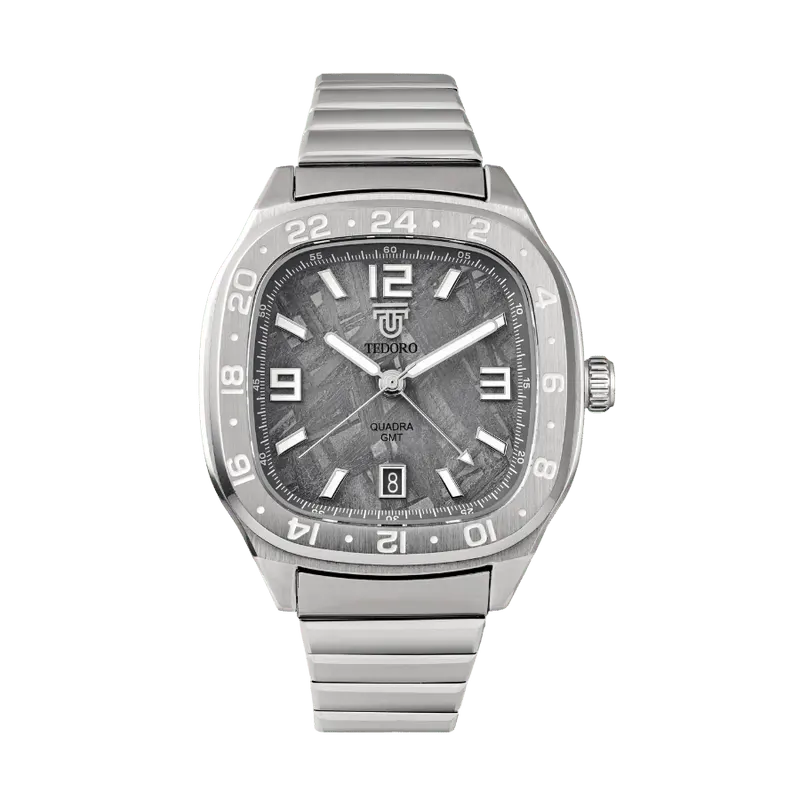
A stone or meteorite dial features a pattern unique to that specific watch and requires extra care regarding impacts—and, in the case of meteorite, moisture. In July, ORELO reviewed the Tedoro Quadra Meteorite GMT, a square-cased GMT with a meteorite dial, and in September, the Nivada Grenchen F77 MKII 100 Years.
[…] Una esfera de piedra no se flexiona, y un golpe seco que una de metal resistiría sin daño puede agrietarla; si eso ocurre, la reparación habitual es sustituir la esfera. La hermeticidad depende de la caja, y la de 30 metros del Opera Black es adecuada para la lluvia y el lavado de manos. ORELO explicó en septiembre cómo se fabrican y cómo se comportan las esferas de piedra en el artículo sobre esferas de piedra y de meteorito. […]