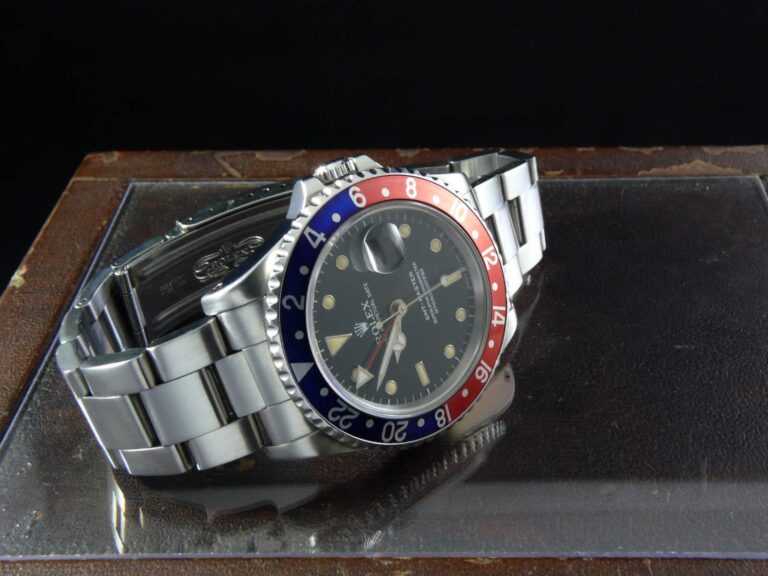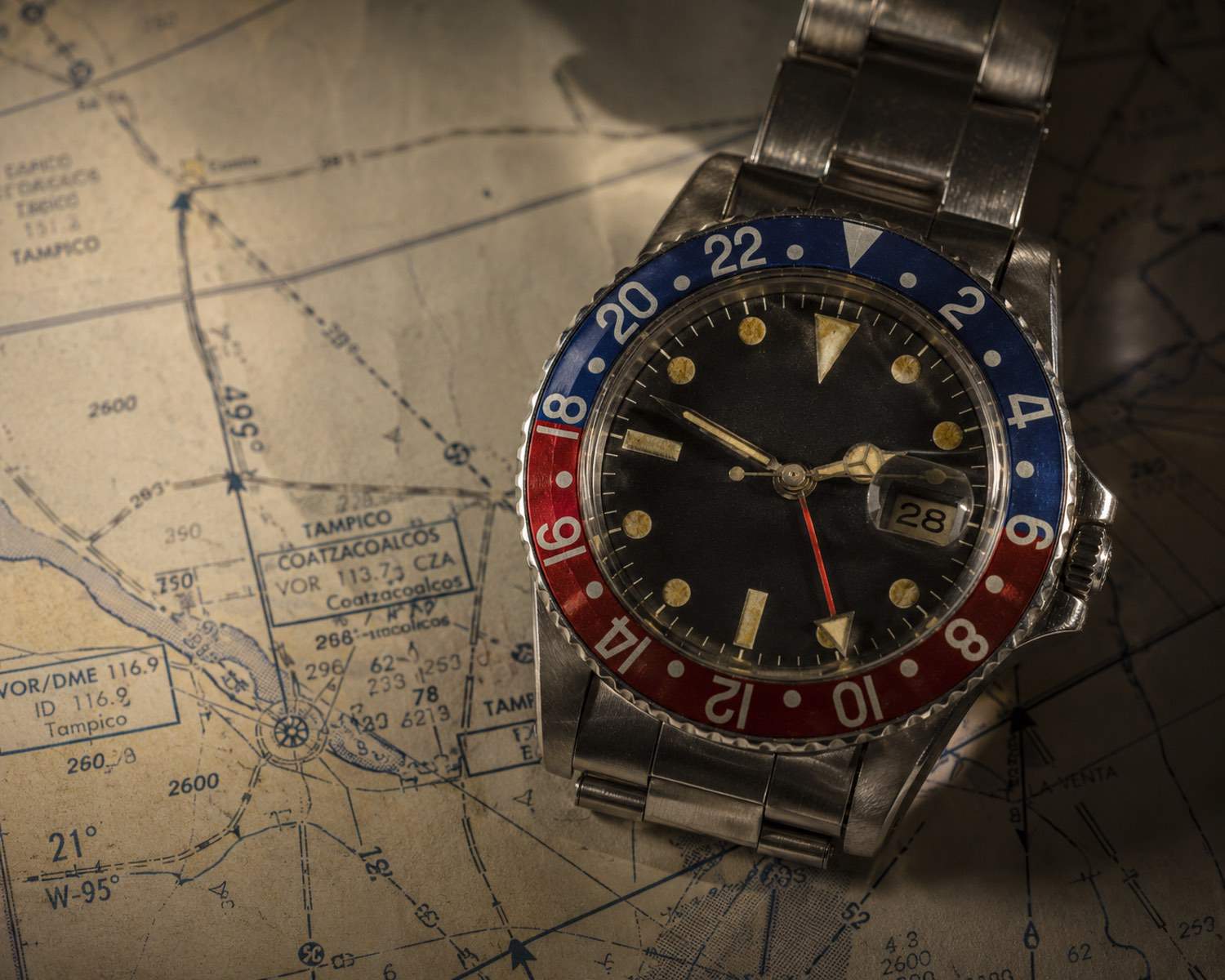

In 1960, thirty Mexican captains traveled to England to learn to fly their country's first jet airliner. When they returned, many wore on their wrists the same watch Pan Am had chosen for its own pilots: the Rolex GMT-Master ref. 1675.
On July 4, 1960, a De Havilland Comet 4C registered XA-NAR lifted off from Mexico City International Airport bound for Los Angeles. The aircraft bore Mexicana de Aviación's livery and one of the most intricate tail designs ever painted on a Latin American commercial plane. It was the inaugural flight of the "Azteca de Oro" (Golden Aztec) service — the first jet operation by a Mexican airline. In that cockpit, on more than one captain's left wrist, a red and blue bezel caught the overhead light. The one collectors now call the "Pepsi."
The story connecting that watch to that aircraft — and to that precise moment in Latin American aviation history — runs deeper than it first appears.
The Watch Pan Am Ordered
In the early 1950s, Pan American World Airways had a growing roster of pilots traveling ever more distantly and frequently. The airline realized that supplying its crews with a watch capable of tracking both local and home time could reduce scheduling errors, help with jet lag, and even boost morale. They approached Rolex and requested the development of a dual time-zone watch for their fleet. Mr Jones Watches
The result was the ref. 6542, delivered in 1954. But the watch that truly defined an era was its successor. By 1959, the GMT-Master had proven its concept, and Rolex was ready to reinvent it from the ground up. The second generation arrived as the ref. 1675 — a complete redesign, inside and out. The new 40mm case introduced crown guards, an aluminum bezel insert, and — from 1963 onward — tritium in place of the radioactive radium used in the previous model. Craftandtailored
The GMT-Master was quickly adopted by many airlines as the GMT standard became required for all aviation planning and navigation. Rolex's 1960s catalog prominently highlighted the fact that both pilots and navigators considered the watch an essential professional instrument. Rescapement.
The Mexican Connection: From Hatfield to Mexico City
Here is the piece of the story that rarely gets told.
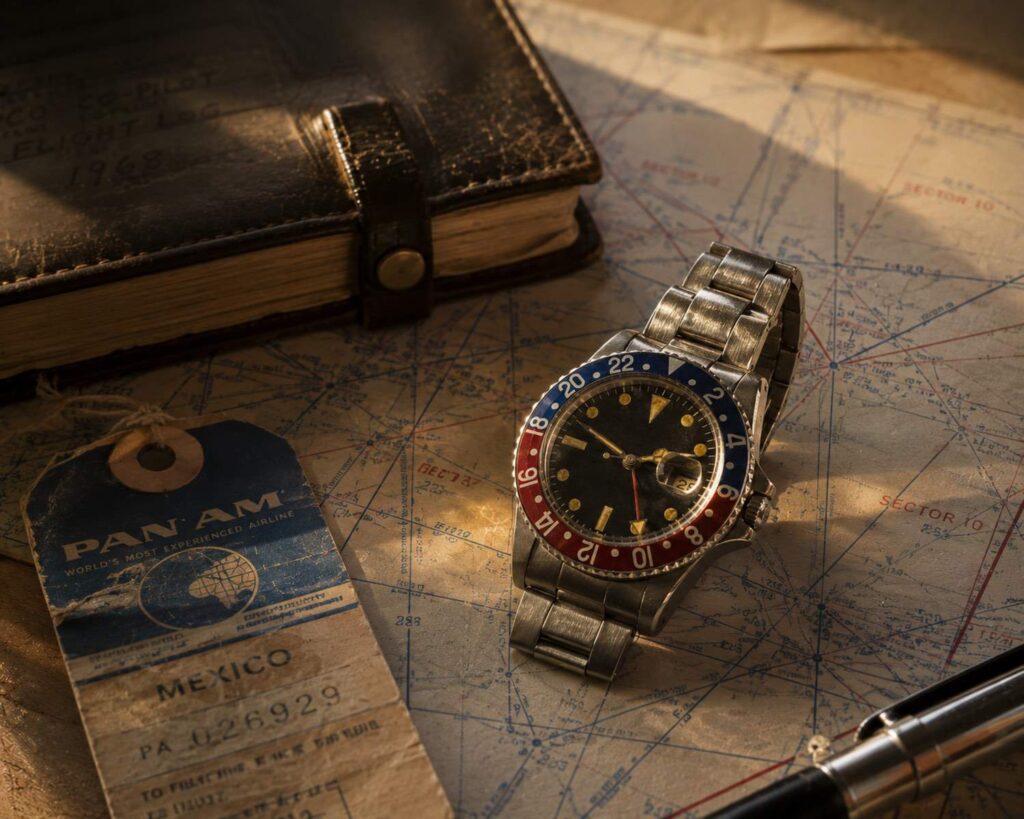
In 1959, with Pan American's direct assistance, Mexicana ordered De Havilland Comet 4C aircraft. Given the close relationship between the two airlines — Pan Am had been a co-founder of Mexicana and financed the Comets directly — thirty of Mexicana's senior captains traveled to the United Kingdom for conversion training. Mexicana launched its first jet services on July 4, 1960, on the Mexico City–Los Angeles route, making it the first foreign airline to serve Los Angeles. Substack
Pan Am was, by that point, the most prominent operator of the GMT-Master ref. 1675 in the world. Beginning in 1965, Rolex ran full-page advertisements featuring Pan Am pilot Bernard Lorenz alongside the airline's logo, explicitly tying the watch's identity to international civil aviation. That visual and cultural link traveled from Pan Am to Mexicana through shared training, shared procedures, and — almost certainly — the duty-free shops at New York and London stopovers where newly jet-rated Mexican captains made their purchases. Ad Patina
No official document confirms "Mexicana equipped its pilots with the ref. 1675." What does exist is the context that makes it near-inevitable: the first generation of Latin American jet pilots, trained alongside and by Pan Am crews, crossing multiple time zones on routes like Mexico City–Chicago–New York, with precisely the operational need the watch was built to address. Varig, the other major Latin American carrier of the period, was simultaneously expanding its routes to Lima, Bogotá, Caracas, Miami, Los Angeles, and Mexico City — building a continental network that demanded exactly this kind of cockpit tool. Simple Flying
The Watch Through Time
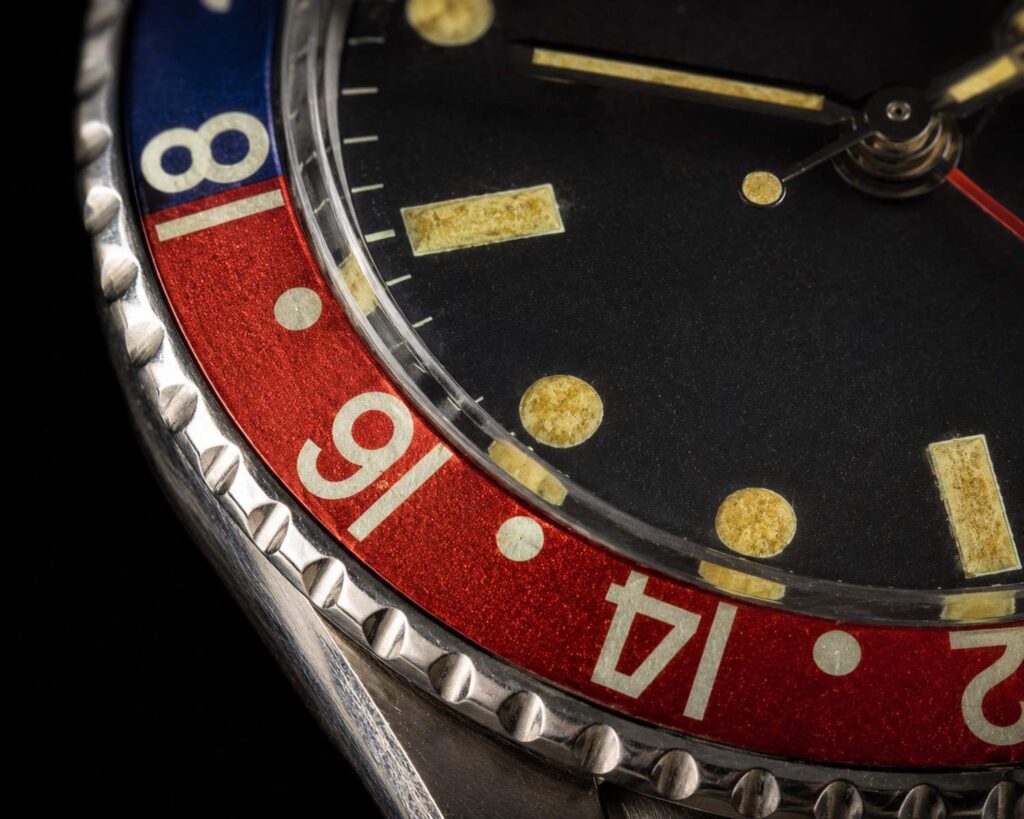
Because ref. 1675 production spanned the entirety of both the 1960s and the 1970s — it was the only GMT-Master Rolex produced between 1959 and 1980 — a remarkable diversity exists within a single reference number. It is the only GMT-Master Rolex ever fitted with both gilt and matte dials. Collectors today distinguish between the "thin font" examples of the 1960s and the "Fat Font" variants of the early 1970s, whose bolder bezel numerals make them immediately recognizable. Craftandtailored
The ref. 1675 outlasted the entire golden age of Latin American aviation. It was in production when Mexicana inaugurated the Azteca de Oro service in 1960, when Aeronaves de México rebranded as AeroMéxico in 1972, and when Varig reached its commercial peak with European-style first-class cabins in the mid-1970s. By 1977, Mexicana — operating a fleet of 31 Boeing 727s — had become Latin America's largest passenger airline by total flights, and in 1978 it became the first Latin American carrier to transport five million passengers in a single year. All of that growth happened with the ref. 1675 on the wrists of the generation of pilots who opened those routes. Reference for Business
Latin America Perspective
The GMT-Master ref. 1675 is not an accessible watch from anywhere in the region today. On the secondary market, a well-preserved example averages around USD $17,800 on Chrono24, with excellent-condition pieces — particularly those with original gilt or tropical dials — climbing considerably higher. Top-quality 1675 examples with original dials and unpolished cases typically start around USD $24,000 and move higher depending on dial integrity and component originality. Chrono24Luxury Watches USA
For buyers in Mexico, Colombia, or Argentina, import duties add significantly to that figure. In Mexico, roughly 16% VAT plus an estimated 15–20% tariff can bring the all-in cost to approximately MXN $550,000–700,000 for a solid example. Chrono24 remains the most reliable platform for sourcing authenticated examples; MercadoLibre listings appear occasionally but demand rigorous authentication — the ref. 1675 is among the most replicated references in the vintage market.
A note of caution: this reference rewards experience. Original dials, unpolished cases, and untouched movements are the difference between a watch worth USD $18,000 and one worth twice that. For a first foray into vintage Rolex, the ref. 16750 or ref. 16700 offer safer, more verifiable entry points.
There is something quietly remarkable about a watch commissioned to manage Atlantic crossings ending up in a Mexican cockpit bound for Los Angeles. The ref. 1675 doesn't record that history in any official catalog. It carries it instead in every dial that survived the 1960s and 1970s on a Latin American wrist. Watches don't remember. But sometimes, we do.