
The brand, which closed in 1996, returns with eleven models ranging from $2,900 to $6,700—positioned at the entry level of the group Breitling has been building since 2023.
At 10:35 on the morning of December 17, 1903, on the dunes at Kill Devil Hills, North Carolina, Orville Wright released the restraining wire on the Flyer and covered about 120 feet in twelve seconds, with Wilbur running alongside the wing. John Daniels, a volunteer from the nearby lifesaving station, tripped the shutter on a camera the brothers had preset on the launching rail. That photograph has illustrated the birth of aviation ever since.
The other instrument that recorded the morning sits in a case at the National Air and Space Museum in Washington, catalogued as A19640054000: a nickel-plated pocket stopwatch with a white dial, black Arabic numerals, a minute register above the seconds pivot and the words "The Sun" in script beneath it. Gallet made it. That December the company had been in business for seventy-seven years.

A racetrack timer at Kitty Hawk
"The Sun" was not a Gallet model but the trademark of a New York importer, and the instrument had nothing to do with flight: it was a horse timer the company had been selling since the 1890s, pressed into service that day because it resolved seconds finely enough.
Gallet was on that dune because of a commercial decision taken half a century earlier. U.S. records place the company's representation in the country as early as 1856, and in 1890 Jules Racine, the founder's grandson, established the New York firm that would serve as sole importer for decades. By 1930, the trade journal The Jewelers' Circularreported that Gallet brought in the large proportion of timers used in the United States.
The Flying Officer and the liquidation
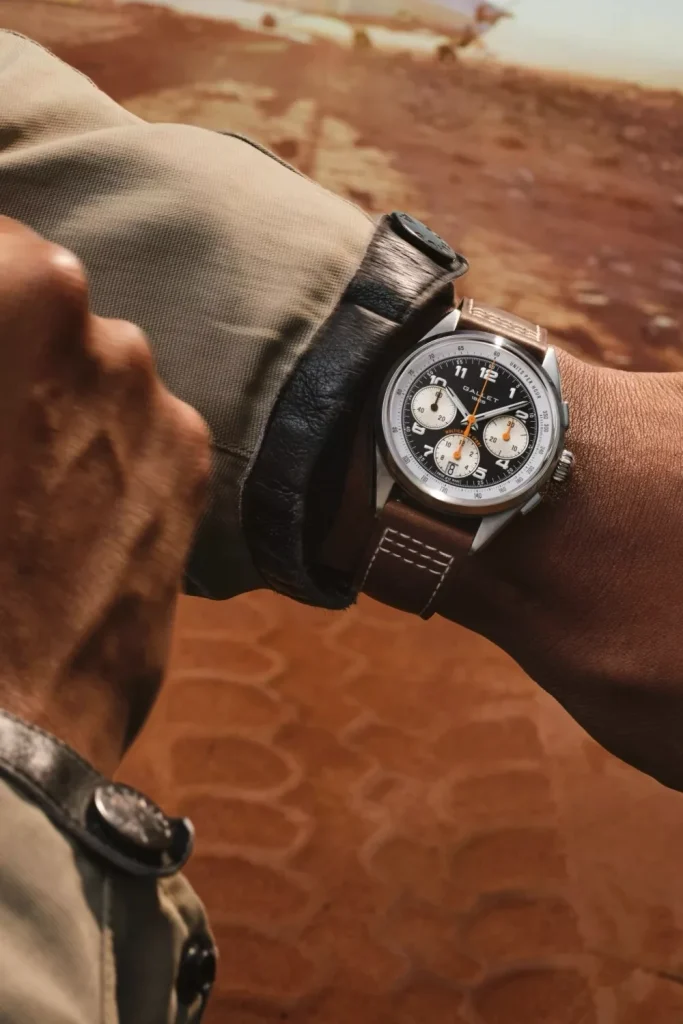
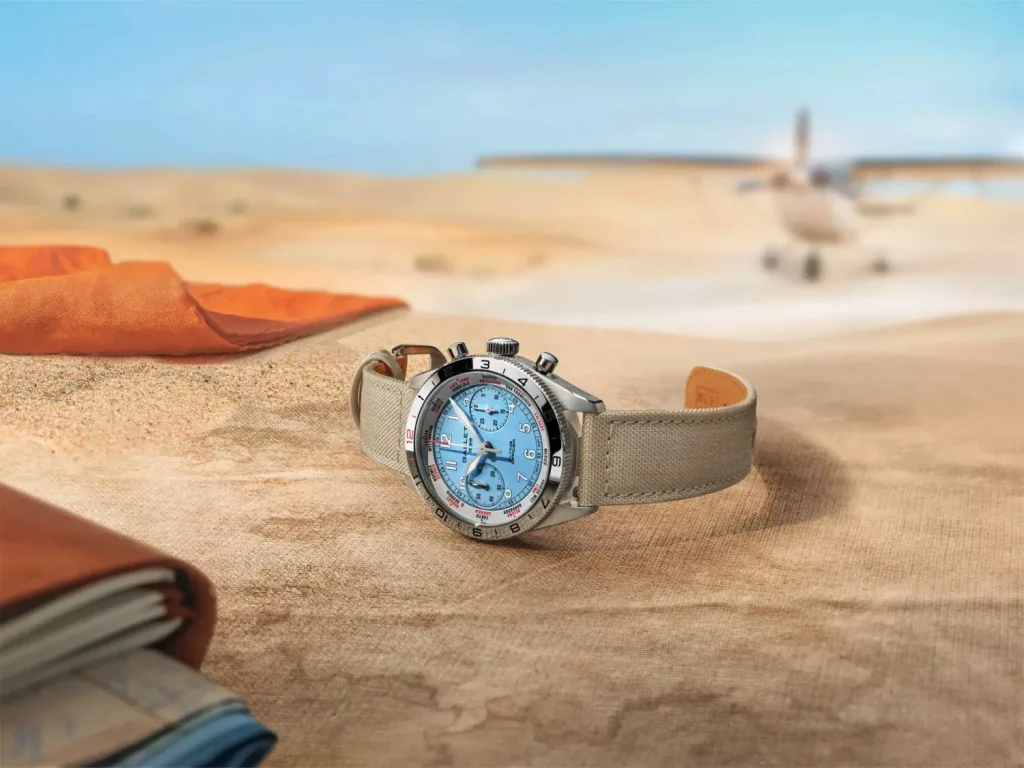
In the late 1930s Gallet introduced the Multichron Regulator and the waterproof Multichron, its two-part clamshell case screwed together at the foot of the lugs and advertised in the United States as the first timing instrument of its kind in the country. Then, in 1939, came the model the relaunch now rests on: the Flying Officer, a chronograph wristwatch with a ring of cities ordered by time zone around the dial. Those cities were refueling points for crews beginning to string together intercontinental legs, not holiday destinations. An early example reached then-Senator Harry S. Truman, a gift from his secretary Victor R. Messall and the attorney Paul Nachtman, and it remains the best-documented watch in the brand's history.
What followed is the familiar story of half of Swiss mechanical watchmaking. Gallet sourced its calibres from Excelsior Park, and to a lesser degree from Venus and Valjoux; quartz dismantled that business model through the 1970s and 1980s. The family gave up ownership in 1994, the brand passed to other Swiss hands, and it was liquidated in 1996 after several attempts to revive it, as Forbes España reconstructs. Breitling bought it in early 2025.
Buying a name with a past
Breitling acquired Universal Genève at the end of 2023 and relaunched it in April 2026 around the Polerouter, starting near CHF 15,000. The parent brand occupies the middle band, roughly CHF 5,500 to 30,000. Gallet closes the structure from below, at CHF 2,500 to 5,900. One owner, three price floors, and two historic names revived inside three years.
Building a brand from nothing means manufacturing credibility with product and with years. Buying a silent name delivers it finished: a photographic archive, models collectors recognize on sight, and a community that has spent decades defending them in forums and at auction. Gallet returns with a stopwatch in the Smithsonian and a watch worn by a U.S. president, and no brand founded this year can buy that.
The title the brand no longer claims
For years it was said that Gallet was the oldest watchmaking house in the world. The claim rested on Humbertus Gallet's Geneva citizenship in 1466 and on family oral tradition of watchmakers and goldsmiths, but not a single piece attributable to those ancestors survives, and documented continuity begins in 1826. On that date Gallet falls behind Vacheron Constantin (1755), Girard-Perregaux (1791) and Bovet (1822). The relaunched brand's official site no longer mentions the title. It says "founded in 1826," and nothing more. This is the kind of fact that usually grows during a relaunch; here it shrank.
Eleven references, four collections
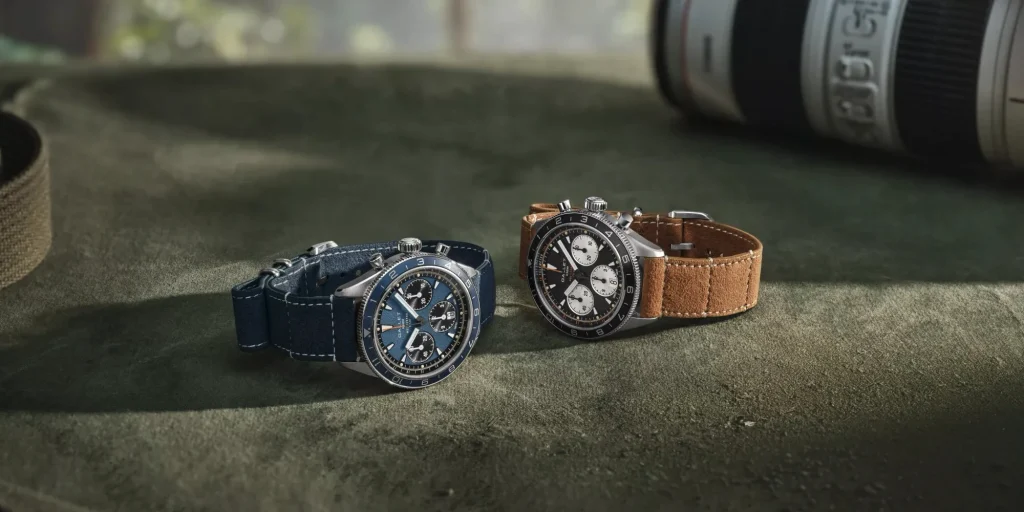
The catalogue runs to eleven watches across four lines. The 40 mm Flying Officer arrives as a three-hander with the Gallet 17 on a Sellita SW200 base, and as a chronograph with the Gallet 23 on a Sellita SW510 base. The Multichron Pilot measures 42 mm with a bidirectional 12-hour bezel and a telemeter scale; the Multichron Sport sits at 41 mm with a fixed bezel and a tachymeter. All three share the calibre, 100 meters of water resistance, a solid caseback and 20 mm lugs on quick-release bars, so any strap in the range fits any watch.
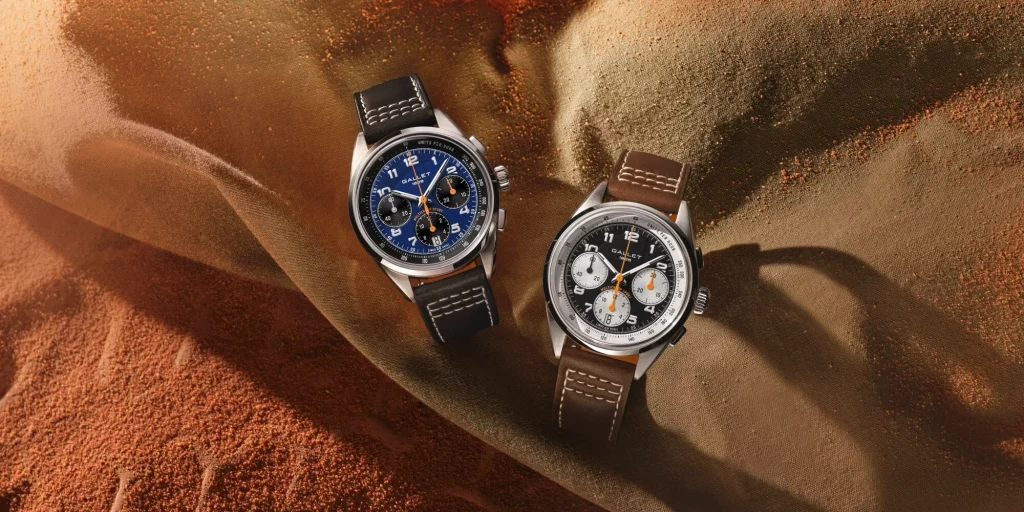
The Gallet Classics stand apart: three 38 mm hand-wound chronographs running Breitling's in-house B09, COSC-certified with a 70-hour power reserve, reinterpreting the Multichron Yachting Big Eye, the Multichron 45 and the Silverlight. They are the only ones with a sapphire back and no Sellita base underneath.

"When I talk about product accessibility, I don't only mean price. I also mean that we have 11 references," Georges Kern said at the Geneva launch, in remarks reported by Forbes España. The simplification is real and shows up in use: one lug width, one price per watch type, and straps that move between every model.
A $4,400 chronograph on a Sellita base competes head-on with Tudor and Longines, which at that price offer exclusive calibres or chronometer certification, and Forbes España names those two, along with TAG Heuer, as the group's declared target. The Classics make the stronger case: by the same comparison, a COSC-certified B09 at $6,700 undercuts the Breitling carrying that movement.

Distribution in Spain and Latin America
Gallet did not open its own retail network; instead, it relies on Breitling’s network, comprising around 160 points of sale—90 of which are parent-brand boutiques—along with an online store. Of that total, 85 stores are located in Europe, while 45 are distributed across Canada, the United States, and Mexico.
Technical Specifications · Gallet, 2026 Collections
| Collections | Flying Officer, Multichron Pilot, Multichron Sport, Gallet Classics |
| References | 11 watches |
| Case | Steel. 40mm (Flying Officer), 42mm (Multichron Pilot), 41mm (Multichron Sport), 38mm (Classics) |
| Water resistance | 100 m across the three contemporary collections |
| Chronograph movement | Gallet 23, automatic, Sellita SW510 base, approx. 65-hour power reserve. |
| Three-hand movement | Gallet 17, automatic, Sellita SW200 base, approx. 38-hour power reserve. |
| Classics movement | Breitling B09, manual-winding manufacture movement, COSC-certified, 70-hour power reserve |
| Caseback | Solid in the contemporary models, sapphire in the Classics. |
| Straps | 20mm handles across the range, quick-release bars, leather, rubber, fabric and field |
| Prices (USD) | 2,900 Automatic Flying Officers · 4,400 chronographs · 6,700 Classics · +200 on bracelets |
| Prices (Spain) | €2,600 · €4,100 to €4,300 · €6,100 · additional straps €90 |
| Distribution | Around 160 points of sale, 90 of which are Breitling boutiques. |
| Availability | From September 3, 2026 |