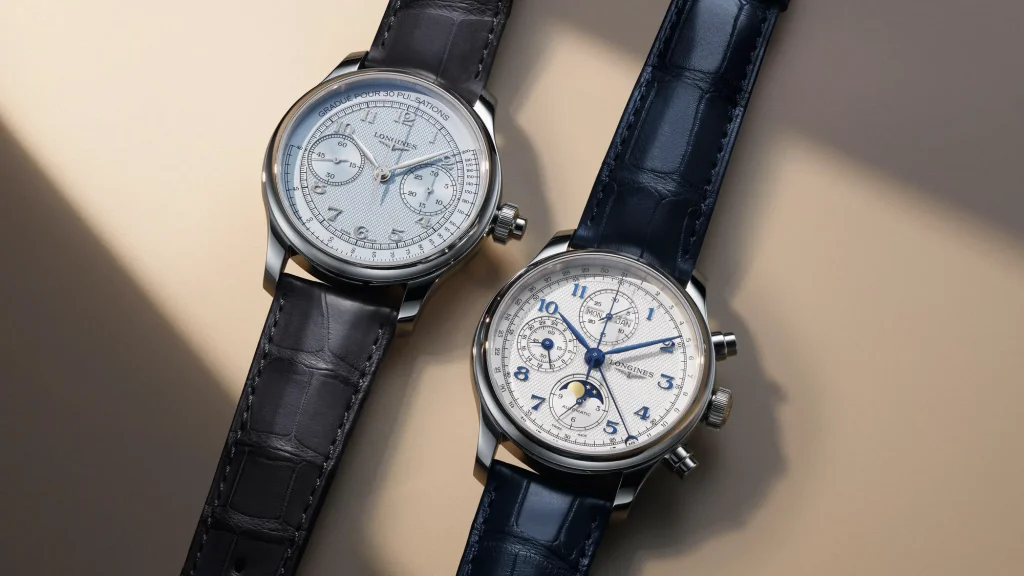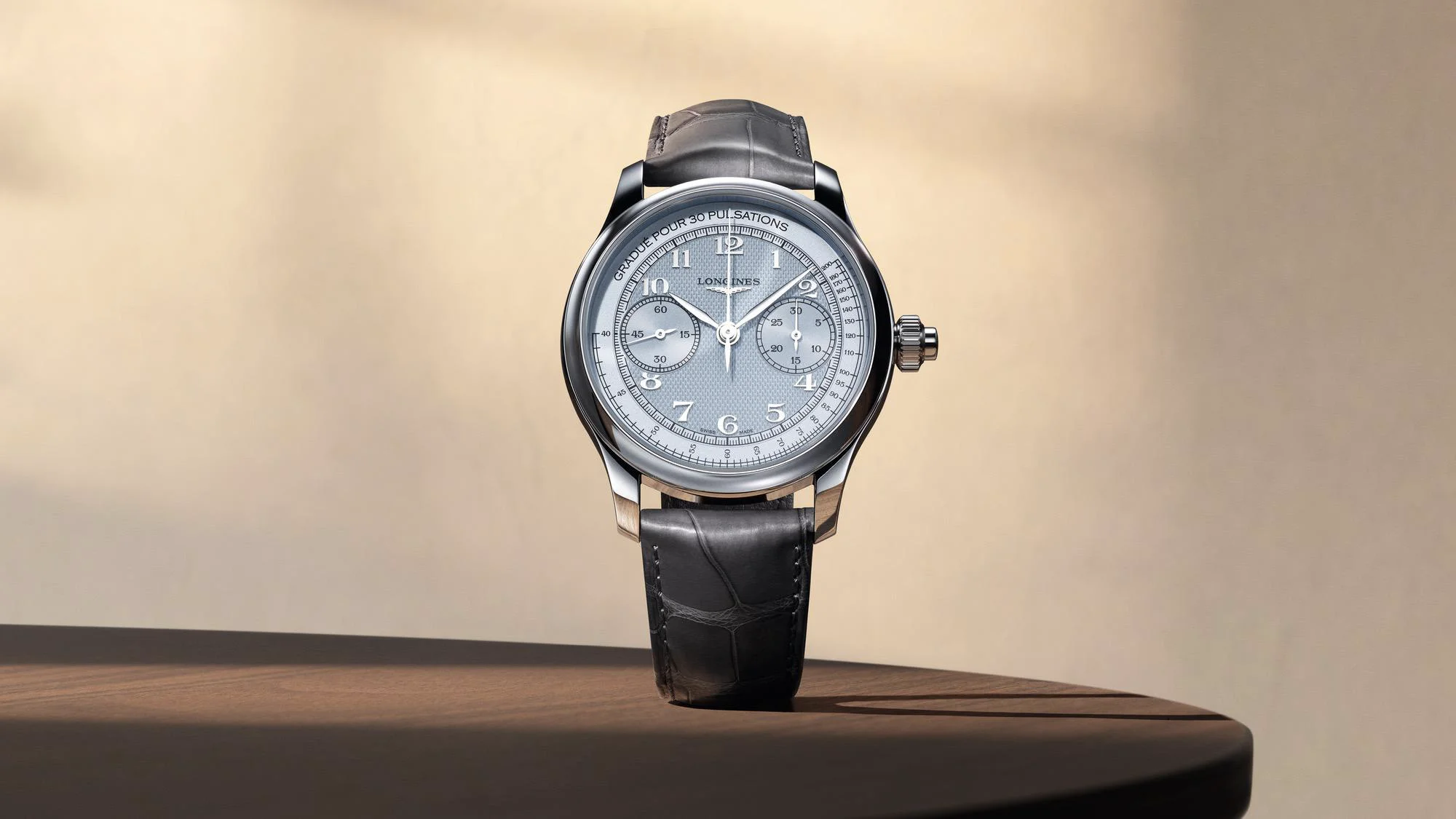

The Master Chrono Monopusher takes up a complication the Saint-Imier house first fitted to a wristwatch in 1911, with a hand-wound calibre, a column wheel and a pulsometer scale.
The Master Collection has been the classical side of the Longines catalogue since 2005, and this year the brand rebuilt it entirely, with concave case surfaces, dials carrying a finer barleycorn pattern and adjustment systems in every clasp. What remained was the complicated end of the range, which arrived in late August with two pieces. One is an update of the Chrono Moonphase; the other, the Chrono Monopusher, takes up a complication the current catalogue did not offer.
Technical Specs
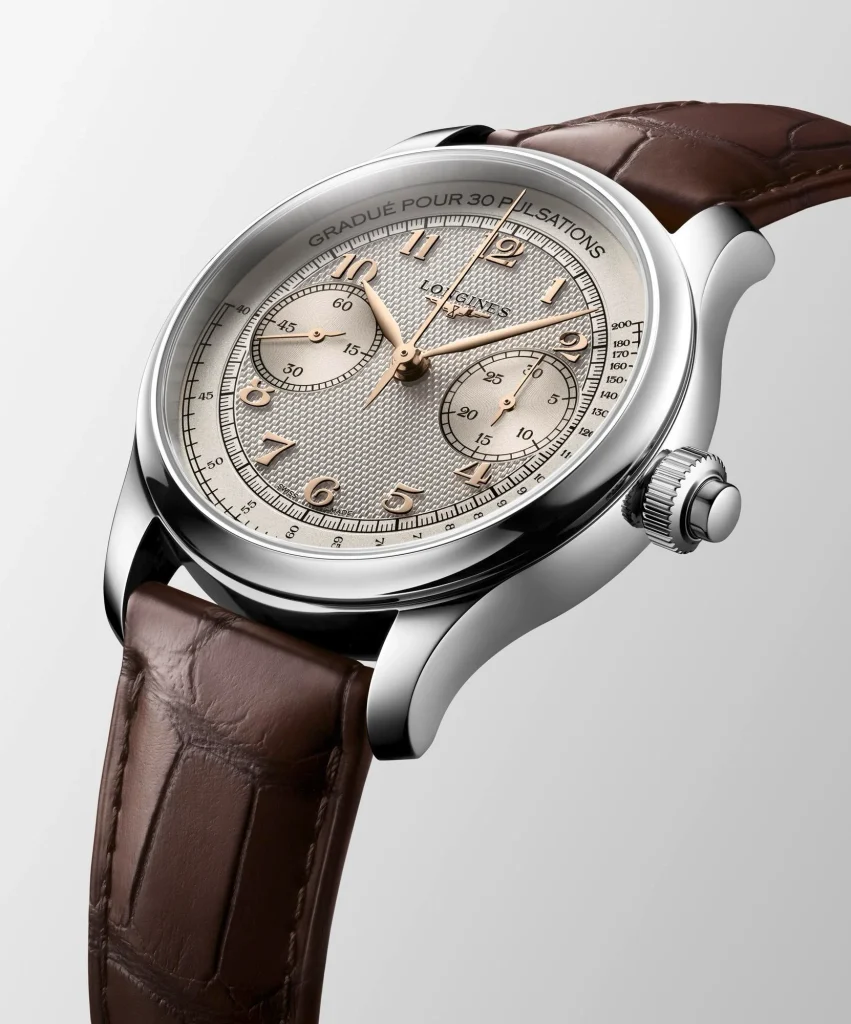
| References | L2.960.4.78.2 (ivory dial, brown strap) · L2.960.4.93.2 (frosted blue dial, anthracite strap) |
| Case | Polished stainless steel, 41 mm diameter, 12.6 mm thick, 48.6 mm lug to lug |
| Crystal | Anti-reflective sapphire on both sides, plus sapphire caseback |
| Water resistance | 3 bar (30m) |
| Dial | Barleycorn pattern in ivory or frosted blue, black printed pulsometer scale, snailed subdials |
| Hands and markers | Applied numerals and leaf-shaped hands, polished or rose-gold toned depending on version |
| Caliber | Calibre L799.5, Longines exclusive, manual winding |
| Chronograph | Monopusher with column wheel, pusher integrated into the crown |
| Frequency | 28,800 vph (4Hz) |
| Power reserve | 68 hours |
| Functions | Hours, minutes, small seconds at 9, 30-minute counter at 3 |
| Strap | 21 mm alligator leather, triple folding safety clasp with fine adjustment |
Case and dial
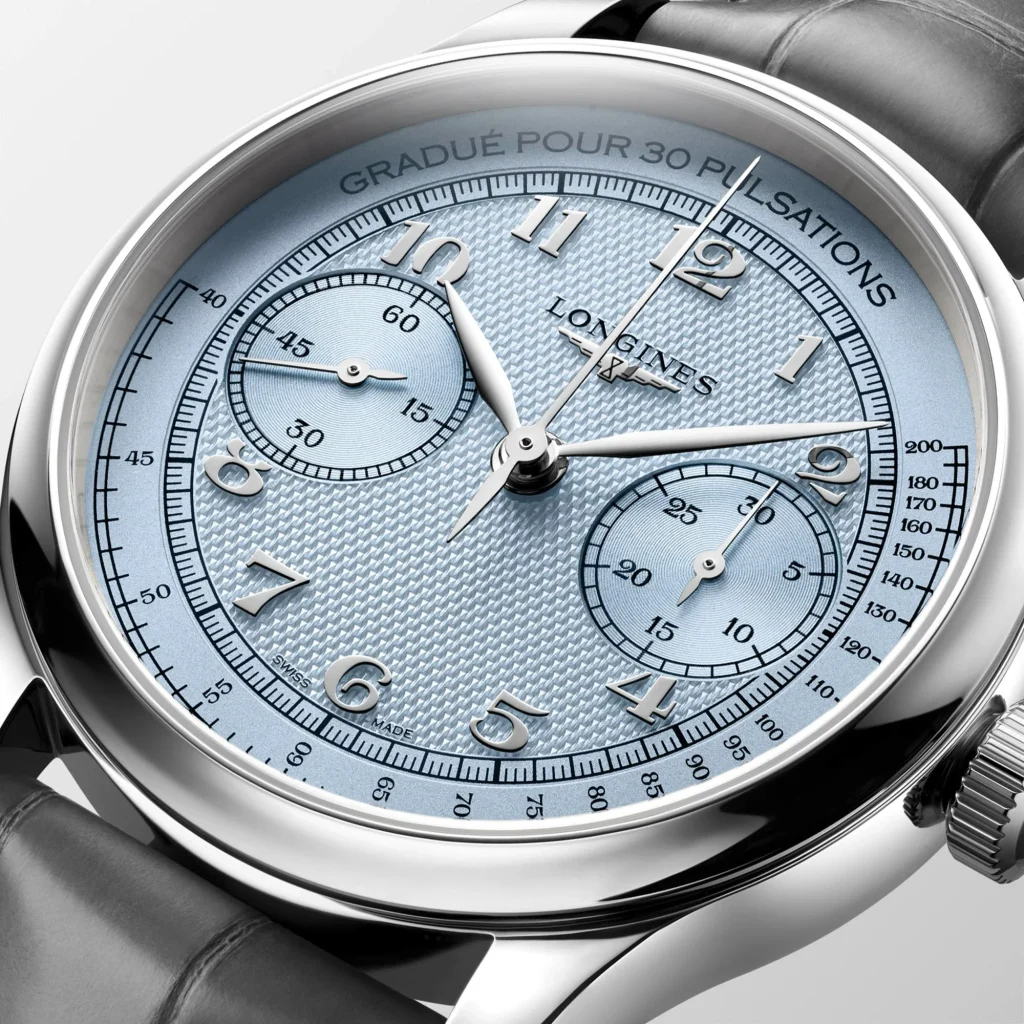
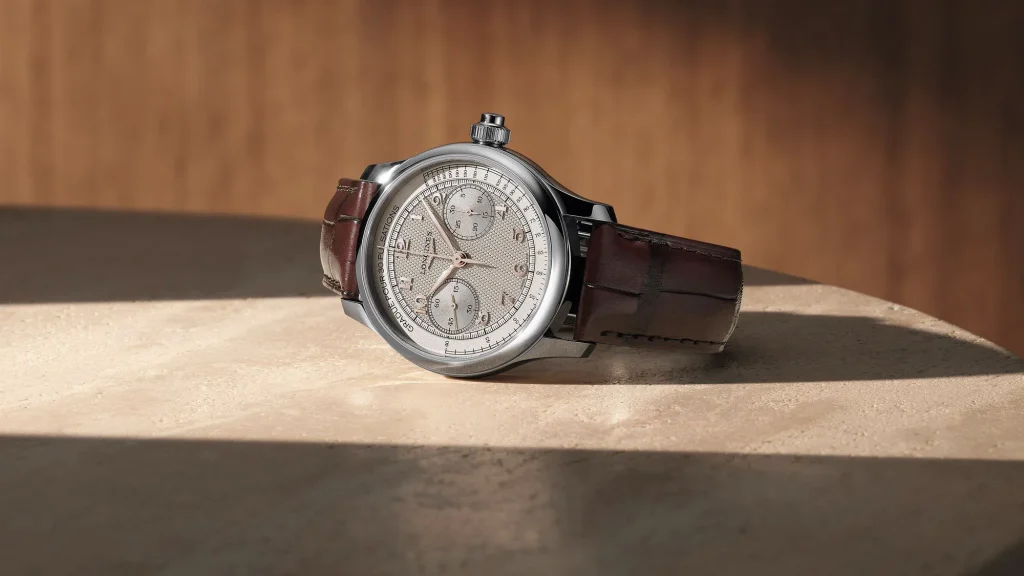
The right flank of the case carries none of the two pushers a chronograph usually wears, only a knurled crown housing the single button of the whole watch, and much of the character of the piece rests on that absence: in profile it reads as a three-hander, and only the dial gives away what sits inside. The barleycorn texture fills the centre in a very fine grain, the two snailed subdials sit symmetrically at 9 and 3, and the pulsometer scale runs around the perimeter, printed in black over ivory or over frosted blue.
The ivory version, with applied numerals and rose-gold-toned leaf hands, is the classical reading of the design; the frosted blue, with rhodium-plated elements, repeats the shade Longines introduced this year on the HydroConquest and the Conquest Heritage. At 12.6 mm the case stays restrained for a mechanical chronograph, though 48.6 mm lug to lug puts it beyond those who prefer more discreet proportions. The 3 bar of water resistance belongs to a dress watch, and to that add a pusher housed in the crown and an alligator strap as the only choice, since no bracelet version exists.
A single pusher
The monopusher gathers into one button the three commands a conventional chronograph splits between two: the first press starts the central seconds hand, the second stops the measurement and the third returns it to zero. There is therefore no way to pause and resume, because once the chronograph has been stopped the only available action is to reset it and begin again. Next to any two-pusher chronograph, that is a limitation in use.
The pulsometer scale on the dial belongs to the same world. Before electronic monitors, a doctor would start the chronograph, count thirty heartbeats, stop the hand and read the beats per minute straight off the scale, with no arithmetic in between. One single measurement, without pauses, which is precisely what a monopusher handles well.
Calibre L799.5
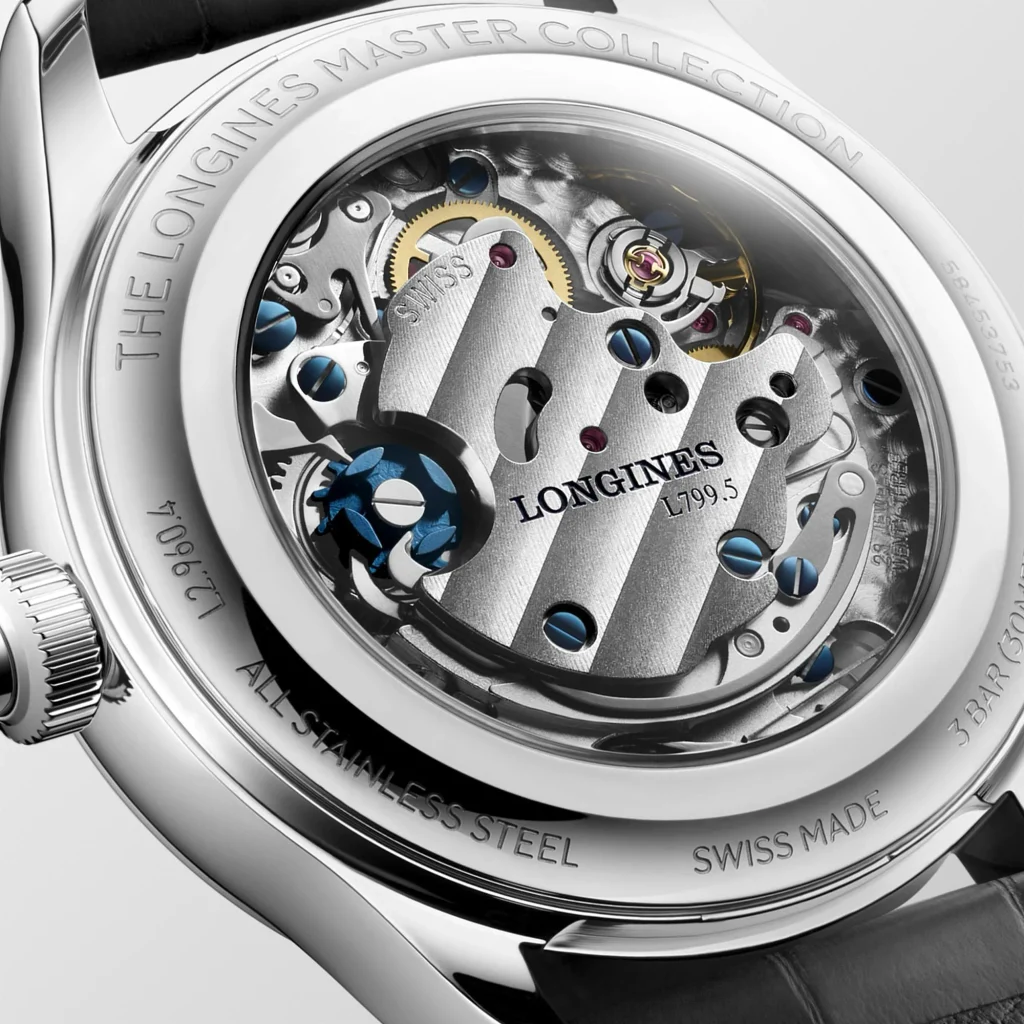
The movement is hand-wound, beats at 28,800 vibrations per hour and holds 68 hours of power reserve, enough to leave the watch on Friday evening and find it running on Monday morning. The chronograph is governed by a column wheel, the toothed component that distributes the start, stop and reset commands with a more progressive action than a cam, and which gives the pusher its characteristic feel. The absence of an automatic rotor is what keeps the case under 13 mm despite the chronograph inside. Through the sapphire caseback come the blued column wheel, blued screws, Geneva stripes on the upper bridge and perlage on the mainplate. According to Longines itself, the lineage of the calibre goes back to the 13.33Z of 1913, which the brand credits as the first compact-format chronograph movement.
Availability in our region
Longines publica el precio mexicano en su sitio oficial: $78,100 pesos, sin venta en línea y con la indicación de acudir a un distribuidor autorizado. La cifra queda muy cerca de convertir los 3,900 dólares del precio estadounidense al tipo de cambio de la fecha de publicación y sumarle el 16% de IVA. En España el precio oficial es de 3,800 euros con venta directa en longines.com. El localizador oficial de la marca señala tres puntos autorizados en Bogotá, ninguno con precio publicado, y para Argentina no hay información oficial.
The verdict from ORELO
El Chrono Monopusher está dirigido a quien ya resolvió el cronógrafo de uso diario y busca un mecanismo con historia propia, de los que obligan a pensar antes de apretar el botón. Dentro de la misma colección renovada, el modelo de tres agujas de 39 mm cumple mejor el papel de reloj único y el Chrono Moonphase ofrece más complicaciones a cambio de 13.8 mm de grosor. Lo que sostiene al monopulsador es su rareza: un cronógrafo con rueda de pilares, fabricado en Suiza, era hasta ahora territorio de uno o dos escalones más arriba.